
Is your startup targeting everyone? Use the Niche-Down Test to define your ICP, identify poor-fit prospects, and build sharper messaging from customer data.
When everyone is your customer, no one knows why they should choose you.
Calling your market “everyone” can make your opportunity look bigger, but broad messaging gives each buyer less reason to care. Your sales process gets harder, outreach becomes less relevant, and you spend time on poor-fit leads.
The Niche-Down Test helps you identify your ideal customer profile (ICP), define who you are not for, and build a sharper go-to-market strategy.
TLDR: If you cannot name your specific buyer, their urgent problem, and who you should not target yet, your ICP needs work. Start with customer evidence, not persona templates.
Why a Broad Market Can Hurt Your Startup
A large total addressable market (TAM) looks attractive in a pitch deck. But you do not need to serve an entire market to win your first customers. You need to solve a specific problem for a group that values your solution.
Compare these messages:
Broad: “We help businesses improve efficiency.”
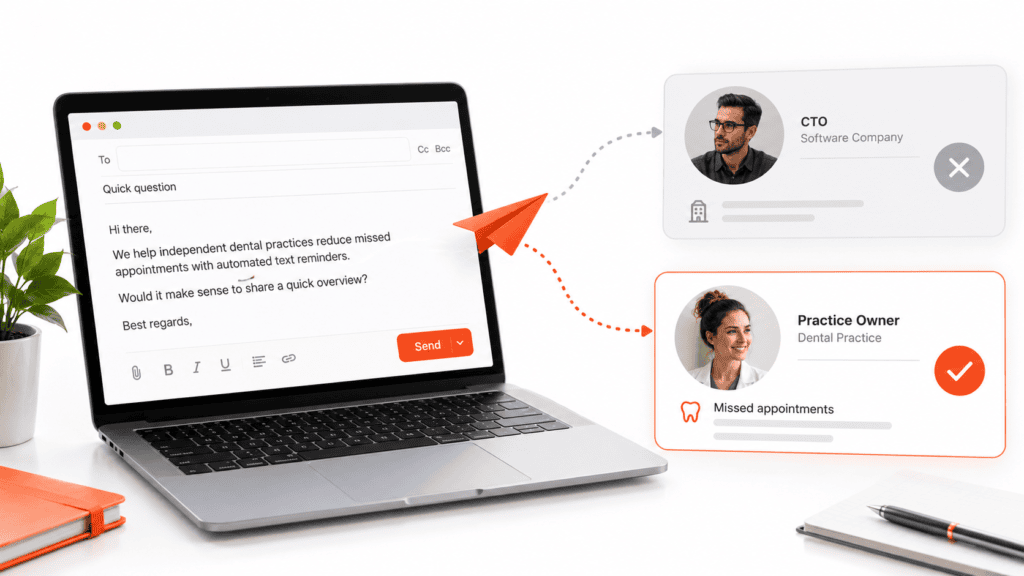
Specific: “We help independent dental practices reduce missed appointments with automated text reminders.”
The second message names a buyer, a problem, and an approach. A dental practice can quickly decide whether it is relevant.
The Cold-Email Test: Is Your ICP Wrong?
Low reply rates do not always mean your email copy is weak. Your target audience may not need the product.
Retool founder David Hsu described early outreach to a LinkedIn group of around 300 to 400 FileMaker developers. The response rate was below 2%, and every reply was negative. Retool later found a better fit with developers building internal applications.
The lesson is not that every narrow market works. It is that you must test the audience, not just the message. Before rewriting another email, check whether the people receiving it have the problem you solve.
Visual 2 — Middle (The Cold-Email Test)
The Claustrophobia Signal
Narrowing your market can feel like giving up opportunities. Clay co-founder Kareem Amin explained to First Round Review that narrowing the company’s focus felt “claustrophobic.” Clay had users across different roles, but it needed a clearer focus to improve its value for a specific group.
That discomfort is part of making a decision. A clear starting market does not mean you can never expand. It gives you a place to prove your product and message first.
What a Narrow ICP Changes
| Decision | Broad ICP | Narrow ICP |
| Messaging | “We help businesses grow.” | “We help roofing companies reduce invoicing delays.” |
| Channels | Several channels with no clear priority. | Channels chosen around one buyer. |
| Pricing | Guesswork about budget and value. | Pricing tested against a known problem. |
| Sales | Many poor-fit conversations. | Clearer fit signals and disqualifiers. |
How to Choose Your ICP Using Customer Data
Do not build your ICP from assumptions alone. Start with evidence from customers, prospects, and lost opportunities.
1. Compare Won and Lost Deals
If you have enough data, review up to 20 closed-won deals and 20 closed-lost or churned accounts.
Look for patterns in industry, company size, buyer role, problem urgency, sales cycle, and customer results. If 15 of your 20 strongest customers share a key trait, investigate whether that trait points to your best starting segment.
If you are pre-seed and have few customers, use interviews, pilot users, outreach replies, and lost opportunities instead. Your ICP is a hypothesis until more evidence supports it.
2. Find Who Buys, Stays, and Gets Value
A single sale does not prove a strong ICP. Look for customers who continue using the product, renew, refer others, or achieve the outcome you promised.
Also review why deals failed. Was there no budget, no urgent problem, no decision-maker, or a poor product fit? Those patterns can guide your next round of targeting.
For a practical framework, read Tinova’s guide to finding your High-Expectation Customer.
3. Write Your Negative ICP
A negative ICP lists the prospects you should not target yet. It helps your team avoid leads that are unlikely to buy, succeed, or stay.
For software designed for independent law firms, the list might include:
- Large corporate law firms: Their security and procurement requirements may exceed your current capacity.
- Solo practitioners with little administrative workload: They may not have enough need to justify the product.
- Users without buying authority: They may use the software but cannot approve the purchase.
Keep the list practical. Review it as your product, resources, and customer evidence change. Tinova’s guide to building a pre-seed ICP Kill List offers more ways to identify poor-fit accounts.
Visual 3 — Middle (The Negative ICP)

When Is a Broad Market the Right Choice?
A horizontal product can serve multiple industries when those customers share a genuine need. But you can still begin with one buyer, one use case, or one segment.
Expand when you have evidence of repeatable sales, customer retention, and good outcomes in your first segment. There is no magic revenue threshold that automatically means you are ready.
A narrow ICP is a starting point for learning, not a permanent limit.
The Niche-Down Test: Score Your ICP Out of 10
Give yourself one point for every “Yes.”
| # | Checklist | Yes | No |
| 1 | Can you name your primary buyer without saying “businesses” or “everyone”? | +1 | 0 |
| 2 | Have you defined the urgent problem you solve? | +1 | 0 |
| 3 | Do you have a written negative ICP? | +1 | 0 |
| 4 | Can you name the top three channels where your buyer is reachable? | +1 | 0 |
| 5 | Do most of your strongest customers share a key trait, such as industry or role? | +1 | 0 |
| 6 | Have you identified patterns in lost or churned accounts? | +1 | 0 |
| 7 | Can you write an email your target buyer recognizes as relevant? | +1 | 0 |
| 8 | Do you understand your buyer’s budget and price sensitivity? | +1 | 0 |
| 9 | Can you name your main competitors for this segment? | +1 | 0 |
| 10 | Do you have clear criteria for declining poor-fit leads? | +1 | 0 |
How to Interpret Your Score
- 8 to 10: Your ICP has a clear focus. Keep validating it as you grow.
- 6 to 7: You have a direction, but need better evidence or clearer disqualifiers.
- 0 to 5: Revisit your buyer, problem, and targeting assumptions before increasing spend.
If you are pre-seed, treat questions that require sales history as unproven until you have enough evidence. A low score is a prompt to investigate, not proof that your idea cannot work.
FAQs
Is niching down bad for a startup?
No. A clear starting niche helps early-stage startups focus limited time and money on a buyer group they can serve well. You can expand when customer evidence supports it.
How do I choose an ICP at pre-seed?
Start with a group that has an urgent problem, a reason to pay, and a reachable buying process. Interview potential customers and test your assumptions through targeted outreach.
Why is my broad target market not converting?
Your message may be too generic, your list may include poor-fit prospects, or your offer may not solve an urgent problem. Review the audience and customer evidence before blaming copy alone.
What is a beachhead market?
A beachhead market is the specific segment a startup chooses to win first. It gives the company a focused place to validate its offer, generate customer proof, and learn before expanding.
Stop Speaking to Everyone
If your Niche-Down Test score is low, review your customer conversations and sales history before spending more on ads.
Tinova’s Tahira Collection case study reports that the brand’s positioning was narrowed from five audiences to one. It generated $10,000 in the first 48 hours after launch, before paid advertising began. This is a specific client result, not a guarantee that narrowing alone will produce the same outcome.
If you are unsure whether your main issue is the ICP, positioning, offer, or follow-up, explore Tinova’s services to understand how a diagnosis can help prioritize the next step.
Written by: Tinova Growth Team
Tinova is a marketing and growth agency for startups and owner-led businesses. Its current site reports 200 startups diagnosed, 77+ businesses scaled, 3 awards in 2026, and $10M+ in client funding pipeline built.
Updated: October 7, 2026
Disclosure: Tinova provides diagnostic and strategic marketing services. This article offers practical guidance and does not guarantee a particular business outcome.