

Build a GTM plan for investors around four defensible numbers. Learn how to label assumptions, prove your sales motion, and test your next GTM experiment.
Most founders treat their GTM slide like a vision board. Investors treat it like an underwriting document.
They want to know how customers find you, what it costs to acquire them, how long the sale takes, and whether the process can happen again.
A strong GTM plan for investors is not a perfect forecast. It is a clear set of customer evidence, assumptions, and experiments.
GTM Plan for Investors: What They Actually Need to See
At pre-seed, your data may be limited. That is fine. The mistake is presenting assumptions as facts.
Investors are trying to understand repeatability, not volume.
Ten customers from personal introductions tell a different story from ten customers acquired through the same documented process.
The same applies to CAC. Customer acquisition costs can vary substantially by customer type and motion, so a single blended number can hide important differences. First Page Sage’s SaaS data separates CAC by customer type, while Benchmarkit segments benchmarks by attributes such as ACV and GTM motion. (First Page Sage, Benchmarkit)
Your own data should lead. Benchmarks should provide context.
The Four Numbers Investors Underwrite
Label every metric Observed, Inferred, or Assumed.
1. ACV by sales motion
Do not present one ACV if you have different ways of selling.
For example:
- Founder-led outbound: $18K observed ACV
- Self-serve: $2.4K inferred ACV
The important part is not the number itself. It is showing which motion produced it and how much evidence supports it.
2. Sales cycle from first touch to cash
Measure from the first meaningful contact, not the first sales call.
Include introductions, emails, LinkedIn conversations, demos, pilots, and negotiation.
Report a range if your sample is small. If you have only a few closed deals, label the number Inferred rather than presenting it as a proven average.
3. One defensible conversion rate
Do not create a beautiful funnel from weak data.
Choose the stage where you have enough evidence.
8 of 30 discovery calls became paid pilots = 27% observed conversion.
One well-supported number is more useful than six estimates.
4. CAC, with your own time included
Show two numbers:
Spend CAC: tools, advertising, travel, contractors, and other direct costs.
Fully Loaded CAC: those costs plus the founder’s time.
This gives investors a clearer picture of what customer acquisition actually requires.

Observed, Inferred, or Assumed?
| Label | Meaning | How to Use It |
| Observed | Measured from your own customer data | Use as proof |
| Inferred | Based on partial data and a stated assumption | Use with context |
| Assumed | Based on a benchmark or external source | Use for planning |
A plan does not become stronger by hiding assumptions.
An honest assumption with a source is more useful than a false sense of certainty.
The One Sentence That Explains Your GTM Motion
Use this structure:
We acquire [ICP] through [channel] by [specific action], and we know this because we have done it [n] times with [conversion result].
For example:
We acquire revenue operations leaders at 50–200-person SaaS companies through trigger-based outbound, and we have converted 8 qualified opportunities into paid pilots.
That sentence tells an investor who buys, how you reach them, and what evidence you have.
Worked Twice Does Not Mean Repeatable
A GTM motion becomes repeatable when you can explain the steps, run them again, and see a similar pattern.
Two customers from your co-founder’s network do not prove that.
For founder-led outbound, aim to document several closed deals from the same motion. For content or community, track customers who came directly through that channel.
If your sample is small, say so:
“We have three customers from this motion. This is an early signal, not a proven channel.”
That is a stronger investor answer than pretending the evidence is larger than it is.
Tinova’s founder-led sales framework makes the same distinction: early sales are a learning system, and founders should look for repeatable patterns before handing the process to a sales hire.
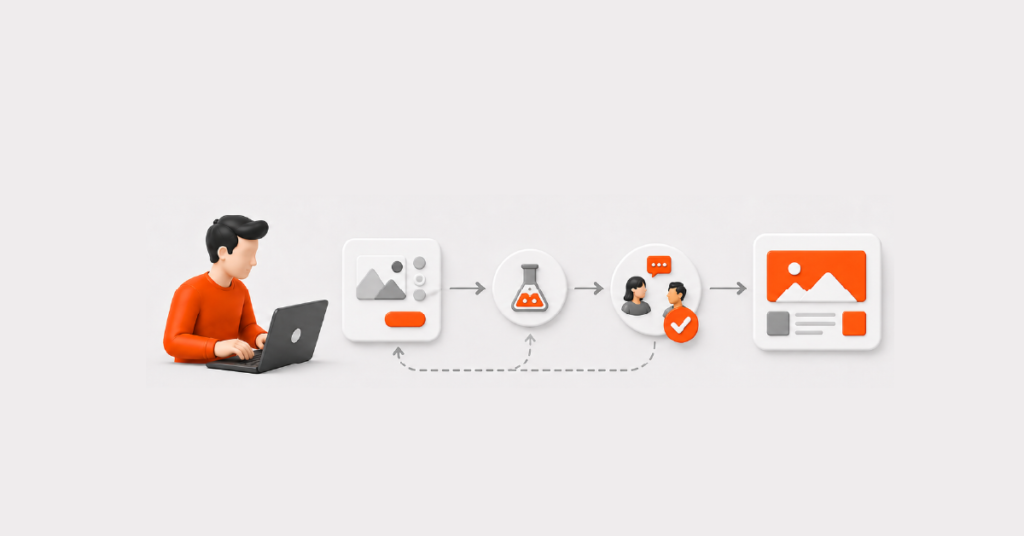
Replace the Hockey Stick With Three Experiments
Your GTM plan should show what you will test next, not only what you hope revenue will become.
Every experiment needs:
- Cost
- Time frame
- Success metric
- Kill criterion
Example:
Test trigger-based LinkedIn outreach to VP Sales at fintech companies for 8 weeks. Stop if 150 targeted attempts produce fewer than 5 qualified meetings.
This tells investors how you intend to use capital to learn, validate, and then scale.
Do not claim a multi-channel strategy if you have only tested one channel.
A stronger statement is:
“We have validated founder-led outbound. Partnerships and paid search are untested. Our next experiment is partnerships because our buyers already use the platforms we integrate with.”
Four Questions Your GTM Plan Must Answer
“How did you get your last five customers?”
Show the channel, trigger, sales cycle, and result for each.
“What happens when you stop selling personally?”
If the answer is “not yet,” say so. Then show the experiment that tests whether the process can be handed off.
“Why do you lose?”
Know your top loss reasons. A clear pattern is more useful than claiming an impressive win rate without context.
“What will you spend the first $200K on?”
Connect each major expense to an experiment or business milestone. Avoid a vague “marketing budget.”
The GTM Underwriting Test
Score one point for every statement that is true:
| # | Check |
| 1 | ACV is shown by sales motion |
| 2 | Sales cycle starts at first meaningful contact |
| 3 | One specific conversion stage has supporting data |
| 4 | Spend CAC and fully loaded CAC are separated |
| 5 | Every metric has a confidence label |
| 6 | One sentence explains the GTM motion |
| 7 | The motion includes a sample size |
| 8 | Next experiments have cost, timing, and kill criteria |
| 9 | You can explain how the last five customers were acquired |
| 10 | Major funding use is tied to specific experiments |
If several boxes remain unchecked, do not hide the gaps. Turn them into your next experiments.
FAQ
What goes on a GTM slide at pre-seed?
Show ACV by motion, sales cycle, one defensible conversion rate, and CAC. Label each number as Observed, Inferred, or Assumed, then explain your repeatable motion and next experiments.
How do you calculate CAC before you have much marketing spend?
Separate direct acquisition costs from fully loaded costs, including founder time. State your sample size so investors understand how much evidence supports the number.
What conversion rate should a pre-seed startup show investors?
Use your own data where possible. For example, 8 paid pilots from 30 discovery calls equals a 27% observed conversion rate. External benchmarks should be labeled as assumptions, not proof.
How do you present GTM with only a few customers?
Focus on how you acquired them and what you learned, not just the customer count. Explain which parts are proven, which are inferred, and what you are testing next.