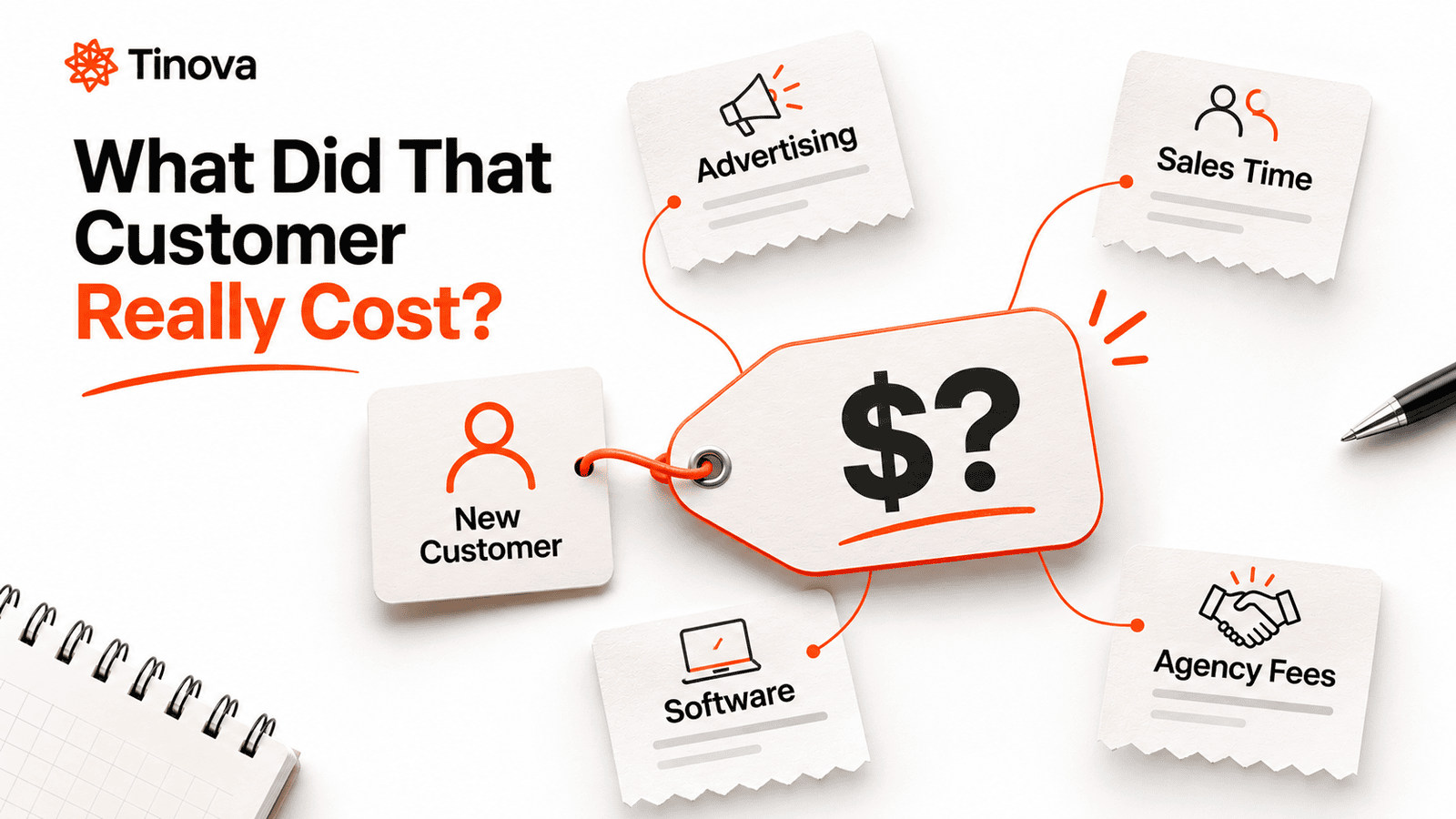
You’ve spent money on advertising, paid for sales tools, and put hours into finding prospects and following up. A few customers have come in, but do you know how much it actually cost to acquire each one?
For an early-stage B2B founder, that number isn’t always easy to find. Advertising costs are visible, but what about sales time, software subscriptions, and agency fees?
Customer acquisition cost (CAC) brings these expenses together so you can understand what you’re spending to gain new paying customers and where your acquisition process may need improvement.
What Is B2B Customer Acquisition Cost and How Do You Calculate It?
Customer acquisition cost is the amount spent on sales and marketing to acquire one new paying customer during a specific period.
The formula:
CAC = Total acquisition costs ÷ New paying customers
Both figures should use a consistent reporting period, with adjustments when longer sales cycles mean spending and customer acquisitions happen in different months.
A Simple B2B Startup CAC Calculation
Imagine your startup has these monthly acquisition expenses:
| Acquisition Expense | Amount |
| Marketing and advertising | $2,000 |
| Acquisition-related sales salaries | $3,000 |
| CRM and marketing tools | $500 |
| Agency and content expenses | $1,000 |
| Total | $6,500 |
If five new paying customers joined during that period:
CAC = $6,500 ÷ 5 = $1,300
Your startup spent $1,300 in acquisition resources per new paying customer.
Which Expenses Should You Include When Calculating CAC?
Counting advertising alone can make your acquisition cost look lower than it really is.
Include:
- Marketing and sales: Advertising, content production, sales salaries, commissions, and agency fees.
- Tools and software: CRM subscriptions, email platforms, and prospecting tools used for acquisition.
- Founder sales time: If you handle prospecting, demos, and follow-ups yourself, estimate the value of that time separately. It represents an imputed management cost, not necessarily cash spent.
For a standard acquisition-only CAC, exclude routine post-sale support and onboarding. Document which costs you include and avoid counting expenses twice.
What Counts as a New Customer in a B2B CAC Calculation?
A website enquiry, booked demo, free trial, or qualified opportunity isn’t a new paying customer. Count a customer when they make their first purchase.
Don’t include renewals or expansion deals from existing customers. These are different revenue activities.
Your sales cycle matters too. You might spend money acquiring prospects in January, but they may not sign contracts until March.
Comparing January’s spending with January’s new customers could produce a misleading result. Record when prospects enter your pipeline and when they purchase, then use a reporting period or cohort analysis that reflects your sales cycle.
Paid, Blended, and Fully Loaded CAC: What’s the Difference?
Businesses use different CAC definitions, so establish what each calculation includes before comparing results.
| CAC Type | What It Measures |
| Paid-channel CAC | Direct paid campaign costs divided by customers attributed to those campaigns |
| Blended program CAC | Acquisition program spending across channels divided by all new paying customers |
| Fully loaded CAC | Program spending plus acquisition-related salaries, tools, and allocated overhead, divided by all new paying customers |
Your $1,300 example is closer to fully loaded CAC because it includes salaries and tools.
Don’t compare it directly with another company’s paid-channel CAC without understanding the difference in costs included.
How Do You Calculate CAC by Marketing Channel?
Overall CAC shows how much your business spends to acquire customers. Channel-level CAC helps you understand which acquisition methods contribute to that cost.
Using the same $6,500 example, suppose your expenses and five new customers are allocated as follows.
In this hypothetical breakdown, each channel’s allocated cost includes its share of relevant sales, marketing, software, and agency expenses, not just direct campaign spending.
| Channel | Allocated Costs | New Customers | Channel CAC |
| SEO | $2,000 | 2 | $1,000 |
| LinkedIn outreach | $1,500 | 1 | $1,500 |
| Paid ads | $3,000 | 2 | $1,500 |
| Total | $6,500 | 5 | $1,300 overall CAC |
This assumes costs and customers are attributed consistently, with shared expenses allocated reasonably.
Don’t choose a channel based on CAC alone. A channel with higher acquisition costs may still be worthwhile if its customers generate more gross profit and remain customers longer.
Why Is CAC Different From Cost Per Lead?
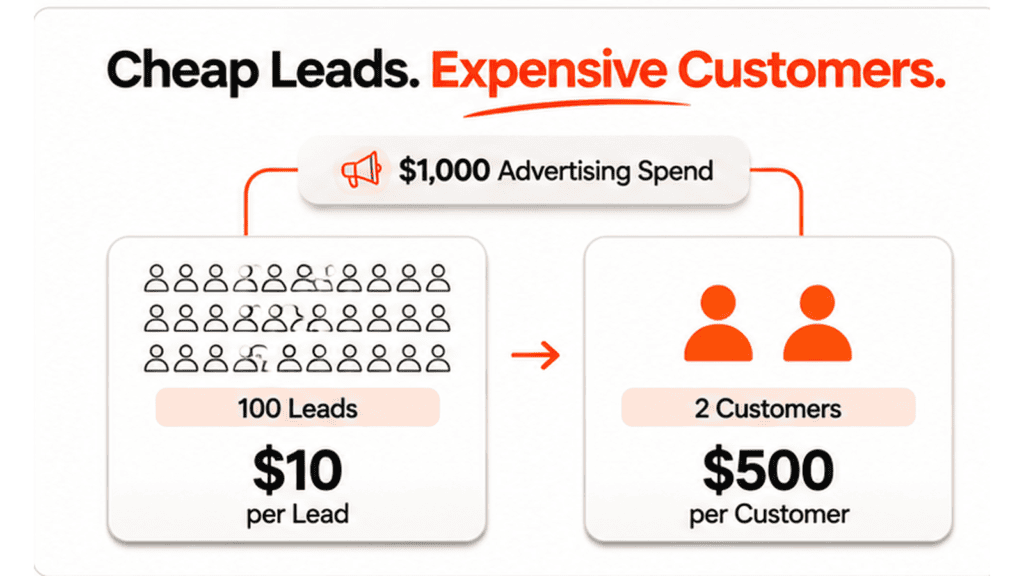
A startup spends $1,000 on advertising and generates 100 leads. Its cost per lead is $10.
But if only two leads become paying customers, its advertising cost per acquired customer is $500, before accounting for other acquisition expenses.
| Metric | What It Measures |
| Cost per lead | Cost of generating an enquiry |
| Cost per qualified lead | Cost of generating a suitable prospect |
| CAC | Cost of acquiring a new paying customer |
Inexpensive leads don’t automatically mean affordable customer acquisition.
You also need to understand what happens between someone showing interest and becoming a customer.
What Is a Good CAC for a B2B Startup?
There’s no single CAC that works for every B2B business.
A $1,300 acquisition cost might be sustainable for a company selling high-value annual contracts but difficult for one selling a low-cost monthly subscription.
Compare CAC with customer lifetime value (LTV), gross profit, and the time it takes to recover acquisition spending.
Industry benchmarks can provide context, but business models, sales cycles, customer segments, and calculation methods vary. Your own acquisition baseline is the best starting point.
How Can You Track CAC Without Expensive Tools?
A spreadsheet is enough to begin tracking acquisition costs.
| Field | What to Record |
| Reporting period | Month or quarter |
| Acquisition source | SEO, outreach, ads, referrals |
| Acquisition costs | Direct and allocated expenses |
| Customer acquisition date | When the first purchase happened |
| New paying customers | Verified customer count |
| CAC | Acquisition costs divided by customers |
| Customer value | Contract value or estimated customer gross profit |
Review your figures monthly. If no customers were acquired during a period, don’t divide by zero. Record the spending and review a longer period or relevant acquisition cohort.
What Should You Investigate When CAC Increases?
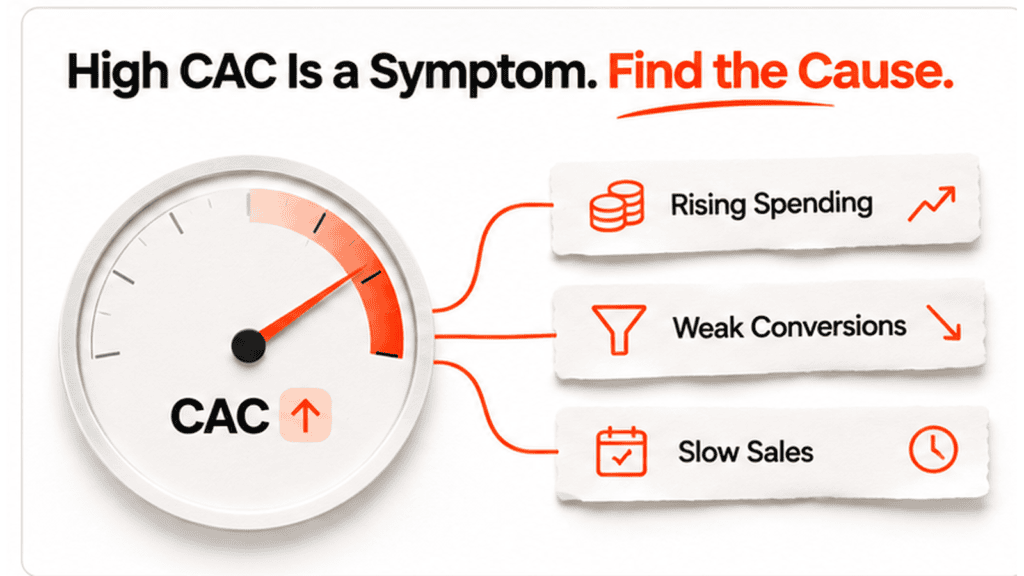
Calculating CAC tells you what acquiring customers costs. Understanding why it changes helps you decide what to improve.
| What Your Numbers Show | What to Investigate |
| Spending rises, but qualified leads don’t | Channel selection and targeting |
| Plenty of leads, few customers | Lead quality and sales conversion |
| Qualified leads, but slow sales | Buying urgency and approval delays |
| CAC rises while conversion stays stable | Acquisition costs and channel mix |
| CAC is high, but customers generate strong gross profit | Customer value and payback period |
These are possible explanations, not guaranteed causes. Review your acquisition data and sales conversations before changing your budget.
Tinova’s published DriveShield case study illustrates why reviewing the acquisition process matters. Tinova reports $3.2 million in new revenue within 28 days after improvements to the client’s offer and follow-up process, followed by the activation of one acquisition channel.
This is a specific reported revenue outcome, not a CAC figure or evidence of a particular CAC reduction. Measuring that would also require the acquisition costs and number of new customers.
The lesson is to understand where your acquisition process needs attention before committing more resources.
Know Your Customer Acquisition Cost but Not How to Improve It?
Your CAC tells you what you’re spending to acquire customers. It doesn’t always explain why that cost is high or which part of your sales and marketing process needs attention.
Book a free 30-minute GAP Analysis with Tinova. We’ll review your customer acquisition approach, help identify where costs or lost opportunities may be coming from, and agree on a measurable goal to improve your process.
Written by Tinova Growth Team
The Tinova Growth Team shares practical guidance for early-stage B2B founders working through challenges in positioning, marketing, sales, and customer acquisition. Our articles focus on helping founders understand what’s holding their business back and what they can do next.