
Most early proof points are empty gestures. Investors know the difference between a real commitment and a logo that cost nothing. Here’s how to build a proof layer that actually moves a deal forward.
The Proof Layer: LOIs, Design Partners and Pilots That Actually Mean Something
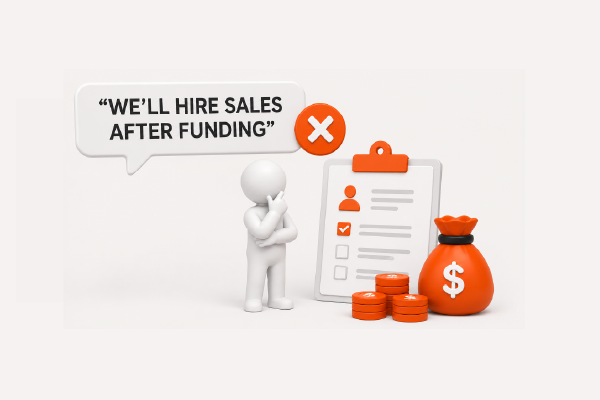
“We have three Fortune 500 pilots in progress.” It sounds impressive in a pitch meeting. The logos look convincing, and founders feel confident. But six months later, none of those pilots became paid customers.
The logos were only logos. The founder confused activity with proof.
At the pre-seed stage, investors do not expect revenue. They want believable evidence that customers are willing to pay.
The value of any proof depends on one question: What did the other party give up to make that commitment?
This article explains how to build a proof layer: a ladder of commitments, from a waitlist signup to a paid pilot, that gives investors real confidence.
It also clears up one point that Google mixes up: the difference between a customer LOI and an investor LOI.
Customer LOI vs. Investor LOI
A customer Letter of Intent (LOI) comes from a potential buyer who plans to purchase or trial your product. An investor LOI is a non-binding term sheet from a fund.
Google frequently mixes these two, but this article focuses only on the customer LOI, the proof founders use to show commercial interest before revenue.
Many founders connect “LOI” with fundraising. At the pre-seed stage, the more valuable LOI comes from a customer. It says, “If you build X, we are prepared to buy Y units at Z price, subject to conditions.” A clear customer LOI can carry more weight than a pitch deck full of market projections.
The Rule: A Proof Point Is Worth What the Other Party Gave Up
Every proof point on your traction slide reflects a level of commitment. A waitlist signup costs an email address. A signed customer LOI takes legal review and budget approval. The more commitment the customer makes, the stronger the proof for investors.
Think of it as a Commitment Ladder:
Proof Type | What the customer gives up | Signal strength | Best used when |
Waitlist signup | Email address, mild interest | Weak | Very early, just gauging awareness |
Free pilot with no agreement | Time, but no formal commitment | Low-medium | You need feedback, not proof of demand |
Letter of Intent (LOI) | Internal sign-off, budget earmarked, legal review | Strong | You want to signal purchase intent before you have a finished product |
Design Partner Agreement | Ongoing collaboration, strategic input, sometimes early payment | Very strong | You need co-development and a reference customer |
Paid pilot or first paid contract | Actual budget dollars | The strongest | You want to prove willingness to pay |
This is the Commitment Rule: the value of your proof grows with the commitment the signer makes. A free pilot that only needed a click proves very little. A design partner who commits team time and signs an agreement provides much stronger evidence.
Why Don't Investors Expect Polished Traction at Pre-Seed?
Investors know your startup has not scaled yet. They are not looking for 100 paying customers. They want proof that at least one customer is willing to pay for the problem you solve.
One paid pilot with a credible company is stronger evidence than 1,000 free waitlist signups.
Hustle Fund explains it well: “Free signups are not traction. They are data points that might indicate interest. Investors want to see skin in the game.” At the pre-seed stage, one design partner who invests money or meaningful time carries more weight than a slide full of company logos.
Many founders rely on logo slides because they look impressive. But logos do not prove product-market fit.
As one founder on r/startups shared, “We landed a pilot with a big bank… We got no revenue from it, they never signed, and we wasted six months chasing.” A logo is not proof. A real commitment is.
What Does a Customer LOI Change in the Fundraising Conversation?
A strong customer LOI changes the conversation from “if” to “when.” Instead of questioning demand, investors start asking what happens after you deliver. It turns your startup from an idea into a business with real customer interest.
A customer LOI does not close your funding round, but it changes how investors see the opportunity. It shows a real buyer has committed time, reputation, and budget while waiting for you to execute.
Tran.vc also highlights that a credible customer LOI can support valuation discussions even before revenue. The strongest LOIs include a price, a timeline, and a decision-maker with buying authority.
What Do Investors Check in a Customer LOI?
Investors focus on three things: who signed the LOI, how specific it is, and whether the terms show a real commitment. A vague customer LOI can hurt more than having no LOI at all.
Who Signed It?
Investors check whether the signer has budget and buying authority. A VP or decision-maker adds credibility. An LOI signed by someone without purchasing power carries little value.
Is It Specific?
A strong customer LOI includes pricing, quantity, timeline, and clear conditions. For example: “Company A intends to purchase 50 seats at $200 per seat per month if the product meets agreed specifications by Q3 2026.” A statement like “We are interested in exploring a commercial relationship” offers little proof.
Does It Show Real Commitment?
Vague terms are a warning sign. Phrases like “subject to internal approval” or “pricing to be negotiated later” weaken the LOI. The strongest customer LOIs clearly state: “If you deliver X, we will pay Y.”
The Legal Template for Startups (LTSE) describes an LOI as a non-binding agreement outlining key terms. Investors see it as proof of sales ability. A clear, detailed LOI shows you earned real customer commitment.
When Is a Design Partner Agreement Better Than a Customer LOI?
A customer LOI shows future intent to buy. A Design Partner Agreement shows active collaboration. If your product is still being built, a design partner can provide stronger validation because they invest time, feedback, and sometimes money.
Common Paper explains that the best Design Partner Agreements include commitments from both sides. The startup provides early access and priority support, while the partner contributes feedback, team time, and, in some cases, an upfront payment.
Choose a Design Partner Agreement when:
- You need real-world product feedback.
- You want a reference customer who will advocate for your product.
- The partner is willing to commit time, resources, or an implementation fee.
Choose a Customer LOI when:
- Your product is nearly ready, and the buyer is waiting for the final version.
- You need to show customer demand before the sales cycle is complete.
- The buyer cannot pay early because of procurement requirements.
Both help build investor confidence, but a design partner who commits time or pays even a small fee is one of the strongest pre-revenue proof points.
How Do You Ask for a Customer LOI or Design Partner Commitment?
A customer LOI or Design Partner Agreement should come after a discovery conversation where the buyer has already confirmed the problem. First understand their pain, the value of solving it, and the cost of doing nothing.
Follow these steps:
- Validate the pain.
“You mentioned this costs your team 15 hours a week. Is that right?” - Get a verbal commitment.
“If we build a solution that cuts that time in half, would you be open to a pilot?” - Put it in writing.
“Let’s capture that in a simple one-page Letter of Intent with the timeline and success criteria.” - Make it a two-way commitment.
You agree to deliver specific capabilities, and the customer agrees to evaluate the product and pay if it meets the agreed conditions.
The 30-prospect test makes this conversation easier. By the time you ask for an LOI, the relationship already exists. The document simply records the commitment the customer has already made.
The Proof Layer, Assembled
By the time you enter a pitch meeting, your proof layer should tell a clear story of growing customer commitment, not just display company logos.
A strong sequence looks like this:
- 50 waitlist signups from a niche community (interest signal).
- 10 free pilots that generated active feedback (engagement signal).
- 2 signed customer LOIs from decision-makers with clear purchase intent (demand signal).
- 1 paying design partner contributing a monthly fee to co-develop the product (strongest willingness-to-pay signal).
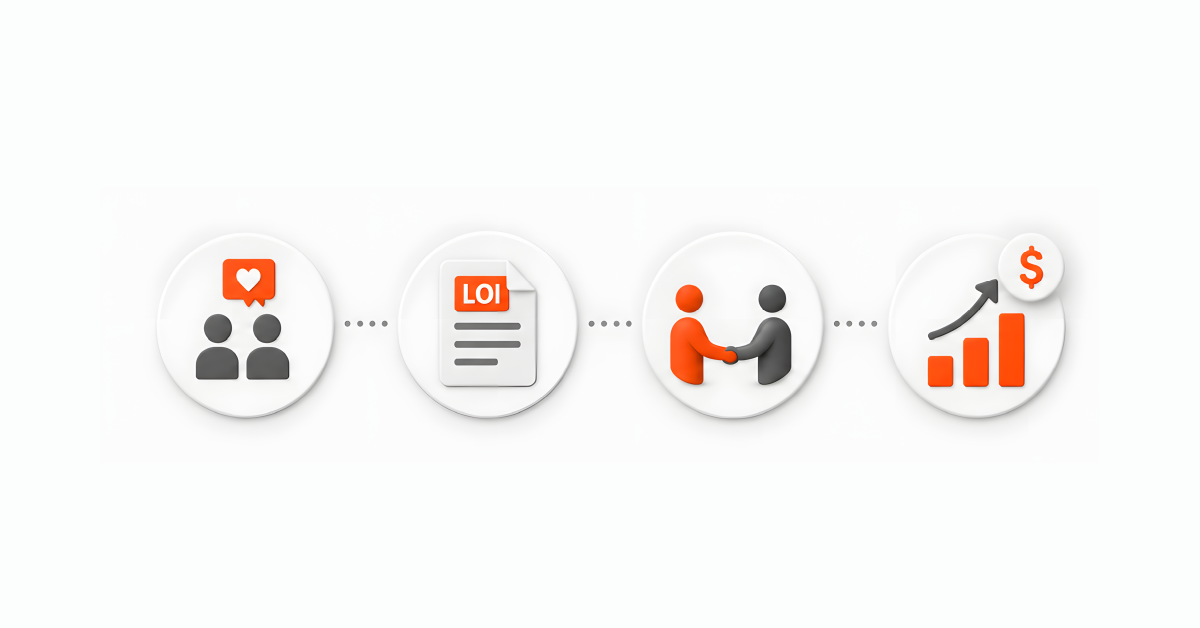
This progression tells investors: we attracted interest, validated engagement, secured written purchase intent, and earned a paying customer. That is far more convincing than a slide filled with logos but no customer commitments.
Download the Proof Layer Scorecard (PDF) to evaluate your own early proof points.
FAQs
What is a customer Letter of Intent (LOI)?
A customer LOI is a non-binding document showing a buyer intends to purchase your product when it is ready. It typically includes pricing, timeline, and key conditions. It is not a contract, but it shows real purchase intent.
Do investors care about customer LOIs at the pre-seed stage?
Yes. Investors value specific LOIs signed by someone with buying authority. A detailed LOI with a buyer, price, and timeline carries far more weight than a vague statement of interest.
How do you find design partners for an early-stage startup?
Design partners come from discovery conversations with prospects facing a real problem. In return for early access and product input, they provide feedback, time, and sometimes payment.
What is the difference between a pilot and a Design Partner Agreement?
A pilot tests your product with a potential customer. A Design Partner Agreement goes further by involving the customer in building and improving the product. Design partners invest more time, resources, or money.
Does a free pilot matter to investors?
Yes, but only if it leads to valuable feedback, testimonials, or a clear path to becoming a paying customer. A free pilot without results is weak evidence.
Your proof layer is what turns a hopeful pitch into a credible one. Every proof point should answer one question: “What did the other party give up?” If the answer is nothing, it does not belong on your pitch slide.
Book an Investor Readiness Audit to build a proof layer that strengthens your fundraising story.
Continue reading?
For more in-depth insights on validating demand before fundraising, read our guide on the 30-Prospect Test Framework.
Want to find the fastest way to collect meaningful proof? Explore our guide on identifying the cheapest proof point.
If you’re wondering whether investors think your startup is ready, learn more about customer readiness and the signals that matter most.
See how one founder built investor confidence with limited traction in the $650K story.

Topics: