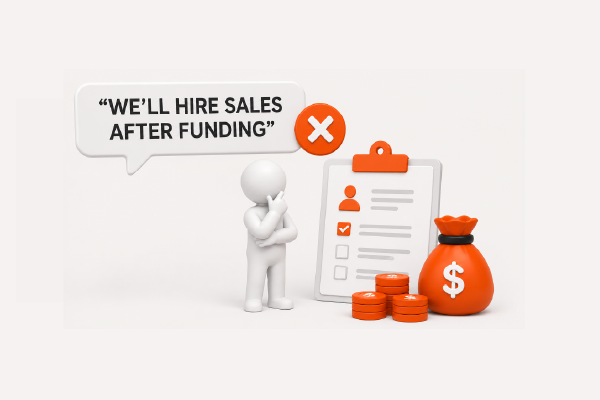

Your 1,000 signups feel like traction. But investors see a number that can’t change your decision. Here’s what real pre-seed traction looks like.

Why your first users give you fake confidence
Your earliest users can inflate your confidence because they arrive with bias. Friends sign up to support you. Incentive-driven users join for a discount, then disappear. A passionate niche may love your vision but never pay. It looks like traction on a spreadsheet, but it isn’t real validation.
Julie Supan, YouTube’s first Head of Marketing and Communications, later helped Airbnb, Dropbox, and Thumbtack refine their positioning. Her lesson was simple: YouTube didn’t sell video hosting. It sold the feeling of having a stage where anyone could participate. That clear positioning attracted high-expectation customers who shaped the product and spread the word.
FlightCar is the opposite example. Early growth came from car owners who wanted guaranteed monthly payments while their cars sat at airports. The company expanded from 1 to 17 airports, but those users were driven by incentives, not the mission. They were early adopters, not high-expectation customers. When the model changed, they left.
Your first users can give you fake confidence. At pre-seed, separate cheerleaders from customers who feel the problem enough to pay.
The fourth false safety net
Founders fall into false safety nets all the time. Revenue feels like proof but can hide poor retention. A big-name hire from Google or Stripe looks reassuring, yet they may never have built with limited resources. Funding feels like validation, but it only proves you sold a vision. Customers prove whether you solved a real problem.
Signups are the fourth false safety net. A growing number feels like traction, but if it doesn’t change your decisions, it’s just noise. A founder celebrating 2,000 signups while ignoring a 2% activation rate is focusing on the wrong metric.
Real confidence comes from repeat customer behaviour, not a signup count.

Pushed or repeat users?
The fastest way to judge traction is pushed users vs. repeat users. Pushed signups come from campaigns, viral posts, or product launches. They create a spike, then disappear. Repeat users come back, invite others, and stay after the campaign ends.
Ed Kang explains the difference between progress and proof. A waitlist is progress. A paying customer is proof. Downloads are progress. Returning without a push notification is proof.
If your traction disappears when you stop spending, you had pushed interest, not real demand.
The test: Can this number change your decision?
A vanity metric is a number that can’t change your decision. Ask yourself: If this metric doubled tomorrow, would your next product move change? What if it dropped by half? If the answer is no, the metric gives comfort, not direction.
Hustle Fund’s Elizabeth Yin uses a similar test: “If you had half the users but twice the retention, what would you do differently?” A founder who can’t answer is tracking signups instead of the metrics that drive decisions.
The best metrics don’t just look good. They help you decide what to do next.
The six numbers that fool founders
These six metrics can look like proof but hide what really matters. They create confidence on the surface while masking the questions that determine whether your startup is truly gaining traction.
Vanity Metric | What It Hides | Replace With |
Total signups | Activation rate, retention | Week-1 activation, Week-4 retention |
Waitlist size | Conversion when invited | Waitlist-to-activated rate |
A viral launch | Attrition after the spike | Day-7 and Day-30 retention of that cohort |
Pilot logos | Actual usage depth, expansion revenue | Design partner engagement score, repeat usage |
A funding round | Product-market fit | Inbound demand, willingness to pay |
A passionate niche | Willingness to pay at scale | Paying conversion within the niche |
Total signups: A signup only costs an email address. Measure signups all the way to revenue. One startup got 1,200 signups in three weeks, but only six activated. Those six taught them more than the other 1,194.
Waitlist size: A large waitlist shows curiosity, not demand. What matters is waitlist conversion. Investors care about who joins and becomes a customer, not the total count.
A viral launch: A launch spike proves you can get attention, not that people will stay. The real metric is how many users are still active a month later. If they leave, you gained attention, not traction.
Pilot logos: A free pilot with a well-known company looks impressive, but consistent engagement and paid expansion matter more than a recognizable logo.
A funding round: Raising money doesn’t prove product-market fit. It proves investors believe in your vision. Customers prove you solved a real problem.
As Tino says, investors stand behind you, customers stand in front of you. A funded startup without repeat customers has momentum on paper, not in the market.
A passionate niche: A community that loves your mission but never pays is a fan club, not a market. Even one paying customer is stronger proof than 100 “I’d pay for this” comments.
What real traction looks like at pre-seed
At pre-seed, traction isn’t a big number. It’s a small group of users who act like real customers. They onboard despite friction, return without reminders, pay with their own money, or refer others. Ten paying strangers are stronger proof than 1,000 signups.
Activation matters more than signups. An activated user has experienced your product’s core value. Track the first meaningful action, such as completing a profile, making a first upload, or completing a transaction. Then measure how many return the following week. That’s where real traction begins.
The one-cohort rule
Forget total numbers. Track one cohort instead. Follow the 20 users who signed up during your best week for 30 days. Measure how many activated, returned in weeks 2 and 4, and became paying customers.
This tells investors far more than 2,000 signups with no user behavior. A startup with 10 paying users who keep coming back has real traction. A startup with 10,000 signups and no retention is just a directory.
How to talk about weak numbers honestly
If your numbers are small, don’t inflate them. Show what you’ve learned. For example: “We have 40 signups. Twelve activated. Eight returned in week 2, and two referred a teammate. Our next step is reducing time to first value.” That tells investors more than “We have 5,000 signups.” It shows you understand the difference between a number and a real signal.
If you want to see how revenue can create the same false confidence, read our article on the revenue false safety net. You can also revisit the 30-prospect test to measure demand before you build.
FAQs
Are signups considered traction?
No. Signups show interest, not commitment. Real traction comes from users who pay, return, complete onboarding, or refer others. A list of email addresses is a lead list, not proof of demand.
Is a waitlist a sign of traction?
Not by itself. A waitlist shows curiosity, but conversion is what matters. Investors want to see how many people activate or pay after they’re invited.
What counts as traction at pre-seed?
Pre-seed traction is a small group of users acting like real customers. Repeat usage, paying customers, referrals, and strong activation matter more than thousands of passive signups.
Activation vs. signups: Which matters to investors?
Activation matters more. Signups are a top-of-funnel metric. Activation shows users reached your product’s core value, making it a stronger predictor of retention and revenue.
What traction metrics do investors want?
Investors look for activation, repeat usage, retention, customer acquisition cost, willingness to pay, and referrals. They care far less about total signups, waitlist size, or viral spikes.
Continue reading
If you’re still validating demand, read our guide on the 30-Prospect Test Framework to learn how founders find real customer signals before building.
See why revenue can become another false safety net and how investors separate healthy growth from misleading numbers.
Want stronger evidence before fundraising? Learn how to identify the cheapest proof point that shows customers genuinely want your product.
Not sure if investors think you’re ready? Read our guide to customer readiness and the signals that matter before raising your pre-seed round.
Curious why funding isn’t proof of product-market fit? Explore our article on why funding ≠ PMF before pitching investors.
We pressure-test your traction story before investors do and help you find the real signal behind the numbers.

Topics: