

Learn why customer validation matters more than investor interest at pre-seed. Discover the proof investors want and how to build it in just two weeks.
You polish your pitch deck, rehearse your vision, and line up investor meetings. Then an investor asks, “How many customers have you spoken to this month?” and you freeze.
Many founders start fundraising before they have real customer proof. The product is not the problem. The timing is. Customer validation makes investor conversations stronger. Without it, every pitch becomes harder.
In this guide, you’ll learn what customer readiness looks like, how to build it in a focused two-week sprint, and why it matters more than investor interest at the pre-seed stage.

The "$1.2M If Scaled" Opener: A Real Investor Red Flag
Tino Aliye, (Link LinkedIn profile) founder of Tinova, who has advised early-stage startups on fundraising and go-to-market strategy, recently reviewed a pitch deck that opened with, “An investor told us we’d be worth $1.2M once we scale.” There were no customer names, discovery quotes, or demand signals. Just confidence borrowed from one investor conversation.
Tino’s response was simple: “Who cares?”
The pitch included 20 organic sign-ups but no market research, supporting data, or proof those users returned. The story relied on an opinion instead of customer evidence.
This is a common mistake. Investor interest is not customer validation. A single customer insight carries more weight than investor praise. Lead with real customer proof, and investor conversations become much stronger.
Why Customer Readiness Comes First
If you are not ready for customers, you are not ready for investors. Many founders mistake early wins for real market proof.
Revenue Alone Is Not Validation
One paying customer does not prove demand. Tino shared a startup that signed one client and stopped developing its market. A few months later, the pipeline had dried up. Real validation means you can generate 20 to 30 leads, close customers, and repeat the process.
Big-Name Hires Do Not Build Confidence
A strong résumé does not guarantee success. Tino shared how a designer with an impressive background created great-looking work but missed what buyers wanted. Understanding the customer matters more than where someone worked. Focus on the problem each team member solves.
Funding Does Not Prove Product-Market Fit
Investor interest is not customer validation. As Tino explains, “Investors give you money because they believe you might be right. Customers pay because you solved their problem.” A funding round reflects potential. Customer demand proves your solution works.
The strongest signal of customer readiness is real proof. Bring customer conversations, feedback, and early demand to investor meetings instead of asking investors to imagine the opportunity.
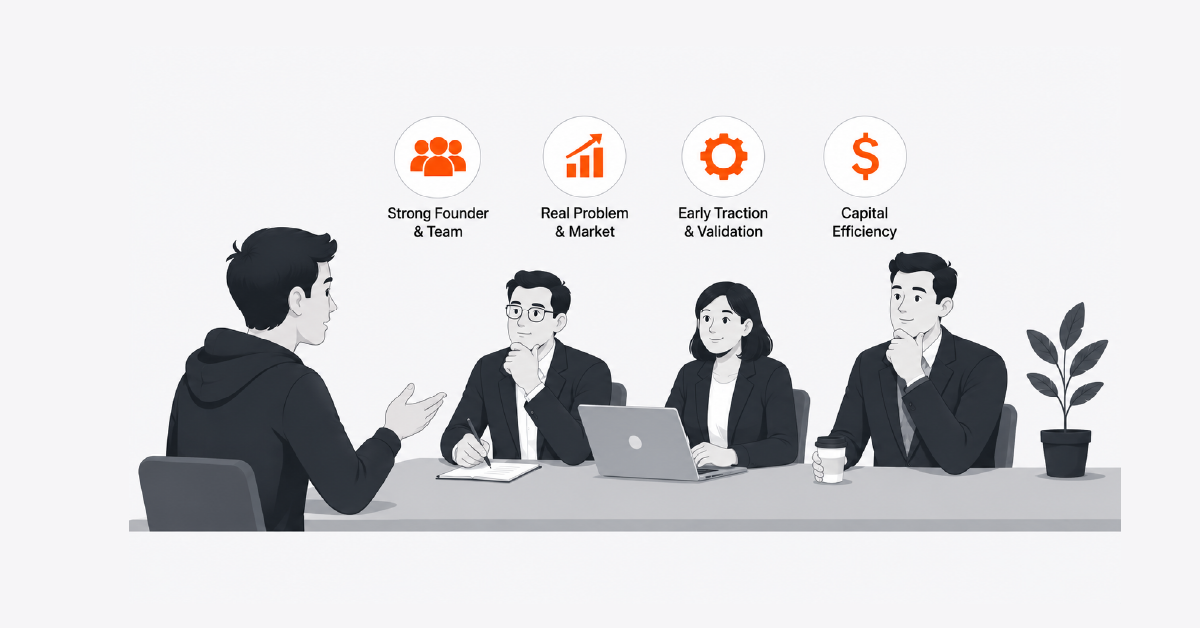
What Real Customer Proof Looks Like at Pre-Seed
Many founders think they need revenue to impress investors. At the pre-seed stage, customer proof matters more. Investors want evidence that real people have the problem and want your solution.
Here are five strong signals of customer validation:
- Discovery Conversations
Speak with 20 to 30 potential customers. Record their exact words, current workarounds, and the impact of the problem. This alone sets you apart from many founders.
- Problem Validation Quotes
Use direct quotes like, “We spend eight hours a week manually reconciling invoices.” Real customer quotes carry more weight than market size slides.
- Letters of Intent or Design Partnerships
Secure commitments from potential customers to test or adopt your product. As one discussion on Reddit’s r/Entrepreneur put it, “If you’re building a startup, always sell before you build.” Even non-binding commitments show genuine interest.
- A WaitlistWithReal Intent
A strong waitlist is more than email sign-ups. Ask visitors about their biggest challenge and let them join voluntarily. If 10% to 15% sign up, you have a meaningful demand signal.
- Pilot Users Who Pay or Stay
A small group of paying or highly engaged pilot users is powerful proof. Tino’s benchmark is simple: “8 of 10 pilot users converted to paid at $49 a month in three weeks.” That is evidence investors can evaluate.
A Waveup guide on pre-seed fundraising reaches the same conclusion. Discovery conversations, a prototype, and early customer demand are the strongest proof points before raising capital.
Proof Spectrum for Pre‑Seed Founders
Type of Proof | What It Looks Like | Investor Takeaway |
No conversations | “The market is huge” | Guesswork, no credibility |
General research | Industry reports, top‑down numbers | Aware, but no direct insight |
Discovery calls | 20–30 named people, direct quotes | Founder did the work, problem is real |
Written interest | LOIs, design partner agreements | Intent to buy, not just curiosity |
Waitlist with depth | Sign‑ups + pain‑point responses | Demand with context |
Paying pilot users | Conversion data, retention signals | Early product‑market fit |
This spectrum helps you see exactly where your startup sits and what to build next.
The Customer-First Proof Framework: Validate, Package, Then Raise
Successful founders follow a simple process: validate demand, package the proof, then raise funding. Skipping a step costs time and credibility.
Step 1: Validate Demand
Talk to 20 to 30 people who face the problem before building or pitching. Ask how they solve it today and listen for repeated pain points. A discussion on Reddit’s r/startups discussion on customer validation found that direct conversations in niche communities revealed far better insights than surveys. The goal is to identify clear patterns, not collect a huge sample.
Step 2: Package the Proof
Turn customer interviews, quotes, and early commitments into a clear story. You do not need a finished product. You need evidence. Create a one-page summary with customer quotes, early interest, and a bottom-up estimate of your first target market.
Step 3: Raise With Evidence
Now your pitch is backed by proof. Instead of saying, “Dentists probably need this,” you can say, “I spoke with 15 clinic owners, 12 described the same billing challenge, and 8 asked to pilot the product.” That is the kind of evidence investors trust.
Many founders reverse this process and pitch investors before talking to customers. As one founder shared on Reddit’s r/Entrepreneur, raising before customer validation is like opening a restaurant without a menu.
A 2-Week Customer Readiness Sprint
You can build meaningful customer validation in just two weeks, even with no budget.
Days 1 to 3: Build Your List
Identify 30 to 50 people or businesses that match your ideal customer. Use LinkedIn, niche communities, your network, or Reddit. Focus on people who have already shared frustrations about the problem online. They are the best people to contact first.
Days 4 to 10: Run Discovery Conversations
Aim for 20 customer conversations. Do not pitch your product. Ask how they solve the problem today, what frustrates them, and what a better solution would be worth. Record their answers in their own words. One Reddit founder increased response rates by offering a small coffee gift card for 15 minutes of feedback.
Days 11 to 14: Organize the Proof
Review your notes, identify repeated pain points, and highlight the strongest customer quotes. Then ask your most interested contacts if they would sign a non-binding letter of intent to pilot your product. Even a few commitments strengthen your investor story.
One Reddit founder shared that 30 letters of intent were enough to raise a pre-seed round before the product was built. That is the power of customer proof.
Quick Answers to Your Pre-Seed Proof Questions
How Much Customer Validation Do I Need Before Raising?
Aim for 20 to 30 customer conversations, 5 to 10 strong customer quotes, and a few people willing to pilot your product or sign a letter of intent (LOI). Depth matters more than volume.
What Proof Do Investors Want at Pre-Seed?
Investors want evidence that real customers have a real problem. Bring customer conversations, direct quotes, and a clear bottom-up view of your market, including who your buyers are, what they pay today, and how you plan to reach them.
Should I Get Customers Before Investors?
Yes, through customer validation. You do not need a large customer base, but you do need proof that people want your solution. As Tino says, “Customers pay because you solved their problem. Investors bet on potential.” Customer proof carries more weight than investor interest.
Build Your Proof Before You Pitch
You do not need a finished product or a big valuation story. You need real customer validation before raising. A few customers who say, “That is exactly my problem, and I want a solution,” carry more weight than assumptions.
We help founders turn customer validation into a proof-backed pitch. One founder improved their positioning, kept the same product, and raised $650K. The difference was the proof.
Ready to strengthen your investor story, then.
For Keep reading
- Which Segment to Prove First

Topics: