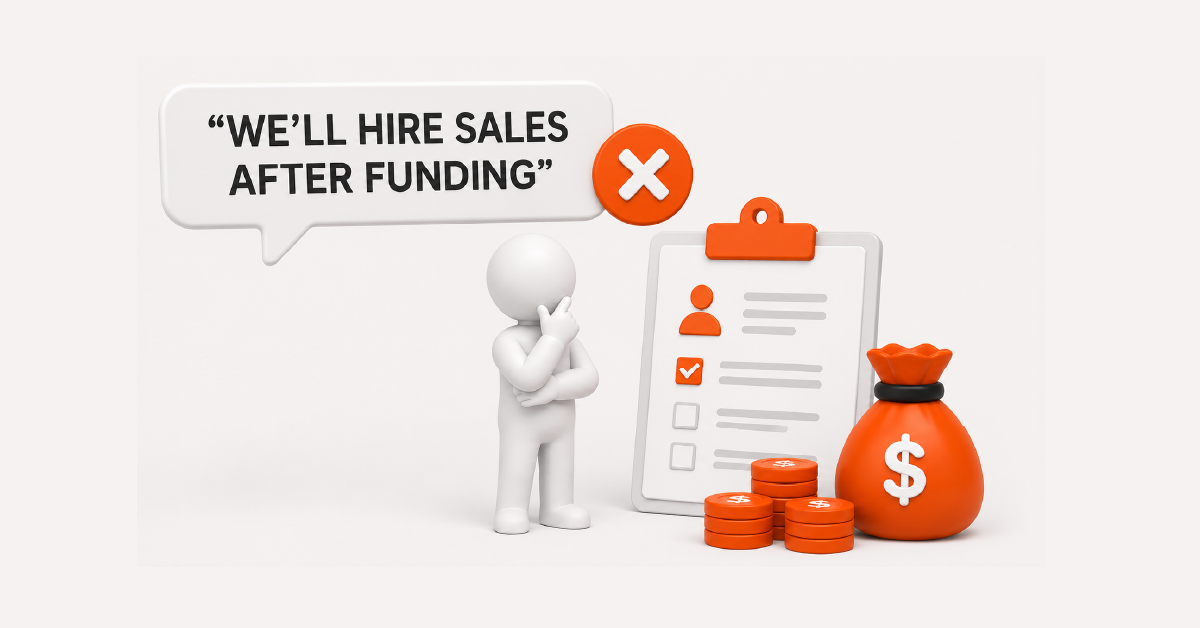
The sentence “we’ll hire sales after funding” tells investors you haven’t proven demand and want their money to find out. Here’s what must be true before that first sales hire.

"We'll Hire Sales After Funding" Is the Sentence That Ends Pre-Seed Rounds
You’re in a pitch meeting, and an investor asks how you’ll get customers. You answer, “We’ll hire a salesperson after this round.” The conversation changes because that response suggests you’re relying on funding to discover whether customers actually want your product.
At the pre-seed stage, investors want founders to prove demand first, not hire someone else to find it. This article explains why that answer raises concerns, what it says about your readiness, and when it actually makes sense to hire a salesperson.
You’ll also learn the answer investors are hoping to hear instead.
What Does the Investor Hear?
When a founder says, “We’ll hire sales after funding,” investors hear that customer demand hasn’t been validated, there is no repeatable sales process, and their investment will fund an expensive experiment. The founder is thinking about scaling, but the investor sees a business that is still searching for demand.

Reason One: There's No Playbook to Hand Over
A salesperson needs a clear sales playbook that explains who to contact, what to say, how to qualify leads, and when to walk away. At the pre-seed stage, most startups haven’t built that process. Hiring sales too early turns the role into an expensive experiment instead of a repeatable system.
Techstars makes this point clearly: “Founders, your first sales hire is probably a mistake.” Until you’ve closed enough deals to spot patterns, you don’t have a playbook. You only have early experiences.
Capwave’s guide on founder-led sales puts it simply: “A sales hire without a clear, repeatable process is like giving someone a map without roads.”
Reason Two: You're Blinding Your Only Source of Customer Insight
Founder-led sales gives you direct insight into pricing, objections, urgency, and the words customers use. Hiring a salesperson too early puts distance between you and those conversations. Instead of hearing customers directly, you rely on secondhand feedback.
Kathryn O’Day’s piece on transitioning from founder-led sales describes the risk well, “The founder is the only person who can hear the nuance in a buyer’s hesitation and adjust the entire company’s strategy. A salesperson can close a known pattern; they can’t invent one.”
While you’re still learning, every customer conversation matters. Staying close to those conversations helps you refine your product, positioning, and sales process before handing it to someone else.
Reason Three: Your First Sales Cycles Can Mislead You
Early sales through friends, referrals, or warm introductions can create the illusion of a repeatable process. Hiring a salesperson based on those wins risks scaling a sales motion that only works because of your personal network.
One founder on r/startups shared that after closing three pilot deals through warm introductions, they hired a salesperson. Despite using the same pitch, the new rep didn’t close a single customer in six months. The founder realized those early wins came from founder relationships, not a proven sales process.
Your first sales show that people who know you may buy. They don’t prove that strangers will. Before hiring sales, close enough customers through unbiased channels to confirm your process truly works.
The Team False Safety Net
Hiring a salesperson too early is a team false safety net. A strong resume can make it feel like you’re building a real company, but a new hire doesn’t create customer demand. As Tino explains, hiring for a role instead of solving a real problem hides whether people actually want your product.
This feels like progress because you’re hiring, interviewing, and growing the team. But the key question remains: Will anyone pay for this? The salesperson becomes a buffer between you and direct customer feedback.
We’ve also seen founders hire experienced VPs of Sales who had never sold without an established brand. That’s the prestige hire myth. At the pre-seed stage, your ability to sell is more valuable than any sales title.
What Must Be True Before You Hire Your First Salesperson
Before hiring your first salesperson, four things should already be true. You’ve closed enough deals to spot a pattern, deals are slipping because of capacity, not messaging, you have a documented sales process, and you know which parts of the sale depend on you versus a repeatable process.
You’ve Closed Enough Deals to Spot a Pattern
Don’t hire after one or two wins. Close enough deals to see the same customer pain, buyer profile, and objections appear repeatedly. The 30-prospect test helps you reach that point.
You’re Limited by Capacity, Not Messaging
If prospects are interested but you can’t keep up with demos or follow-ups, that’s a capacity problem. If deals stall because your message isn’t clear, fix the message before hiring. Sales hires scale a working process. They don’t create one.
You Can Document Your Sales Process
Write down your discovery questions, sales deck, common objections, and responses. If you can’t explain your process, you can’t train someone else. As UpTempo Group explains, founders should map their sales process before handing it over.
You Know What’s Repeatable
Separate what depends on your vision and relationships from what a salesperson can repeat. Hire only for the part that can become a consistent process. As the Sourcing Rule teaches, every assumption should be testable, including whether someone else can sell your product.
The table below can help you decide if you’re ready for your first sales hire.
Readiness Diagnostic for Your First Sales Hire:
Condition | Not Ready | Ready |
Personal close count | Fewer than 5 | 8–10+ from cold or unbiased sources |
Pattern recognition | Every deal feels different | Same pain points and objections repeat |
Capacity bottleneck | Deals stall on message | Deals stall on follow-up time |
Documented playbook | No written process | A clear doc another person could follow |
Transferable motion | Most wins rely on founder | A part of the motion is repeatable by skill |
The Honest Version of the Sentence
Instead of saying, “We’ll hire sales after funding,” say:
“I’ve closed our first 10 pilots myself. Two became paying customers. I know our buyer profile, demo flow, and the three objections we hear most. My next hire is a salesperson because I have a repeatable process, not an experiment.”
This tells investors you’ve validated demand yourself, built a sales process that can be taught, and you’re hiring to scale, not to discover whether customers want the product. That’s the answer investors want to hear.
FAQs
When should a startup hire its first salesperson?
Hire your first salesperson after you’ve closed enough deals yourself, documented the sales process, and confirmed that deals are being lost because of capacity, not messaging. For most startups, that’s after the pre-seed stage.
Is hiring a salesperson before funding a mistake?
In most cases, yes. Without a repeatable sales process, you’re asking a new hire to discover demand instead of scaling it. The exception is when you’ve already proven demand and need help executing.
Why do investors react negatively to “We’ll hire sales after funding”?
Because it suggests the founder hasn’t validated demand personally. Investors want founders to prove the sales process first, then hire someone to scale it.
Does founder-led sales ever end?
Not completely. Even after building a sales team, founders stay involved in key customer conversations, strategic deals, and improving the sales process.
What’s the biggest first sales hire mistake?
Hiring someone with a strong resume and expecting them to create the sales process. Early sales hires succeed with a proven playbook, not a blank slate.
Your first sales hire isn’t a milestone you buy with investor money. It’s a handoff you earn by proving the process yourself. Close your first customers, document what works, then hire someone to repeat it.
We help founders prove their sales process before they build a team. Book an Investor Readiness Audit.
Continue reading for deeper insights on customer validation, traction, and fundraising at the pre-seed stage.
- The Sourcing
Topics: