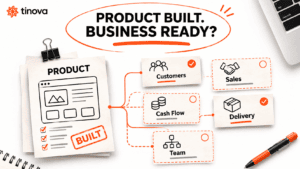
Use this pre-budget marketing checklist to find your real bottleneck, test demand, and decide whether your startup is ready to spend.
Would you pay to treat a problem before finding its cause? Yet when growth stalls, founders respond with more ads, a rebrand, or an agency retainer before checking what is wrong.
The pre-budget marketing checklist helps you find the real bottleneck before committing your runway. You will learn how to check your funnel, test demand, and score your marketing spend readiness.
TL;DR: Low lead volume with healthy conversion may call for more acquisition. Plenty of qualified visitors but few enquiries may point to a problem with your offer, message, or website. Diagnose first, then spend.
Key takeaways
- Find the main bottleneck before approving a new expense.
- Fix a weak funnel before paying to bring more people into it.
- Use small tests and customer feedback to reduce guesswork.
- Increase spending when evidence supports the next step.
Why Marketing Budgets Fail
A marketing budget cannot compensate for an offer people do not want, unclear positioning, or weak customer demand.
CB Insights’ analysis of 431 VC-backed companies that shut down since 2023 found that 70% ran out of capital, while 43% had poor product-market fit. These figures describe that sample, but they point to an important distinction: running out of money can be the final symptom, not the original cause.
Before adding another expense, use a startup root-cause diagnosis to separate the visible problem from the reason behind it.
The Cheapest Test Comes First
Before committing thousands of dollars, run a small test that answers one clear question.
- Send 10 to 30 personalised messages to people in your target audience.
- Show prospects your offer and ask what they understand, value, or question.
- Test one landing page or message before increasing your ad budget.
- Record the responses and decide what to change next.
The goal is not to prove your entire business with a small experiment. It is to learn whether your next investment makes sense. Y Combinator’s guide to choosing a startup idea also stresses learning through customer conversations and testing ideas with real users.
Visual 2 — Middle (The Cheapest Test)

Three Things to Check Before Spending
1. Is Your Message Clear?
Can a potential customer explain what you offer, who it helps, and why it matters within five seconds?
If not, improve the message before paying to promote it.
2. Are You Reaching the Right People?
A clear offer can still fail when it reaches the wrong audience. Define your ideal customer by industry, role, and problem, then test whether that group cares about the solution.
3. Is Your Funnel Broken or Under-Fed?
| Funnel condition | Example | Next step |
| Broken funnel | 1,000 visitors, 1 signup | Investigate the offer, message, and conversion process. |
| Under-fed funnel | 10 visitors, 1 signup | Check lead quality, then test ways to reach more suitable people. |
These are illustrative examples, not industry benchmarks. A small sample is not enough to establish a reliable conversion rate.
The principle is simple: more acquisition can help a working funnel grow, but it cannot repair a weak offer.
The Pre-Budget Diagnostic: Three Steps
Step 1: Find the Biggest Drop-Off
Review your analytics and sales records:
- Website visit to enquiry
- Enquiry to sales conversation
- Sales conversation to paying customer
Find the stage where the most qualified prospects stop progressing. Check the numbers alongside customer feedback before deciding what to fix.
Step 2: Test Demand
Speak with 10 potential customers. Explain the problem you solve and ask how they handle it today, what it costs them, and whether they would pay for a better solution.
Record their actual answers. Interest is useful, but buying behaviour and concrete commitments provide stronger evidence.
Step 3: Set One Measurable Goal
Do not approve a campaign simply because the goal is to get more leads.
For example: “We will test one channel for 14 days with a $1,000 budget and measure the cost per qualified enquiry.”
Set the target using your margins, previous results, and customer economics. A missed target should lead to an investigation, not an automatic budget increase.
The Spend-Readiness Checklist: Score Out of 10
Give yourself one point for every statement that is true.
| # | Checklist item |
| 1 | I have spoken with at least 20 potential customers and recorded their feedback. |
| 2 | I have evidence of demand, such as paid orders, repeat purchases, or strong buying commitments. |
| 3 | A stranger can explain my offer clearly in five seconds. |
| 4 | I can name my target audience and the problem I solve for them. |
| 5 | I know where qualified prospects drop off in my funnel. |
| 6 | I track customer acquisition cost (CAC) and customer value, or have clearly labelled estimates. |
| 7 | I can explain how my business has converted prospects into paying customers. |
| 8 | I have one measurable goal for the proposed spend. |
| 9 | I can explain which known bottleneck the expense is meant to address. |
| 10 | I have run a low-cost test and recorded what I learned. |
How to Read Your Score
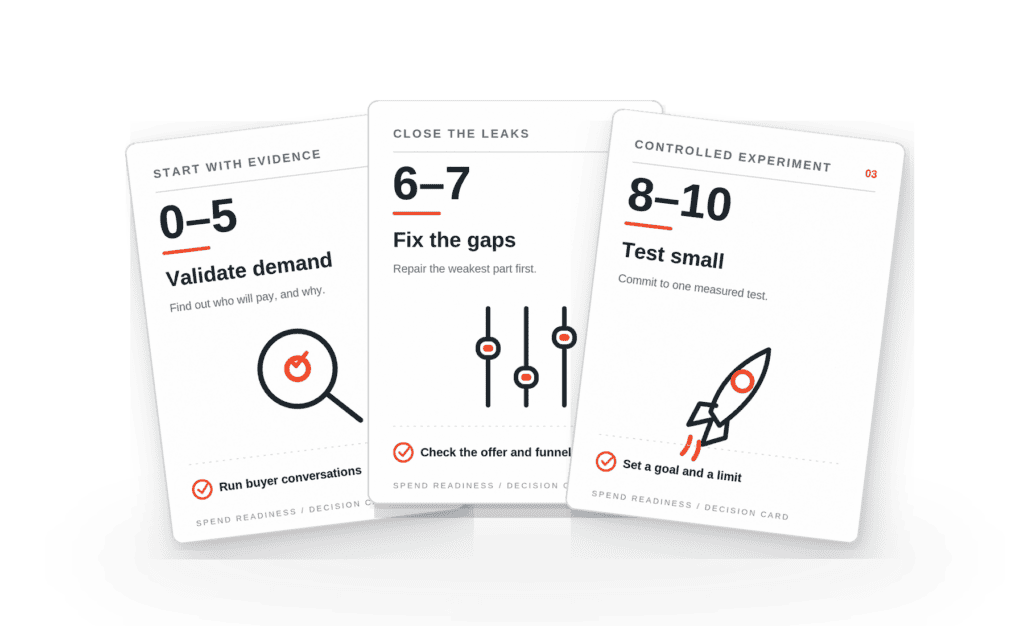
- 8 to 10: Consider a controlled spending test, provided demand and customer economics support it.
- 6 to 7: Address the missing evidence before increasing your budget.
- Below 6: Focus on customer research, offer validation, and low-cost tests first.
The score is a decision aid, not a scientific measure of business readiness. A high score does not replace evidence that customers will pay.
Visual 3 — Middle (Spend-Readiness Decision)
When Should You Open the Budget?
Spend when you can explain what the money will do, how success will be measured, and what you will learn if the test fails.
A published Tinova case study illustrates the importance of choosing the right problem first. DriveShield already had demand, but its offer and follow-up process were limiting conversions. After those were rebuilt, one acquisition channel was activated. The case study reports $3.2 million in new revenue over 28 days.
That is a specific client result, not a forecast for other businesses. The useful lesson is the order of work: address the conversion problem before increasing acquisition.
For early-stage founders, reviewing the numbers in Tinova’s pre-seed customer acquisition cost guide can also help establish what you can afford to spend on each customer.
What Premature Spending Looks Like
At pre-seed, be cautious about:
- Signing a large agency contract before validating demand.
- Rebranding before testing which message resonates.
- Hiring a growth team before understanding how the first customers buy.
- Increasing ad spend without knowing the cost of acquiring a customer.
Your goal at this stage is to learn what works before committing more money to it.
FAQs
Should I run ads before product-market fit?
Start with customer conversations and small demand tests. Paid campaigns may help you learn, but large budgets are risky when the audience, offer, and demand remain untested.
How do I diagnose my marketing before spending?
Review your funnel, speak with potential customers, test your message, and identify the biggest drop-off. Spend only when you have a clear question to answer.
How much should a pre-seed startup spend on marketing?
There is no universal amount. Start with an affordable test and base future spending on demand, margins, customer acquisition costs, and measurable results.
Why does my marketing spend produce few results?
Your offer may be unclear, your audience may be wrong, your funnel may lose qualified prospects, or demand may be weak. Check these factors before adding budget.
Diagnose Before You Spend
If you cannot identify the main bottleneck, start with Tinova’s services and free GAP Analysis. The 30-minute session examines your offer, website, and follow-up process to help rank the gaps that need attention.
Written by: Tinova Growth Team
Tinova is a marketing and growth agency for startups and owner-led businesses. Its current site reports 200 startups diagnosed, 77+ businesses scaled, 3 awards in 2026, and $10M+ in client funding pipeline built.
Updated: October 7, 2026
Disclosure: Tinova provides diagnostic and strategic marketing services. This article offers practical guidance and does not guarantee a particular business outcome.