
Stop treating startup symptoms. Use this root cause diagnosis framework to find the real constraint before spending more on marketing, sales, or growth.
You may not have a lead problem.
You may have a positioning problem that created the lead problem.
You may not have a conversion problem either. The message may be unclear. And when investors stop replying, another deck revision may not solve a targeting or credibility issue.
That is why startup root cause diagnosis starts with the problem behind the visible problem.
Why Founders Treat Symptoms First
Symptoms are easier to see.
“No leads” gives you a number.
“Low conversion” gives you a percentage.
“Investors are not replying” gives you an inbox to check.
The root cause takes more work. It may sit in positioning, customer understanding, offer design, targeting, or product value.
CB Insights analyzed 431 VC-backed startups that shut down and found that running out of capital was cited in 70% of cases, while poor product-market fit appeared in 43%, bad timing in 29%, and unsustainable unit economics in 19%.
The cash problem was frequently the final event, not the deeper cause. CB Insights’ 2026 startup failure analysis supports the same diagnostic idea: fixing the final symptom does not necessarily fix what caused it.
The first question should not be “What should we spend on?”
It should be “What evidence explains this problem?”

Three Common Symptom-vs-Root-Cause Mismatches
“We Need More Leads”
The first reaction is more outreach, ads, or lead-generation software.
But ask one question first:
Can a stranger explain what you do and who it is for after seeing your homepage?
If not, bringing more people to the same unclear message will not fix the lead problem.
Tinova’s current approach starts with diagnosis before deciding what to build. Its Services page explains the principle clearly: identify the business leak first, then decide which capability needs work.
“Our Conversion Is Too Low”
Founders may change buttons, layouts, forms, or analytics tools.
But conversion can fall because the message does not match the customer’s problem.
Before changing the page, speak to five customers and ask:
“What did you think we were offering when you first saw it?”
Their answers can tell you more than another round of design changes.
“Investors Keep Ignoring Us”
The answer may not be a new pitch deck.
Check:
- Are you targeting investors who match your stage?
- Is your company explained clearly?
- Does your website support the same story as your deck?
- Can your founder profile show relevant proof?
Tinova’s Customer Readiness Comes Before Investor Readiness makes the distinction clear: investor interest does not replace evidence that customers have a real problem and are willing to act.
The Root-Cause Pass
Before approving another marketing, sales, product, or software expense, run these three checks.
1. Start With the Symptom
Write the problem in one sentence.
For example:
“We are getting 300 website visitors a month but only two qualified conversations.”
Do not jump to the solution yet.
2. Walk Backward
Ask what has to happen before the symptom disappears.
For the example above:
Visitor → understands offer → sees relevance → trusts company → takes action
Find the first point where the evidence breaks.
That is where the diagnosis should begin.
3. Ask What Must Be True
Ask:
“What would have to be true for this symptom to disappear?”
For low lead volume, the answer could be:
“People understand the problem we solve and recognize that the offer is for them.”
Now you have a testable condition instead of a vague marketing problem.
YC’s startup guidance takes a similar customer-first approach, encouraging founders to ask about the hardest part of a problem and the last time the customer experienced it rather than relying on broad assumptions. Y Combinator’s customer interview guidance provides that framework.
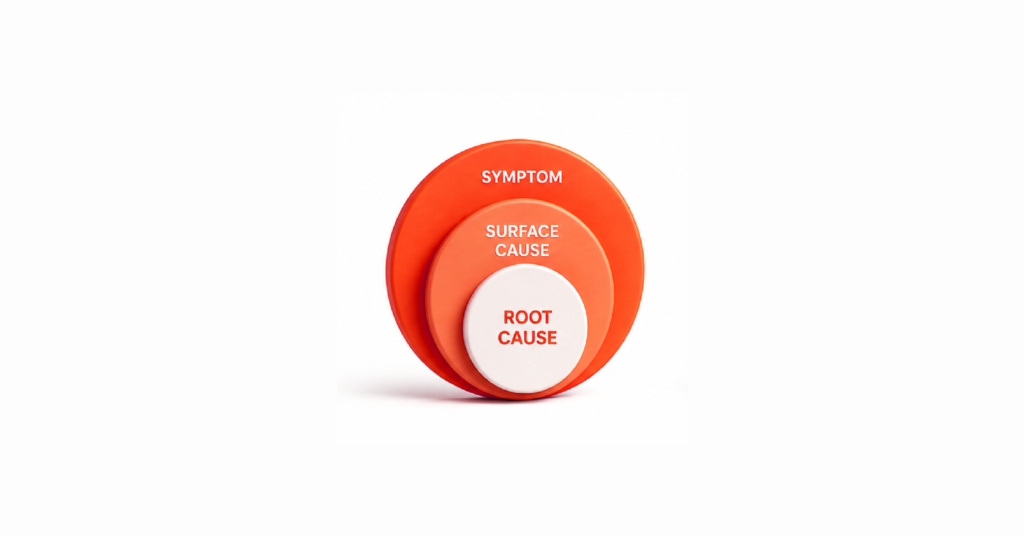
Symptom vs. Root Cause Map
| Visible Symptom | Possible Root Cause | First Test |
| No leads | Positioning is unclear | Test the one-line message with strangers |
| Low conversion | Message does not match the problem | Interview five customers |
| Investor silence | Weak fit or founder signal | Audit the target list and profile |
| Need funding to grow | Customer proof is weak | Review repeat usage and buying patterns |
| Product is not working | Problem may not be painful enough | Ask about recent examples and current alternatives |
These are diagnostic starting points, not fixed answers. The same symptom can have different causes across companies.
What 200 Startup Diagnoses Tell You
Tinova currently reports 200 startups diagnosed and says its free GAP Analysis identifies a company’s biggest growth leaks and ranks them by revenue impact.
That process points to a useful rule:
Diagnose the leak before choosing the tool.
A founder who thinks they need ads may need clearer positioning. A founder who thinks they need a salesperson may need a repeatable sales process. A founder who thinks they need funding may need stronger customer evidence.
The fix changes once the diagnosis changes.
The Diagnosis-Before-Dollars Rule
Before spending, write down three things:
The symptom: What is happening?
The suspected cause: Why do you think it is happening?
The evidence: What have you observed that supports that belief?
If the third answer is missing, you are still working from a hypothesis.
A few customer interviews can test that hypothesis before you commit to weeks of ad spend, a new hire, another redesign, or a large software contract.
For founders working through customer conversations, Tinova’s Founder-Led Sales guide recommends treating early sales calls as a research process and recording the patterns that repeat across conversations.
When Should You Stop Diagnosing and Start Building?
Diagnosis should not become another form of delay.
Once you have evidence for the likely cause, test one fix.
- If the issue is positioning, change the message.
- If the issue is activation, improve the first value step.
- If the issue is targeting, rebuild the audience.
- If the issue is sales repeatability, document the process before hiring.
Then measure whether the symptom changes.
Good diagnosis leads to a decision.
Tinova’s Results Library follows this same structure by showing what was broken, what was built, the result, and the timeframe for named clients.
FAQs
How do I find the root cause of a startup problem?
Start with the visible symptom, map what happens before it, and find the first step where evidence breaks. Then test the suspected cause before spending money on a solution.
Is “no leads” a positioning problem?
It can be. Test whether a stranger can explain your product, target customer, and value after seeing your homepage or outreach. If they cannot, lead generation may not be the first problem to solve.
Should I diagnose before spending on marketing?
Yes. Identify the suspected cause and the evidence supporting it first. Customer interviews, funnel data, and direct sales conversations can help you test the diagnosis before adding more spend.
What is startup root cause diagnosis?
Startup root cause diagnosis is the process of tracing a visible business problem back to the condition causing it, then testing that condition before choosing a solution. It helps founders fix the cause rather than repeatedly treating the symptom.
Written by: Tinova Growth Team
Tinova is a marketing and growth agency for pre-seed and seed founders and owner-led businesses. Its current site reports 200 startups diagnosed, 77+ businesses scaled, 3 awards in 2026, and $10M+ in client funding pipeline built.
Updated: October 7, 2026