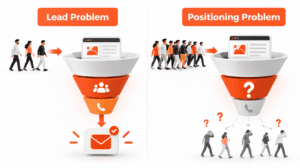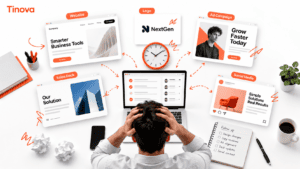
Can a stranger explain your startup in one sentence? Use the One-Sentence Test to sharpen your positioning, spot vague copy, and score your homepage out of 10.
Can a stranger explain what your startup does after reading your homepage once?
If your explanation takes three paragraphs, you may not have made clear choices about who you serve, what problem you solve, and why your solution is different.
The One-Sentence Test gives you three quick ways to diagnose unclear positioning, including a test using an AI language model (LLM).
TL;DR: If a stranger cannot repeat your offer in one sentence, your message needs work. Make it clear before spending more on ads, website redesigns, or sales materials.
Why Complexity Loses Buyers
A complex product does not need a complicated explanation. Buyers should be able to understand the main benefit before learning how the technology works.
In Wynter’s 2026 B2B Vendor Differentiation Survey, 64% of surveyed B2B SaaS marketing leaders found competing vendors difficult to distinguish by their websites and messaging. The lesson is simple: clear messaging must explain not just what you do, but why your solution is different.
This matters for people and AI-powered search tools. A 2026 First Round Review guide to positioning AI products makes a similar point: calling a product “AI-powered” does not explain why a customer should choose it.
The Three Tests
1. The Retell Test
Show your homepage to someone unfamiliar with your business for 10 seconds. Hide it and ask: “What does this company do?”
- Fail: “It’s some kind of software for businesses.”
- Pass: “It helps restaurants reduce food waste.”
If the person cannot name your customer and the problem you solve, your message needs more clarity.
2. The Three-Paragraph Test
Write your current company explanation. Cut it to three sentences, then one.
Your final sentence should answer:
- Who do you help?
- What problem do you solve?
- How do you solve it differently?
You do not need to fit every feature, vision statement, and claim into the sentence. Choose the information a potential customer needs first.
If you cannot shorten your explanation, revisit your positioning before rewriting the homepage.
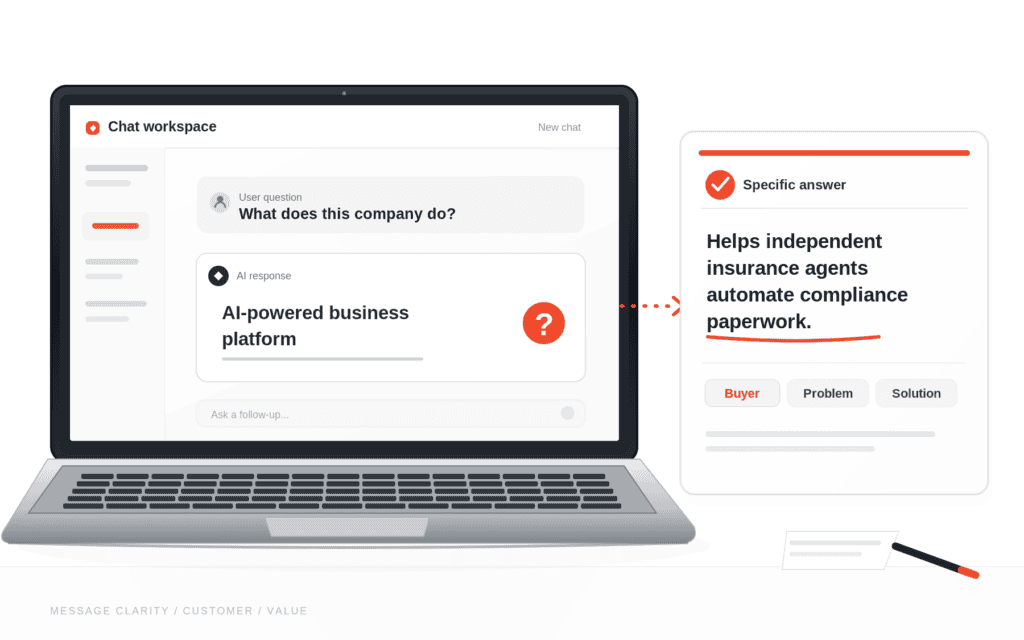
3. The LLM Test
Remove your company name from your homepage copy. Paste the text into an LLM and ask:
“What does this company do, who does it help, and what makes it different?”
- Fail: “A comprehensive AI-powered platform that streamlines workflows and drives efficiency.”
- Pass: “A tool for independent insurance agents that automates compliance paperwork so they can spend more time serving clients.”
The test helps you spot generic messaging. It does not predict how every AI search system will rank or recommend your business.
Visual 2 — Middle (The LLM Test)
Build a Stronger One-Sentence Positioning Statement
Use this formula:
We help [specific buyer] reduce [costly problem] by replacing [old method] with [new approach].
Example: “We help dental clinics reduce missed appointments by replacing manual reminder calls with automated two-way texting.”
The sentence names the buyer, problem, and solution. A potential customer can understand it without reading a paragraph of technical details.
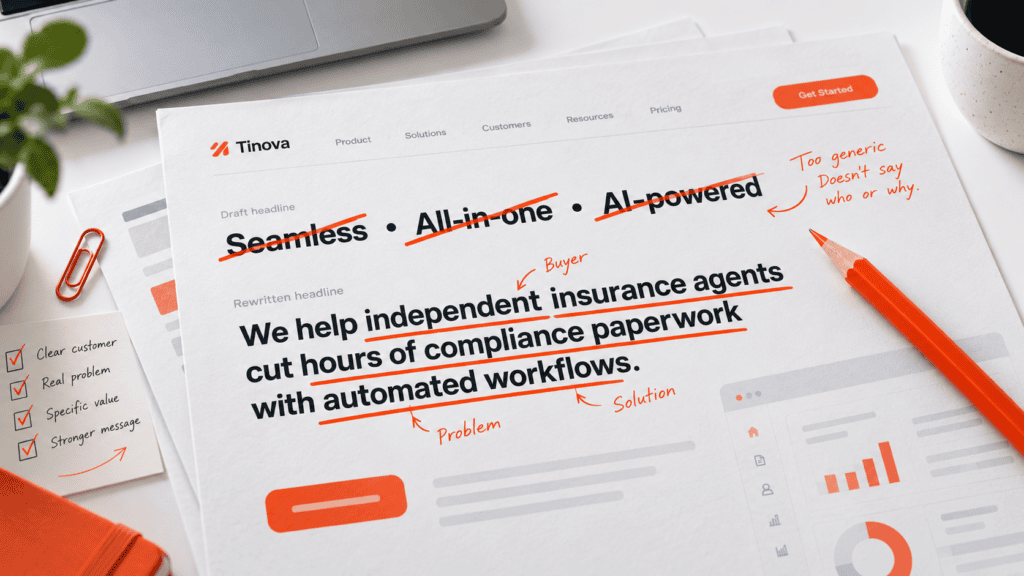
Remove Words That Make You Sound Generic
Review your homepage for phrases such as:
- “Seamless”
- “End-to-end”
- “AI-powered”
- “All-in-one”
These phrases are not automatically wrong, but they are weak substitutes for a clear benefit. Explain what your product does, who needs it, and why it is different.
Compare these examples:
Weak: “We help businesses grow with innovative technology.”
Stronger: “We help independent insurance agencies reduce compliance paperwork with automated document checks.”
Your positioning should be specific enough that a competitor could disagree with your claim or offer a different approach. If any business could use the same sentence, narrow it down.
Visual 3 — Middle (Removing Generic Messaging)
For more help identifying your target customer, read Tinova’s guide to positioning your startup around your High-Expectation Customer.
When a Longer Explanation Is Fine
Some products need more context, especially deep-tech products and new categories. That does not mean the opening message should be vague.
| Situation | Example | Diagnosis |
| Complex product, clear positioning | “We use machine learning to predict equipment failure in factories.” | The buyer, problem, and purpose are clear. |
| Unclear positioning | “We empower businesses with cutting-edge insights.” | The buyer and problem are missing. |
Lead with the value. Explain the technology next.
The One-Sentence Test: Score Your Positioning Out of 10
Give yourself one point for every “Yes.”
| # | Checklist | A “Yes” Means |
| 1 | Can a stranger explain what you do? | You have tested it with someone unfamiliar with your business. |
| 2 | Does your sentence name the buyer? | It identifies a specific customer, not “everyone.” |
| 3 | Is the problem concrete? | You name a clear issue, such as missed appointments. |
| 4 | Do you explain your approach? | You identify what your solution replaces or improves. |
| 5 | Have you checked for generic phrases? | You have replaced vague claims with specific benefits. |
| 6 | Is your difference clear? | Your message gives buyers a reason to consider you. |
| 7 | Does an LLM describe you specifically? | Its answer names your customer and core benefit. |
| 8 | Can you explain your offer in one sentence? | The short version keeps the main point. |
| 9 | Does your homepage lead with the value? | Visitors see the core offer before a long feature list. |
| 10 | Can your team repeat the same message? | Team members describe the offer consistently. |
How to Read Your Score
- 8 to 10: Your positioning is clear enough to build on. Keep testing it with customers.
- 6 to 7: Improve the weak points before increasing marketing spend.
- 0 to 5: Revisit your buyer, problem, and differentiation before investing in more marketing materials.
A score is a diagnostic guide, not a guarantee of conversion or growth.
FAQs
What is the One-Sentence Test?
It checks whether a stranger can understand your startup’s offer in one sentence. You test the clarity of your message with a person, a shorter explanation, and an LLM.
Why can’t people understand what my startup does?
Your positioning may name too many audiences, describe features without a clear benefit, or use claims that also fit your competitors. Start by defining your primary customer and the problem you solve.
How do I explain a complicated product simply?
Lead with the customer and outcome, not the technical details. For example, “We help hospitals reduce surgery scheduling delays” gives people a starting point before you explain the software.
How do I make my startup messaging AI-search friendly?
Write clear, accurate copy that names your audience, problem, solution, and differentiator. This helps readers and gives language models more specific information to interpret, but it cannot guarantee visibility in AI-generated answers.
Fix Your Positioning Before You Spend More
A low score is a reason to investigate, not to buy another marketing service immediately. Talk to customers, find out how they describe the problem, and rewrite your sentence using their language.
Tinova’s published Tahira Collection case study illustrates why audience focus matters. The project narrowed its launch positioning from five audiences to one and reported $10,000 in revenue within the first 48 hours. This is one client result, not a forecast, but it shows how a more focused message can guide a launch.
If your customer, offer, or message is still unclear, explore Tinova’s services and free GAP Analysis to assess what needs attention before your next marketing investment.
Written by: Tinova Growth Team
Tinova is a marketing and growth agency for startups and owner-led businesses. Its current site reports 200 startups diagnosed, 77+ businesses scaled, 3 awards in 2026, and $10M+ in client funding pipeline built.
Updated: October 7, 2026
Disclosure: Tinova provides diagnostic and strategic marketing services. This article offers practical guidance and does not guarantee a particular business outcome.