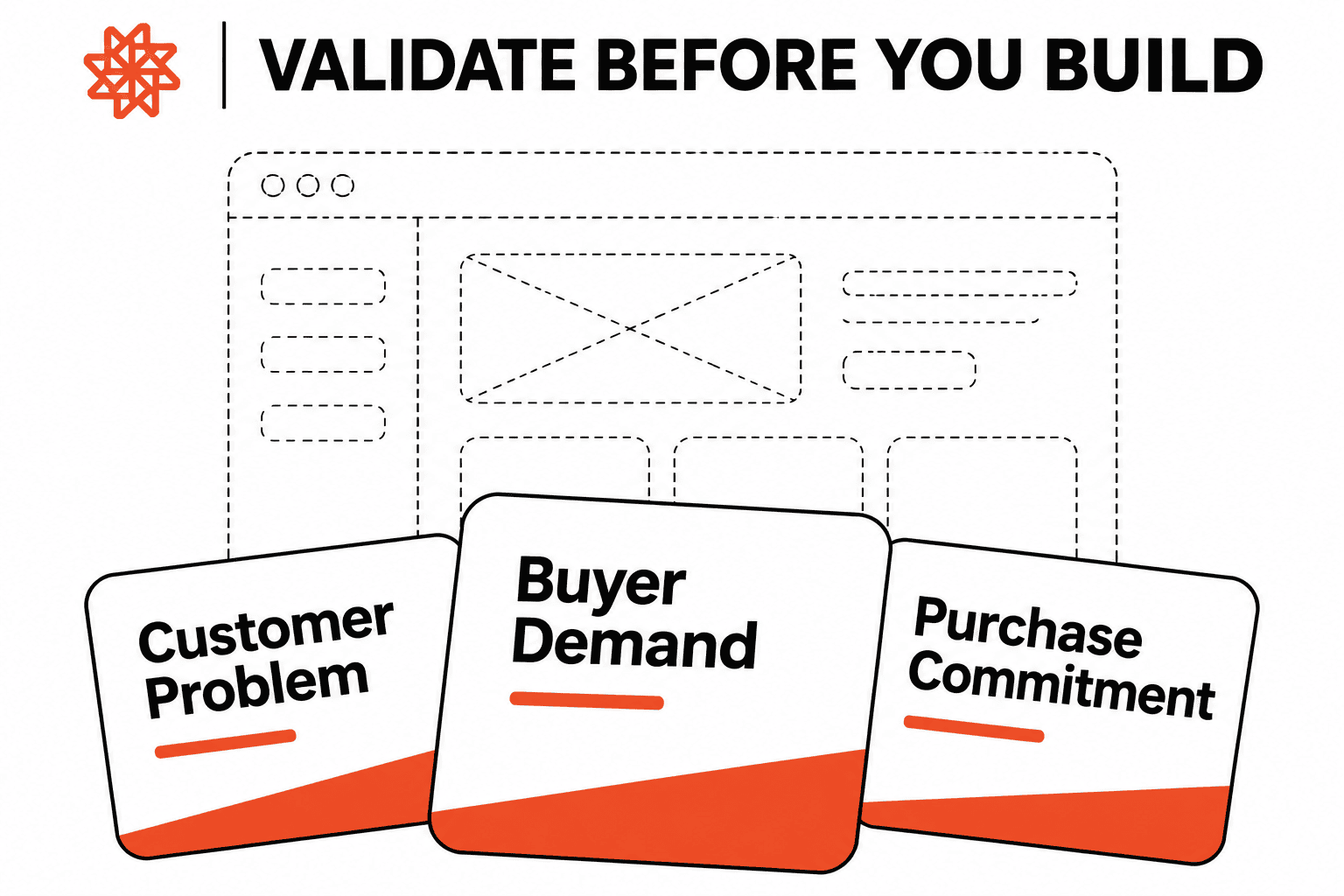
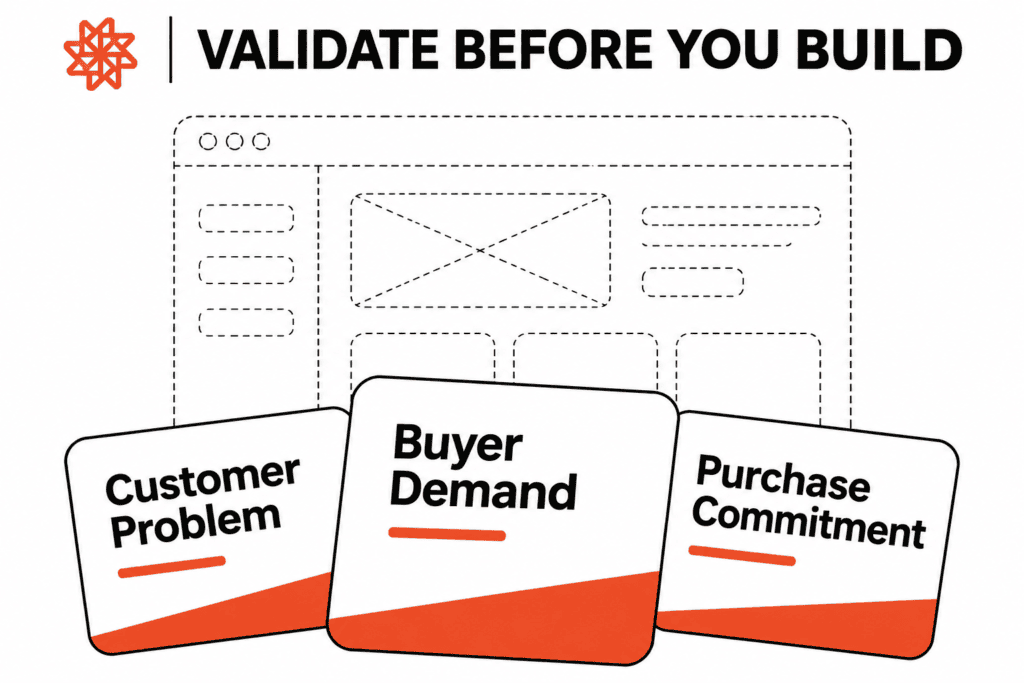
Finding people who have a problem is not the same as finding customers who will pay to solve it.
To validate a startup idea, identify a specific customer problem, find out how businesses currently solve it, speak to the people who can approve a purchase and test whether they will pay for your solution.
You don’t need a fully developed product to start gathering this evidence.
Welcome to our series on building and growing a startup.
Explore the articles in this series:
Part 1: If You Had 30 Days to Work on Your Startup, What Would You Work On?
Part 2: How to Make Your Offer Clear to Potential Customers
Part 3: What Skills Do You Need to Run a Startup?
Part 4: How to Validate a Startup Idea Before Building a Product ← This post
Let’s get into it.
Start With a Problem Customers Need to Solve
A problem can be frustrating without being important enough for a business to spend money solving it.
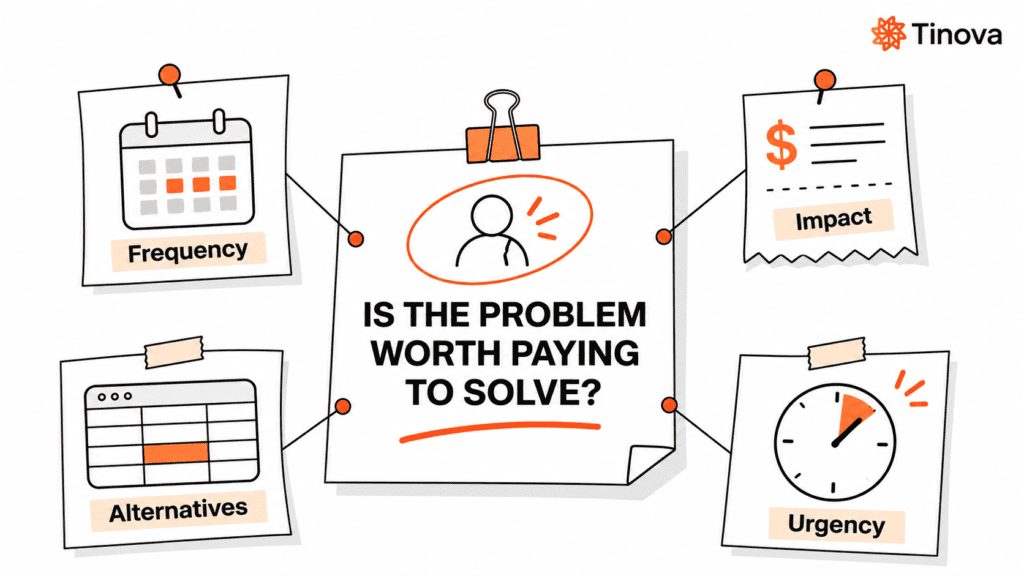
When researching market demand, look at four things:
- Frequency: How often does the problem occur?
- Impact: What does it cost the business in time, money or lost opportunities?
- Alternatives: How are customers handling it today?
- Urgency: What makes solving it a priority now?
Read competitor reviews, industry discussions and Reddit threads. Free tools such as Google Trends can also help you explore search interest, although this alone does not establish buying intent.
Your competition includes spreadsheets, manual processes and even doing nothing. Find out what would make customers leave their current solution for yours.
Identify Who Will Actually Buy Your Product
In B2B, the person experiencing a problem may not control the budget.
Understand these three purchasing roles:
- User: The person who experiences the problem.
- Champion: The person who advocates for your solution within the company.
- Decision-maker: The person who approves the purchase.
One person may fill all three roles.
Define your ideal customer profile by company type, size, role and circumstances.
For example, if you’re developing a sales management tool, companies hiring their first sales team may be a better starting point than small businesses in general.
Look for relevant companies through LinkedIn, industry communities and professional networks.
Ask Customer Discovery Questions That Reveal Real Demand
Instead of asking, “Would you use this?” find out what people have already done about the problem.
This is a central principle of Rob Fitzpatrick’s book, The Mom Test.
Ask potential customers:
- When did you last experience this problem?
- How did you deal with it?
- What did it cost your business?
- What solutions have you already tried or purchased?
- How did your company decide to purchase its last similar solution, and who approved it?
Start with a small group of relevant customers, then continue until you have enough consistent evidence to inform your next decision.
Record their answers, objections and agreed next steps. If several businesses describe a different problem, investigate it before returning to your original idea.
Choose the Right Startup Idea Validation Method
You don’t need a minimum viable product (MVP) to test every assumption. Choose the simplest experiment that answers your biggest unanswered question.
| Validation method | What it can demonstrate | What it cannot establish alone |
| Customer interviews | Problem significance | Purchase commitment |
| Landing page with a waitlist | Interest in an offer | Willingness to pay |
| Prototype or mockup | Understanding and usability | Continued usage |
| Pre-order or deposit | Financial commitment | Long-term demand |
| Paid pilot | Willingness to pay | Repeatable sales |
| MVP | Usage and early value | Product-market fit |
Vanta offers a useful example. According to Todd Jackson’s founder interviews, its founders used a spreadsheet to test whether SOC 2 security compliance preparation could become a product.
As potential customers began approaching them for help, the team gained more confidence in the opportunity.
They were learning what customers needed before investing in a full software product.
How to Test Willingness to Pay Before Building an MVP
Offer qualified buyers a specific outcome at a clear price through a paid pilot, pre-order or deposit.
A waitlist tells you someone is interested. A booked meeting shows they’re willing to spend time. Neither tells you whether they’ll become a paying customer.
To offer a paid pilot, define:
- The problem you will solve.
- What the customer will receive.
- The price and delivery timeframe.
- How you will measure the result.
For instance, if you’re developing software that automates sales reporting, you could offer to produce those reports manually for a paying customer first.
Be clear about what exists, what is still being developed and the delivery and refund terms.
For businesses with longer purchasing cycles, an introduction to the budget owner or progress through formal approval can also provide useful evidence.
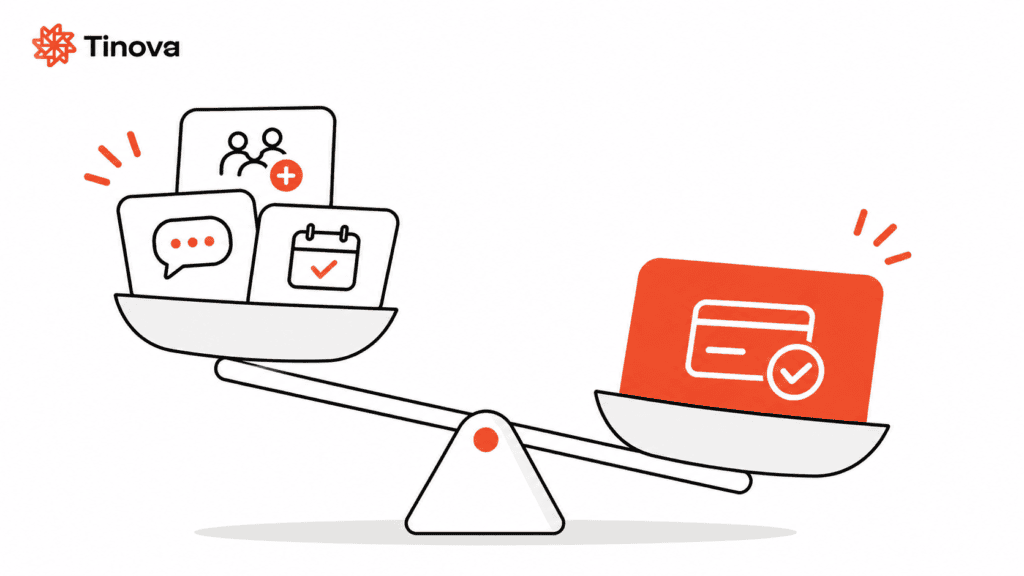
What If People Show Interest but Don’t Buy?
Before running a validation test, decide what result would justify continuing, changing your approach or stopping.
Poor results do not automatically mean nobody needs your product. First, check whether your test reached the right people and whether they understood the offer.
| Validation result | What to investigate | What to do next |
| No outreach responses | Audience, message or channel | Check buyer relevance before testing a new message. |
| Positive interviews but no commitment | Urgency or timing | Ask what would make solving the problem a priority. |
| Waitlist signups but no purchases | Price, value or trust | Test a paid offer or investigate existing objections. |
| Interested users but no approval | Budget and business case | Speak with the decision-maker. |
| Customers describe another problem | Original assumption | Investigate the alternative problem. |
| Only one company pays | Repeatability | Approach comparable businesses. |
If relevant buyers understand your offer but reject the price, find out why before changing your audience.
Test one important variable at a time. You want to identify the underlying problem, not abandon a potentially viable idea because of a poorly designed test.
How Do You Know When Your Startup Idea Is Validated?
There is no universal number of interviews, signups or sales that tells you when an idea is validated.
The evidence you need depends on how much time and money you’re about to invest.
Startup Idea Validation Checklist
Before committing to development, ask yourself:
- Have I identified a specific customer segment?
- Do I understand the problem, its cost and existing alternatives?
- Can I reach the people who approve purchases?
- Have customers demonstrated commitment beyond verbal interest?
- Can I find other businesses with the same need?
- What remains untested, and what result would change my decision?
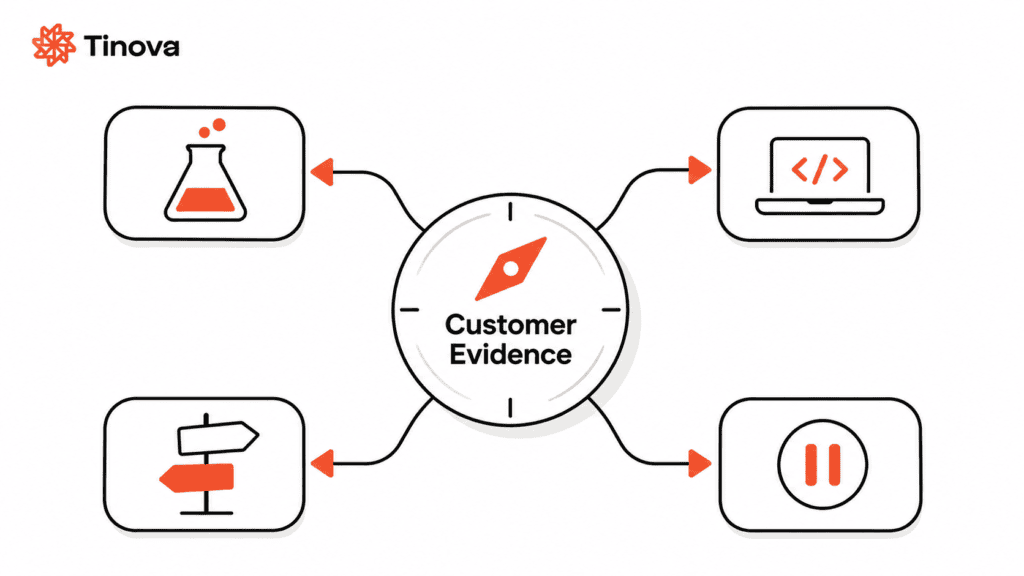
Continue testing if the problem matters but purchase commitment remains uncertain.
Build a limited MVP when credible customer commitments justify development.
Change direction when evidence points towards a different buyer, problem or offer.
Pause when repeated, well-designed tests reveal insufficient commercial demand.
Early validation is not product-market fit. You still need to establish whether customers receive ongoing value and whether you can acquire and serve them sustainably.
You don’t need all the answers before building. You need enough evidence to make your next decision.
If you’ve tested your offer or spoken to potential customers but still aren’t sure why people aren’t committing, Tinova’s Free GAP Analysis can help you identify where the problem lies and what to test next.
Written by Tinova Growth Team
The Tinova Growth Team shares practical guidance for early-stage B2B founders working through positioning, marketing, sales and customer acquisition.