
No local network? Take the 12-point immigrant founder credibility test to see what strangers find when they search for you and what to improve first.
Immigrant founder credibility is the trust you earn when you cannot rely on an established local reputation. You build it through visible proof of your work, a clear point of view, and a consistent record that people can verify.
This guide explains why the starting point can be different for immigrant founders and provides a 12-point checklist to assess your public credibility.
Why Is Building Credibility Harder for Some Immigrant Founders?
A founder who has spent years in one market may have former colleagues, university contacts, and industry relationships ready to make introductions. Their reputation can travel through people who already know their work.
An immigrant founder entering a new market may have years of experience but few local contacts who can vouch for it. Their qualifications may be unfamiliar, and their previous achievements may be harder for new contacts to verify.
This is a difference in access, not ability.
Researchers use the term social capital to describe the value people gain from relationships, trust, and shared networks. When you start in a new market, you may need to build those connections while also proving your expertise.
The challenge is real, but it does not define your potential.
What Builds Immigrant Founder Credibility?
You cannot depend on people discovering your work through personal connections alone. Give them clear reasons to trust what you say.
1. Public Proof Over Private Reputation
People in a new market may not know what you achieved in your previous country or role. Make that experience easy to understand and verify.
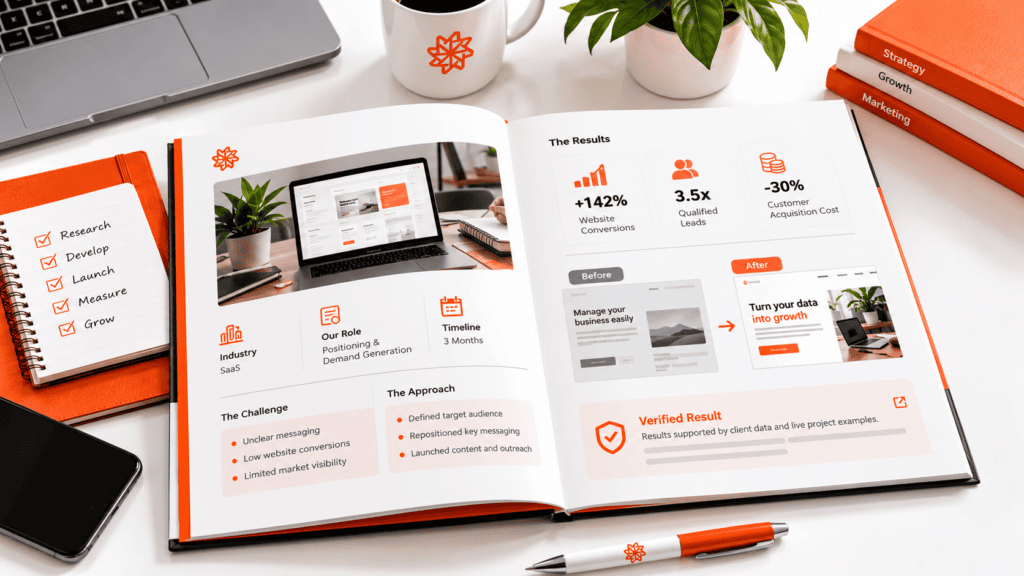
Publish a case study, document a project, share a useful technical article, or explain how you solved a specific business problem. Whenever possible, include the result, your contribution, and the evidence behind your claims.
A specific result carries more weight than a broad claim about your expertise.
Visual 2 — Middle (Public Proof Over Private Reputation)
2. A Clear Point of View
A stranger may check your LinkedIn profile and website before agreeing to a meeting. If both contain generic descriptions, they may struggle to understand what makes your work different.
Compare these two statements:
- “We help startups grow.”
- “We help early-stage startups identify why their marketing is not turning interest into customers.”
The second statement identifies a problem and explains the value you offer. A clear point of view helps people understand how you think and where your expertise applies.
3. Consistency That People Can Verify
One strong post can attract attention, but a consistent record gives people more evidence to assess.
Publish useful insights, explain what you have learned, and update your portfolio as your work develops. Over time, a stranger can review your ideas and examples instead of relying on a single introduction or claim.
Your online presence becomes a record of your thinking, experience, and results.
What Does the Data Say About Immigrant Founders?
The National Foundation for American Policy’s June 2026 report on immigrant founders found that immigrants founded or co-founded 455 of 775 US billion-dollar startups, or 59%. The report also found that approximately 66% of these companies were founded or co-founded by immigrants or their children.
These figures describe the scale of immigrant entrepreneurship in the United States. They do not guarantee individual success or remove the barriers a founder may face when entering a new market.
They do, however, challenge the idea that an unfamiliar background prevents founders from building significant companies.
The 12-Point Immigrant Founder Credibility Checklist
Score one point for each statement that is true today.
| # | Check | What It Measures |
| 1 | A stranger can find your name in Google search results. | Visibility: People can find you. |
| 2 | Your LinkedIn profile explains the problem you solve. | Clarity: Your value is easy to understand. |
| 3 | Your website or profile communicates a clear point of view. | Differentiation: Your thinking stands out. |
| 4 | You have published original thinking in the last 30 days. | Proof of work: Your expertise is visible. |
| 5 | You have a case study or testimonial showing a specific result. | Social proof: Someone else can support your claims. |
| 6 | A stranger can verify your experience in under three minutes. | Verifiability: Your claims are easy to check. |
| 7 | Your public work shows a consistent record over six months. | Consistency: Your presence is sustained. |
| 8 | You have spoken at an event, appeared on a podcast, or shared expertise with an audience. | Authority: Others recognise your knowledge. |
| 9 | Someone in your network makes introductions for you. | Network: Trust is beginning to travel through relationships. |
| 10 | You can name a person who would confidently refer you. | Relationship depth: Trust exists between specific people. |
| 11 | You have declined work that did not fit your expertise or goals in the last 12 months. | Standards: You make deliberate choices. |
| 12 | You can ask for a meeting or sale without apologising for your background. | Confidence: You communicate your value clearly. |
How to Read Your Score
| Score | Interpretation | What to Do Next |
| 9 to 12 | Your public credibility has a strong foundation. | Keep your information current and review your proof every quarter. |
| 5 to 8 | Some important pieces are in place, but gaps remain. | Improve your clearest weaknesses, starting with your profile and proof of work. |
| Below 5 | Strangers may struggle to verify your expertise. | Start with one case study and a clear explanation of the problem you solve. |
This is a practical self-assessment, not a validated scientific test. It measures how easily people can understand and verify your professional credibility, not your worth as a founder.
Where Should You Start If You Score Below 5?
Start with three manageable steps:
- Publish one case study. Explain the problem, what you did, and the result. Use only claims you can support.
- Rewrite your LinkedIn headline. State the problem you solve rather than relying on your job title.
- Share one useful insight each month. Explain a lesson from your work, a decision you made, or a problem you know how to solve.
You do not need a large audience to begin. You need clear information that helps the right people understand your experience.
For founders preparing to raise capital, credibility also depends on the evidence behind the business itself. Tinova’s guide to what investors want to see before funding a startup explains how team capability, customer demand, traction, and business fundamentals contribute to an investor’s assessment.
How Do You Turn Credibility Into Trust?
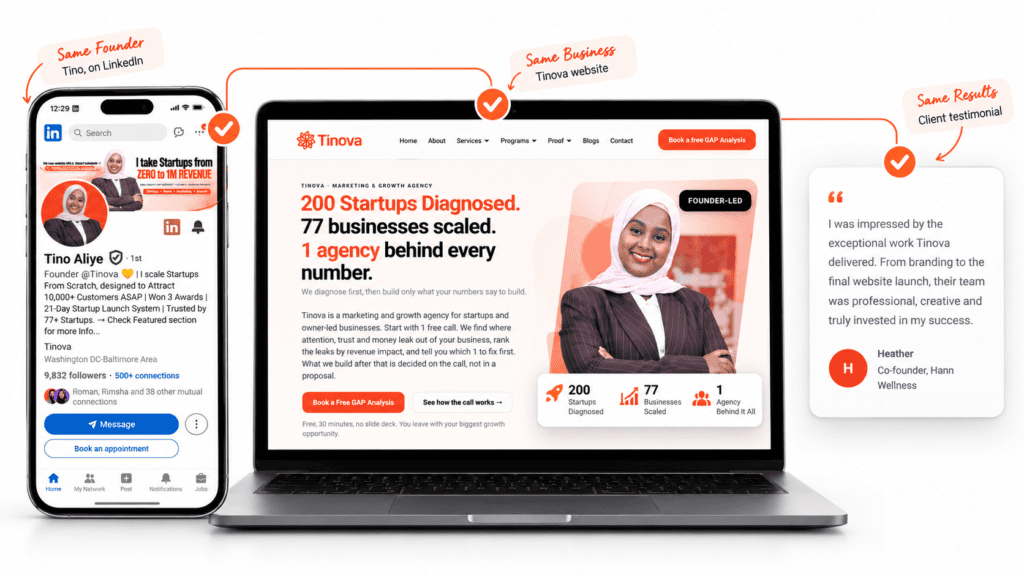
Visibility alone does not guarantee trust. Your claims must match the evidence people find.
Keep your website, LinkedIn profile, case studies, and public statements consistent. Explain your role in each project, distinguish your contribution from the team’s work, and use numbers only when you can verify them.
Tinova’s results library offers a useful example of how business claims can be supported through named case studies, client testimonials, and stated results. The same principle applies to an individual founder: show what you did, explain what changed, and make the evidence easy to check.
Visual 3 — Middle (Turning Credibility Into Trust)
As your relationships grow, public proof can also make introductions more effective. People who understand your expertise have a clearer reason to recommend you to someone else.
FAQs
Do immigrant founders face a credibility disadvantage?
Some immigrant founders face barriers because they lack local references, established networks, or familiarity with the market. These challenges vary by country, industry, and individual circumstances. Public proof, clear communication, and trusted relationships can help others assess their expertise.
How can immigrant founders build a network?
Start by sharing useful work, participating in relevant professional communities, and contributing to conversations where your expertise matters. Build genuine relationships before asking for introductions. A clear portfolio or case study gives new contacts a concrete reason to understand and recommend your work.
How successful are immigrant-founded startups?
The NFAP’s June 2026 report found that immigrants founded or co-founded 59% of US billion-dollar startups in its study. This shows the substantial contribution of immigrant entrepreneurs, although it does not predict the outcome for any individual founder.
What should an immigrant founder’s online presence show?
It should explain what you do, which problems you solve, and what evidence supports your experience. A clear profile, useful published work, verifiable results, and consistent information help strangers assess your credibility without relying on personal introductions.
Credibility Is Built Through Evidence
You do not need to wait until you have a large network to show what you can do. Start by making your expertise visible, explaining your point of view, and documenting your work.
The goal is not to appear credible to everyone. It is to make it easy for the right people to understand your value and verify your claims.
Written by: Tinova Growth Team
Tinova is a marketing and growth agency for startups and owner-led businesses. Its current site reports 200 startups diagnosed, 77+ businesses scaled, 3 awards in 2026, and $10M+ in client funding pipeline built.
Updated: October 7, 2026
Disclosure: Tinova provides diagnostic and strategic marketing services. This article offers practical guidance and does not guarantee a particular business outcome.