When to hire first salesperson startup? “After funding” can be a red flag. Learn what must be true before your first sales hire.
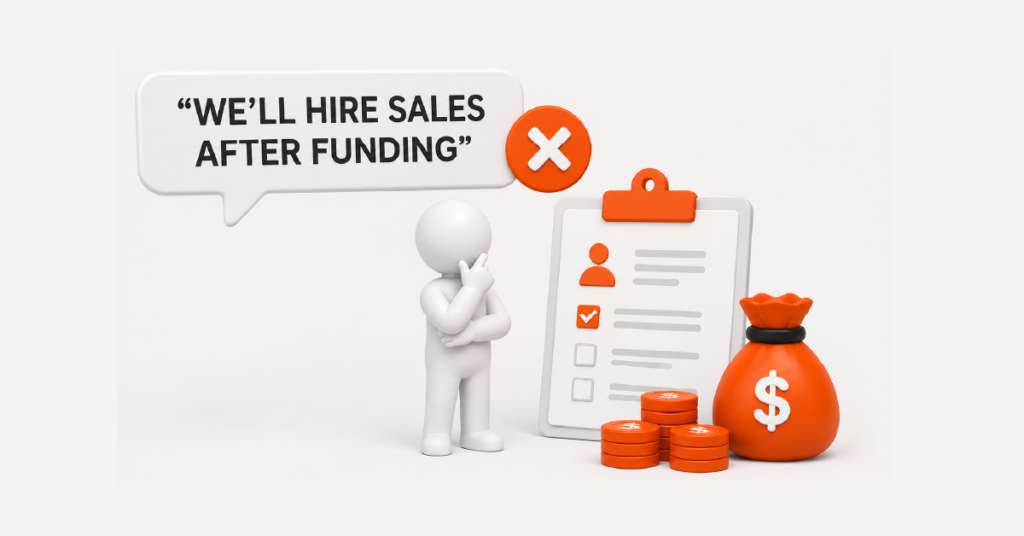
At pre-seed, saying “We’ll hire sales after funding” can raise a bigger question: have you proved that customers will buy without a sales team?
Knowing when to hire first salesperson startup is less about the funding date and more about whether your sales process is ready to hand over.
Quick Answer: Hire when you can explain who buys, why they buy, how the sale works, what objections repeat, and what another person can follow without relying on founder intuition.
Key Takeaways
- Funding is not the trigger. Sales readiness is.
- Your first salesperson should scale a working process, not discover whether customers want the product.
- Founder-led sales gives you direct customer feedback while the process is still changing.
- A documented, repeatable sales motion matters more than hitting one fixed customer count.
Why “We’ll Hire Sales After Funding” Raises Questions
When an investor hears “we’ll hire sales after funding,” they may wonder whether the new hire is being brought in to scale demand or discover demand.
Techstars makes a similar point in its guidance on early sales hiring: founders need to understand customer value, objections, messaging, and the sales process before handing those conversations to someone else.
The issue is not that hiring after funding is always wrong. The issue is what the hire is expected to figure out.
Your First Sales Hire Needs a Process to Follow
A salesperson needs answers to basic questions:
- Who is the right buyer?
- What problem makes them act?
- What does the first conversation look like?
- Which objections keep coming up?
- What qualifies a prospect?
- Why do deals get won or lost?
If those answers change with every conversation, the founder is still doing customer research.
Tinova’s 30-Prospect Test follows this same idea: use early customer conversations to learn the buyer, pain points, objections, and sales motion before trying to scale it.
Three Reasons to Delay the First Sales Hire
1. You Have No Playbook Yet
Your first salesperson cannot build a reliable process from guesses.
They need a starting point for targeting, messaging, qualification, follow-up, and closing. Techstars describes early founder-led sales as a learning stage where customer conversations help shape the product and sales process.
2. You Lose Direct Customer Learning
Early sales conversations can reveal more than whether someone will buy.
They show how customers describe the problem, what they question, what they value, and where your offer falls short.
Hiring too early can put another person between the founder and those lessons.
3. Warm Wins Can Give You False Confidence
A few referrals or personal introductions can produce early customers without proving that strangers will buy through the same process.
That is why the better question is not:
“Have we made sales?”
It is:
“Can we explain why those sales happened and repeat the process?”
Tinova’s Revenue False Safety Net guide makes the same distinction between early revenue and repeatable sales.

When to Hire Your First Salesperson
Look for four conditions.
1. The Same Pattern Keeps Appearing
You are seeing similar buyers, problems, triggers, objections, and reasons for buying.
There is no universal customer count. Tinova’s current sales framework focuses on repeatability rather than a fixed number of customers.
2. Sales Is Limited by Capacity
If qualified prospects want demos but the founder cannot keep up with calls, follow-ups, and deal management, capacity may be the problem.
If deals are still failing because the message, buyer, or offer is unclear, keep learning first.
3. The Process Is Written Down
Document:
- Discovery questions
- Qualification rules
- Core pitch
- Common objections
- Follow-up process
- Reasons deals are won or lost
If another person cannot understand the process, it is not ready to be handed over.
4. Another Person Can Repeat It
This is the key test.
Can someone follow the process without needing the founder to explain every decision?
If yes, you may be moving from founder-led sales toward a repeatable sales motion.
First Sales Hire Readiness Check
| Condition | Not Ready | Ready |
| Buyer | Still changing | Clear pattern |
| Messaging | Changes every deal | Repeated message works |
| Objections | New every time | Same objections repeat |
| Sales process | Mostly in founder’s head | Written and teachable |
| Deal flow | Needs founder relationships | Can work beyond founder network |
| Bottleneck | Demand or positioning | Founder capacity |
The exact customer count matters less than the pattern.
What About Hiring a Generalist First?
Not every startup needs to jump from founder-led sales to a dedicated salesperson.
A support generalist can handle CRM updates, prospect research, outreach, and follow-up while the founder continues running important sales conversations.
Tinova’s current founder-led sales framework describes this as a possible hybrid stage between pure founder-led selling and hiring a dedicated closer.
That can make sense when the founder has a working sales motion but still needs help with execution.
The Better Answer to an Investor
Instead of:
“We’ll hire sales after funding.”
Try:
“I’m still leading sales because I’m using these conversations to refine our buyer and process. We’ve seen the same objections and buying pattern across recent deals, documented the process, and the next hire will help us handle the volume.”
The difference is simple: the hire is tied to evidence, not the funding date.
Don’t Hire to Discover Demand
Your first salesperson should not be responsible for answering:
“Will anyone buy this?”
The founder should have learned enough to answer that question first.
The salesperson can then help answer:
“How do we repeat this with more customers?”
That distinction can save months of hiring, training, and pipeline work built around a sales process that was never proven.

Key Takeaways
- Do not use funding as the only trigger for a first sales hire.
- Founder-led sales should continue while you are still learning the buyer and sales process.
- Look for repeatable patterns, not a magic customer number.
- Document the process before handing it over.
- Hire when the bottleneck is capacity, not unclear positioning or demand.
- Consider a generalist or sales support role if the process works but execution is consuming founder time.
FAQs
When should a startup hire its first salesperson?
Hire when the founder understands the buyer, messaging, objections, sales process, and reasons deals are won or lost, and another person can follow that process.
Should I hire a salesperson after raising funding?
Not automatically. Funding can give you the resources to hire, but sales readiness should determine whether you hire.
How many customers should a founder close before hiring sales?
There is no universal number. A better signal is whether the same buyer profile, message, sales process, and reasons for winning or losing deals repeat.
Why should founders do sales first?
Founder-led sales gives the company direct customer feedback while the product, positioning, and sales process are still being tested.
Can a startup hire sales before funding?
Yes. The important question is whether the role has a clear problem to solve and a sales process that is ready to be repeated. Funding alone does not determine readiness.
What is the biggest first sales hire mistake?
Hiring someone to discover a sales process that the founder has not yet understood. The better use of a first salesperson is to help repeat and improve a process that already has evidence behind it.