
Most pre-seed founders do not need 60 GTM tools. See the lean stack, buying triggers, 20 tools to skip, and the audit that keeps your stack focused.
Founders can spend weeks comparing GTM software before they have a repeatable way to find or close customers.
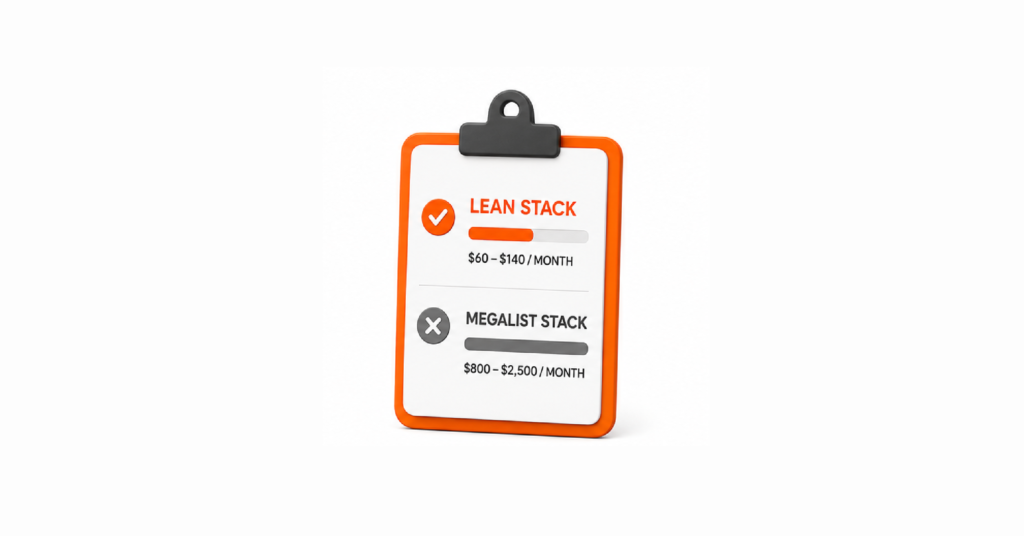
The best GTM tools for early stage startups are not the tools with the most features. They are the ones that solve the biggest customer or revenue problem you have right now.
At pre-seed, that can be a spreadsheet, a CRM, a calendar, or one focused research tool.
What Belongs in a Pre-Seed GTM Stack?
A useful early stack covers nine areas:
Targeting, discovery, sales capture, pricing, deal enablement, security, activation, distribution, and metrics.
The mistake is buying software for all nine before you know which problem needs attention.
Tinova’s Customer Readiness framework starts with customer evidence before building a larger growth system. The same idea works for your software stack: diagnose the gap first, then buy for that gap.
The Lean Stack, Leak by Leak
| Leak | Start With | Buy Later When |
| Targeting | ICP list + LinkedIn | Prospect research becomes a recurring task |
| Discovery | Buyer-question research + useful pages | You need a larger content system |
| Sales | Free CRM + calendar | More reps or automation need support |
| Pricing | WTP interview notes + spreadsheet | Pricing complexity requires software |
| Deal enablement | Proposal + Champion Kit | Several people need the same sales assets |
| Security | Security overview + policies | A buyer requires formal compliance work |
| Activation | Free event tracker + onboarding checklist | Customer volume makes manual tracking hard |
| Distribution | One channel test | The first channel shows repeatable results |
| Metrics | Four-number spreadsheet | Reporting needs several connected data sources |
The trigger matters more than the tool.
Targeting: Start With 20 Good Accounts
Do not start with a giant database.
Build a list of 20 companies that closely match your target customer and record why each one belongs there.
Your list should answer:
- Who is the buyer?
- What problem makes them relevant?
- What trigger makes now a good time to contact them?
Tinova’s 30-Prospect Test follows the same principle: start small, talk to qualified prospects, and use the results to improve the sales motion.
Discovery: Answer Buyer Questions Before Publishing More Content
Your discovery stack does not need a large SEO platform on day one.
Start by identifying the questions your target customer asks during research, then create useful pages that answer them directly.
One strong answer to a buyer’s question is more useful than ten pages written only to increase the publishing count.
Sales Capture: Keep the CRM Simple
A founder-led sales process needs three things:
Lead record + next action + calendar.
A free HubSpot CRM or another basic CRM can handle early tracking. You do not need a sales engagement suite before you have enough prospects to justify one.
Your CRM should tell you:
Who contacted us? What happened? What happens next?
That is enough to prevent leads from disappearing in an inbox.
Pricing: Use Conversations Before Pricing Software
At pre-seed, pricing is still a hypothesis.
Use a simple interview tracker and record:
Current alternative → customer value → price reaction → buying timing
Tinova’s SaaS pricing guide recommends using real pricing conversations to test willingness to pay rather than waiting for perfect data.
Put a price in front of a buyer before paying for software to analyze pricing.
Deal Enablement: Give the Champion What They Need
You may win the demo and still lose the deal because the person on the call is not the final decision maker.
Create a simple Champion Kit containing:
- One-page business case
- ROI example
- Security overview
- Common objections and answers
A sales portal can wait until several people need to use and maintain the same materials.
Security: Buy Compliance Software When the Requirement Becomes Real
Start with a security overview, policies, and a clear explanation of your current status.
Wait on tools such as Vanta, Drata, and Secureframe until a buyer or procurement process gives you a reason to move faster.
“We may need SOC 2 someday” is not the same as “our buyer requires SOC 2 this quarter.”
Activation: Measure Value Before Adding More Analytics
For a small customer base, use:
One activation event + free event tracking + onboarding checklist + customer conversations.
You need to know whether customers reached the outcome they bought the product for.
More dashboards do not answer that question by themselves.
Distribution: Run One Channel Properly
Five channels at 20% effort each can leave you with five weak experiments.
Tinova’s Pre-Seed Marketing Channel guide recommends choosing one high-intent channel, one defined audience, one primary metric, and a focused test before adding another.
Y Combinator’s Essential Startup Advice also emphasizes talking to users and focusing early effort on learning what customers need.
A founder who understands one working channel has more useful information than a founder running five channels with no clear result.
Metrics: Four Numbers Are Enough to Start
Track:
ACV
Sales cycle
Conversion rate
CAC
Label each as Observed, Inferred, or Assumed.
Tinova’s current GTM framework uses this structure to separate evidence from estimates. It helps prevent an early number from being presented as a proven benchmark.
For the economics behind the stack, Tinova’s Business Foundation also makes a useful point: if the numbers do not work at 10 customers, more marketing will not make them work at 100.
The 20-Tool Skip List
These tools can solve legitimate problems. The point is to wait until the problem is large enough to justify the software.
| Tool / Category | Wait Until |
| Salesforce Sales Cloud | A dedicated sales team needs it |
| HubSpot Sales Hub paid | Free CRM limits the workflow |
| Outreach | Outbound volume needs sequencing |
| Salesloft | A sales team needs automated sequences |
| Marketo | Marketing automation has real list volume |
| Drift | Conversational demand justifies it |
| Intercom | Support and product messaging need a larger system |
| Paid Amplitude | Free analytics no longer answers key questions |
| Paid Mixpanel | Product analysis requires deeper reporting |
| ChartMogul / Baremetrics | Recurring revenue reporting needs dedicated software |
| Vanta / Drata / Secureframe | A buyer creates a compliance deadline |
| Pendo / Appcues | Manual onboarding no longer works |
| Apollo paid | A proven outbound motion needs more data |
| ZoomInfo | Target-account research needs enterprise-scale data |
| Metabase / Looker | Several data sources need a BI layer |
| Gainsight / ChurnZero | A customer-success team needs a dedicated system |
| Gong / Chorus | Multiple sellers need call analysis |
| 6sense / Demandbase | Enterprise account-based marketing is justified |
| Ahrefs / Semrush paid | SEO operations need deeper competitive analysis |
| Sprout Social / Hootsuite | Several active social channels need centralized management |
Skip does not mean never. It means the trigger has not arrived yet.
The Stack Audit
Give yourself one point for each true statement:
| # | Check | Score |
| 1 | We can name our target customer clearly | 1 |
| 2 | We have a focused prospect list | 1 |
| 3 | Every lead has a next action | 1 |
| 4 | Our price has been tested with buyers | 1 |
| 5 | Our proposal answers common objections | 1 |
| 6 | We know our security requirement | 1 |
| 7 | We can measure customer activation | 1 |
| 8 | We are testing one main channel | 1 |
| 9 | We track four core GTM numbers | 1 |
| 10 | Every paid tool has a clear job | 1 |
| 11 | We know which tool we could cancel | 1 |
| 12 | We know what event would justify the next tool | 1 |
| 13 | No enterprise software was bought just because it is popular | 1 |
| 14 | Our CRM shows every active opportunity | 1 |
| 15 | We can explain where our numbers came from | 1 |
12 to 15: Your stack fits the stage.
8 to 11: Review what you are paying for.
4 to 7: You have tool gaps and customer-readiness gaps. Fix the highest-risk one first.
0 to 3: Start with a spreadsheet, CRM, calendar, and customer conversations.
One Tinova Proof Point
Tinova’s results library reports 200 startups diagnosed, 77+ businesses scaled, 3 industry awards in 2026, and $10M in client pipeline built. Its case studies name the client, state the timeframe, explain what was built, and distinguish pipeline from revenue. (See the Tinova results library)
One example is Tahira Collection, where positioning was narrowed to one audience instead of five and the launch produced $10K in the first 48 hours before paid spend began.
The lesson for GTM software is simple:
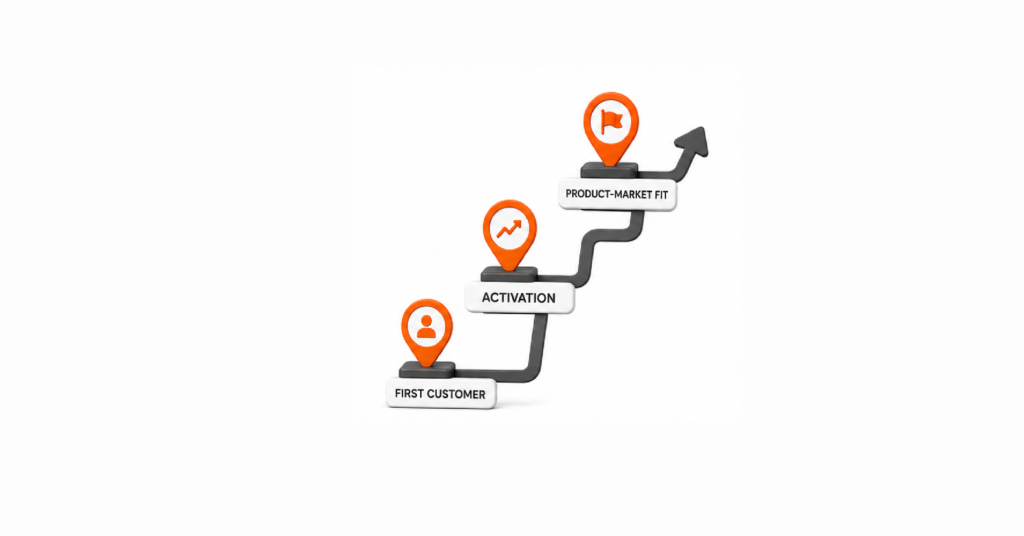
Fix the commercial decision before adding the software that supports it.
When Should You Add Another Tool?
Buy the next tool when you can answer three questions:
What problem does it solve?
What does the current process fail to do?
What evidence says the problem is large enough to pay to solve?
That keeps your stack connected to the business instead of the other way around.
FAQ
What are the best GTM tools for early-stage startups?
Start with a simple CRM, calendar, prospect list, customer research system, analytics free tier, and spreadsheet. Add specialist tools when a specific workflow becomes difficult to manage manually.
How many GTM tools does a pre-seed startup need?
There is no universal number. A small founder-led company can cover targeting, sales, pricing, activation, distribution, and metrics with a handful of low-cost tools and manual processes.
What GTM tools should startups avoid at pre-seed?
Avoid buying enterprise sales, marketing, analytics, customer-success, and compliance platforms before the underlying workflow needs them. The 20-tool Skip List above gives practical triggers.
Should a startup buy an all-in-one GTM platform?
Usually, no. Different GTM problems require different workflows, and an all-in-one platform can create more setup than value when the customer process is still changing.
When should a startup start paying for GTM software?
Pay when a recurring problem is costing enough time, revenue, or accuracy to justify the subscription. The business problem should create the buying trigger.
Ready to Audit Your GTM Stack?
The best GTM tools for early stage startups are the ones that solve a problem you can already see.
Start with the customer, define the leak, choose the smallest useful tool, and set the trigger for the next upgrade.
Tinova’s free GAP Analysis uses the same diagnosis-first approach to rank the biggest leaks by revenue impact before recommending what to build.
Written by: Tinova Growth Team
Tinova is a marketing and growth agency for startups and owner-led businesses. Its official site reports 200 startups diagnosed, 77+ businesses scaled, 3 awards in 2026, and $10M+ in client funding pipeline built.
Updated: September 24, 2026
Review Focus: Repeatable revenue, retention, customer acquisition cost, business durability, product-market fit.