
Most founders pick a price without realizing it commits them to a GTM motion. If your price is $49/month, you can’t afford a sales team. Here’s how to align price and motion before you waste runway.
Does Your Price Support Your Motion? The GTM Decision Most Pre-Seed Founders Skip
“We’ll start with a free trial, convert users to a $29/month plan, then hire a sales team once we reach 500 customers.”
It sounds like a solid plan, but there’s a problem. A $29 monthly price can’t support a sales team. The economics break long before you hire your first salesperson. Pricing and go-to-market motion aren’t separate decisions. They have to work together.
This article explains how to match your pricing with the right GTM motion. You’ll learn why adding sales too early fails, the two most common pricing and GTM mistakes, and how to present a pricing strategy investors can trust.
The 11-month number, and why it misleads founders
ChartMogul found that SaaS companies adding a sales motion to a product-led growth (PLG) model see an early revenue boost. But after about 11 months, churn rises and growth slows.
The product wasn’t built for a sales-led buying journey, so customers acquired through sales leave faster than self-serve customers.
Many founders copy competitors without realizing they’re copying a different business model. The 11-month mark is when early sales gains begin to disappear and the self-serve engine starts losing momentum. At pre-seed, you can’t afford to learn that lesson too late.
Why price sets the speed
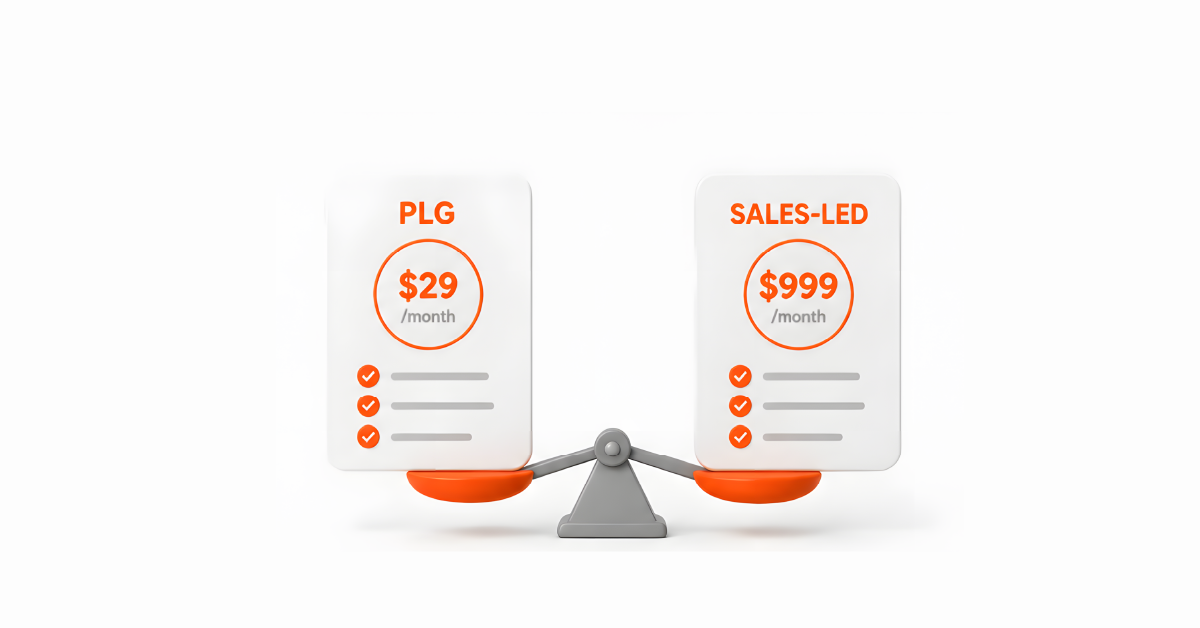
Your price determines how much you can spend to acquire a customer. A $50/month product with a 12-month lifetime generates a $600 LTV. At a 3:1 LTV:CAC ratio, your allowable CAC is $200.
That’s nowhere near enough to support an outbound sales team. Your price determines your GTM motion, growth speed, and economics.
As we explain in our CAC estimates guide, founder-led outbound can work for a $1,000/month enterprise product because the LTV supports it.
For a $20/month SaaS, the economics don’t work. Pricing and GTM aren’t separate decisions. They’re the same strategy.
What the data says about layering sales too early
ChartMogul’s research shows that adding a sales team before reaching $2M ARR can slow growth.
It pulls time and resources away from improving the product and self-serve experience, while sales-acquired customers tend to churn more than self-serve customers.
Hiring sales before finding a repeatable motion increases the cost of learning.
ChartMogul also found that the strongest companies master one GTM motion before adding another. The same applies to sales-led businesses.
At pre-seed, focus on the motion that fits your price and how your customers buy instead of trying to run multiple GTM motions at once.
The two failure modes
Founders make two common pricing and GTM mistakes. The first is a low-priced product with a sales team the business can’t afford.
The second is a complex product expected to sell through self-serve. Both waste time and money.
Low price, sales-led motion: A founder on r/startups priced their SaaS at $49/month and hired a salesperson. The rep cost $70,000 a year, and even with 10 deals a month, the economics didn’t work. Raising prices later pushed existing customers away. The price called for a self-serve model from the beginning.
Complex product, self-serve motion: A high-value B2B product that requires security reviews, procurement, and multiple decision-makers won’t sell through a self-serve funnel alone.
Enterprise buyers expect a conversation. If your product costs $10,000 per year, your GTM motion should support that buying process.
The table below shows which GTM motion fits different pricing levels.
Monthly Price | Annual Contract Value | Viable Motion | Reason |
Under $50 | Under $600 | Self-serve PLG only | CAC cannot support human touch |
$50–$250 | $600–$3,000 | Self-serve with light-touch sales assist | CAC allows some human intervention at scale |
$250–$1,000 | $3,000–$12,000 | Inside sales, founder-led | LTV supports a dedicated rep |
$1,000+ | $12,000+ | Field sales, enterprise | High-touch, multi-stakeholder motion viable |
The pre-seed version: You don't have an ASP. You have a hypothesis.
At pre-seed, you don’t have an Average Selling Price (ASP). You have a pricing hypothesis. That hypothesis determines your go-to-market (GTM) motion. If your price and motion don’t match, your GTM strategy starts with the wrong assumptions.
The Sourcing Rule applies here. Every number in your GTM plan should come from a customer conversation or a clearly labeled assumption. Your price is the assumption. Your GTM motion is the result of that assumption.
If you believe customers will pay $500 per month, you’re also assuming a founder-led or sales-assisted motion. If you’re unsure, test the price before committing to the motion.
The question to ask instead
Instead of asking “PLG or sales-led?” ask, “What price supports the GTM motion we can run with our current resources?” That question turns strategy into simple economics. If you’re a two-person team, your realistic options are founder-led sales or self-serve. Your price should support that choice.
Successful pre-seed startups choose one GTM motion and set a price that fits it. They don’t try to do everything at once.
Price is also a way to define your market. Your High-Expectation Customer (HXC) will pay more because they feel the problem more deeply than a casual user.
Putting it in the deck
Your pitch deck should clearly explain: “We priced at X, which supports GTM motion Y and carries risk Z.” This shows investors that your pricing, GTM strategy, and risks are connected.
For example: “We priced at $99/month, so we’re using a product-led growth (PLG) motion. Our biggest risk is self-serve conversion, which we’ll test with a 100-user waitlist before investing in customer acquisition.”
Or: “We priced at $1,200/month, so we’re using founder-led sales. Our biggest risk is relying on the founder, so we’ll document the sales process within 90 days before making our first sales hire.”
This level of clarity gives investors confidence that you understand your GTM strategy, customer acquisition costs, and the risks behind your pricing decisions.
FAQs
What is the difference between PLG and sales-led GTM?
Product-led growth (PLG) lets the product acquire and convert customers with little human involvement. Sales-led GTM relies on a sales team to close deals. The right motion depends on your price and how your customers buy.
How does pricing affect go-to-market strategy?
Pricing determines how much you can spend to acquire a customer. Lower prices fit self-serve models, while higher prices can support sales-led growth. Your pricing and GTM motion should always match.
Can a startup use both PLG and sales-led motions?
Yes, but not at the beginning. Most pre-seed startups should master one GTM motion first. Once it’s repeatable, you can expand to another motion.
When should a SaaS startup add a sales team?
Add a sales team when your pricing supports it, your sales process is repeatable, and growth is limited by capacity, not demand. For many SaaS companies, this happens after $1M to $2M ARR.
How do I choose the right GTM motion for my SaaS product?
Start with your pricing. Estimate what customers will pay, then choose the GTM motion your economics can support. Don’t copy another company’s playbook. Build one that fits your business.
Your pricing and GTM motion are one decision. Test both with real customers, explain the risks clearly, and show investors how your strategy works.
Ready to match your pricing with the right GTM motion? Book an Investor Readiness Audit.
Further Reading
- What CAC Actually Means Before You Have Customers – How to build a defensible CAC estimate when you have zero customers, and why your time must be in the math.
- The Sourcing Rule: Researched Assumption or Fantasy Spreadsheet? – Every number in your deck must trace to a real buyer or an explicitly labeled assumption with a test.
- Which Slice Is Yours? Define Your First Customer Segment – How to pick the narrow, winnable customer segment that makes your GTM credible.
Topics: