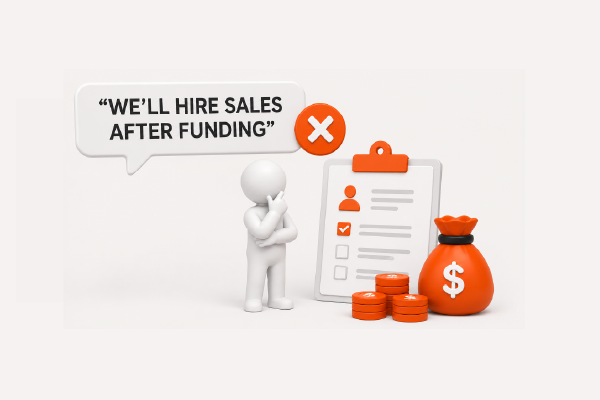

Saying “we’ll hire sales after funding” is a red flag. Before you do, run the 30-prospect test. It takes two weeks and tells you if your GTM actually works.

The 30-Prospect Test: Why Founder-Led Sales Is a Risk Test, Not a Sales Tactic
“I sent 40 cold emails and got zero replies. No one cares about this product.”
A founder shared this after testing a polished deck and working prototype with real prospects. The problem wasn’t the product. It was the message. The lack of response became the clearest customer signal.
The 30-prospect test is a two-week exercise that helps founders stop guessing and start learning. Founder-led sales isn’t about becoming a salesperson. It’s about proving that the problem is real, the right buyers are reachable, and your message connects.
If reaching 30 prospects feels impossible, sending messages to thousands won’t fix your go-to-market strategy.
Founder-Led Sales Is Not About Being the Best Salesperson
Many founders hear they should sell because they know the product best. That’s true, but it misses the bigger purpose.
At the pre-seed stage, founder-led sales is a risk test, not a scaling tactic. It helps you learn if the problem is urgent, whether you can reach the right buyers, and if your message gets a response.
As Forum Ventures explains, early sales should focus on learning, not growth. You are not trying to close dozens of deals. You are proving that a repeatable sales process is possible.
Techstars puts it clearly: “Your first sales hire is probably a mistake.” The reason is simple: founders need to validate the sales process before handing it to someone else.

What you actually have at pre-seed
At pre-seed, you have a hypothesis, not a market. You have an idea of who might buy, a problem you’re testing, and a product that’s still evolving. You don’t yet have a proven channel, repeatable sales process, or reliable CAC. That’s normal. The 30-prospect test turns those assumptions into evidence.
apwave’s founder-led sales tactics explain that early outreach should be manual and personal. You’re not building a pipeline yet. You’re validating the problem and learning what buyers actually need.
The 30-prospect test, step by step
The 30-prospect test has four steps: find 30 ideal prospects, send each a personal message, track every response, and learn from the results. It takes about two weeks, costs only your time, and gives you real customer insight.
Find 30 ideal prospects
Choose 30 people who closely match your ideal customer profile, not 300. If finding 30 qualified prospects feels difficult, your ICP is likely too broad.
Write a personal message
Skip templates. Mention their specific context, the problem you believe they face, and ask a simple question that starts a conversation. The goal is a reply, not a pitch.
Track every response
Record who replied, ignored you, declined, or asked questions. The quality of replies matters as much as the response rate. Their words reveal whether the problem is important.
Learn from the outcome
No replies? Your message may not match a real pain point. Replies from the wrong people? Your ICP needs work. Interest that fades? Your value proposition may be weak. The test validates your ICP, messaging, and pain urgency at the same time.
One founder on r/startups turned 0 replies from the first 30 emails into 6 discovery calls after rewriting the message based on buyer feedback. The failure wasn’t the channel. It was valuable customer data.
The four questions the test answers before funding
The 30-prospect test answers four questions every investor cares about: Can you find your ideal customer? Does the problem matter? Does your message get real responses? And do the conversations follow a repeatable pattern? These answers carry more weight than early revenue projections.
The table below shows what each outcome tells you and what to do next:
Test Outcome | What It Tells You | Next Step |
Low response rate (under 10%) | Message doesn’t resonate or wrong audience | Rewrite your outreach note; tighten ICP definition |
High response but no follow-up calls | Problem is mild, not acute | Re-evaluate problem urgency; ask different questions |
Some replies, requests to talk | Problem resonates with a subset | Double down on that subset; refine ICP |
Multiple discovery calls with genuine interest | Strong signal of repeatable demand | Move to pilot/LOI discussions; document pattern |
What investors are listening for
Investors don’t focus on early revenue. They look for proof of a repeatable sales motion. They want to hear that you spoke to real prospects, uncovered objections, and found clear patterns. Saying, “I spoke to 30 prospects and here’s what I learned,” is far stronger than “We’ll hire sales after funding.”
That statement tells investors you validated demand yourself instead of expecting a sales hire to do it. Founders who do the early, hands-on work earn more trust.
Also, don’t confuse a large waitlist with real demand. Signups are only interest. Customer conversations reveal buying intent and readiness. That’s why the 30-prospect test is a stronger signal than vanity metrics.
The counter-argument worth taking seriously (Sandy Kory)
Sandy Kory argues that founder-led sales and marketing can become a distraction if they consume your time without creating a repeatable system. It’s a valid point. The 30-prospect test avoids this by being time-boxed: 30 prospects, two weeks, then review the results. It’s a structured experiment, not a long-term sales strategy.
In his founder-led marketing, article, Kory warns against getting stuck in endless manual outreach. The 30-prospect test gives you a clear outcome: either you’ve found a repeatable motion you can build on, or you’ve identified what needs fixing before investing more time or money.
Run the test this week
You don’t need a CRM, a budget, or a sales coach. Find 30 prospects, send a personal message, and track every response. Within two weeks, you’ll have more valuable GTM insight than weeks of planning.
If the test exposes a problem, you’ve avoided spending funding on a broken motion. If it confirms demand, you’ll have evidence investors want to see.
The 30-prospect test isn’t about sales. It’s about finding the truth. And at pre-seed, that truth is more valuable than any number on a pitch slide.
FAQs
What is founder-led sales for pre-seed startups?
Founder-led sales means founders handle early customer conversations themselves to validate demand, improve messaging, and gather real market feedback. It’s a learning process, not a scalable sales function.
How do you get your first 30 customers as a startup?
Start with the 30-prospect test. Identify 30 ideal prospects, send personalized outreach, track responses, and learn from the patterns. The goal is customer conversations, not immediate sales.
What are common founder-led sales mistakes?
The biggest mistakes are treating early sales as scaling instead of learning, using generic templates, and hiring sales before proving a repeatable motion.
Should founders do sales before hiring?
Yes. Founders should lead the first customer conversations to understand pain points, objections, and buyer language. Once the process is repeatable, a sales hire can scale it.
Is “doing things that don’t scale” still relevant?
Yes, especially at pre-seed. Manual outreach like the 30-prospect test gives you real customer insight and helps validate a repeatable GTM motion before you scale.
Founder-led sales is the fastest and lowest-cost way to test demand. Spend two weeks learning from real prospects instead of guessing. That’s the evidence investors trust.
→ We help founders run the 30-prospect test and turn the results into a GTM story investors believe. Book an Investor Readiness Audit.
Continue reading for deeper insights on customer validation, traction, and fundraising at the pre-seed stage.
- Hiring sales after funding
- 1,000 Signups Is Not Traction: Why Your First Users Give You Fake Confidence
- PLG vs Sales Led Pricing: Does Your Price Support Your Motion?

Topics: