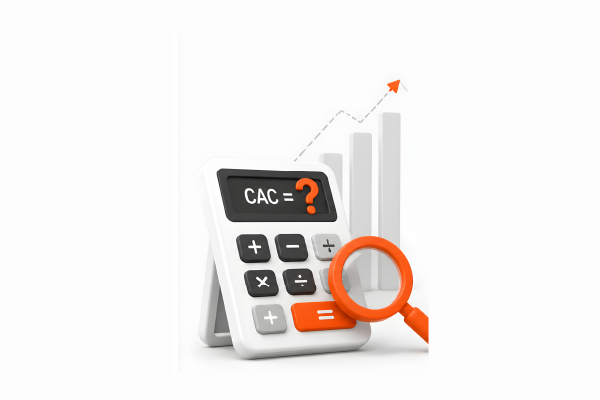
At pre-seed, your CAC number is fake. Investors want your reasoning, not a precise figure. Here’s how to build an estimate that includes founder time and holds up to scrutiny.
What CAC Actually Means Before You Have Customers
“So, what’s your CAC?”
If you’re pre-seed with no customers, that question can catch you off guard. The standard Customer Acquisition Cost (CAC) formula divides sales and marketing spend by new customers. With zero customers, it tells you nothing.
This article explains why the standard CAC formula doesn’t work at the pre-seed stage, what investors actually want to hear, and how to build a defensible CAC estimate by treating founder time as a real cost. We call this the Reverse CAC Estimate.
What Is the Formula Everyone Teaches, and What Does It Assume?
The standard Customer Acquisition Cost (CAC) formula is total sales and marketing expenses ÷ new customers acquired. It assumes you already have enough customer data to calculate an average.
At the pre-seed stage, that data does not exist, so the formula provides little value.
HupSpot for Startups defines CAC as the total cost of acquiring a customer, including sales and marketing expenses, divided by the number of new customers. That works for businesses with steady sales, but not for startups with zero customers.
If you force the formula, you’ll end up with an undefined number or made-up conversions. One founder on r/startups admitted they had no idea how to answer the CAC question
The investor was not looking for a perfect number. They wanted to know whether the founder understood how customer acquisition will work and what it will cost.
What Is the Investor Really Asking?
At the pre-seed stage, investors are not looking for an exact CAC number. They want to understand your thinking behind the unit economics. Can you explain what it may cost to acquire a customer, what that customer is worth, and whether the business can become sustainable?
Mike Lingle’s LinkedIn post about backwards LTV-to-CAC arithmetic explains this well: “For a pre-revenue startup, you work backwards from LTV to figure out what CAC you can afford.” Investors care less about the number and more about the reasoning behind it.
They want to see you’ve connected pricing, margins, retention, and acquisition costs into a realistic plan.
Why Isn't Your CAC Zero If You Have No Marketing Spend?
Many founders say their CAC is $0 because they are not paying for marketing. That is misleading. Founder time is the biggest customer acquisition cost at the pre-seed stage. Ignoring it gives an unrealistic view of your unit economics.
Founder Time Is a Real Cost
Claiming “$0 marketing spend” sounds efficient, but it leaves out the value of your time. Hours spent on outreach, demos, and follow-ups are all part of customer acquisition. That time could have been spent building the product or growing the business.
Founder-Led Sales Has a Cost
Tango.vc’s deep dive on early CAC explains that founder-led sales is the main acquisition cost for early-stage startups. For example, if a founder’s annual salary is $120,000 and half of their time goes to customer acquisition, that’s $60,000 in acquisition cost. Acquiring 10 customers would make the founder-driven CAC $6,000, not zero.
Don’t Ignore Indirect Costs
Direct costs like tools, travel, ads, and contractors are easy to track. Indirect costs, such as time taken away from product development and strategy, also affect your true CAC. A realistic CAC includes both, giving investors a clearer picture of whether your business can scale.
How to Build a CAC Estimate With No Customers
You can’t calculate Customer Acquisition Cost (CAC) without customers, but you can build a Reverse CAC Estimate. Start with price, gross margin, and customer lifetime, then work backwards to estimate a realistic CAC. Treat every number as an assumption until you have real customer data.
Start With Price and Margin
Use your expected monthly price as the starting point. Then apply a conservative gross margin, such as 80%. For example, a $200 monthly plan with an 80% margin leaves $160 per month to cover acquisition costs and profit.
Estimate Customer Lifetime
Without retention data, use a cautious estimate of 12 to 18 months. For a $200 monthly plan over 12 months, your LTV is about $1,920 using an 80% margin.
LTV = Monthly Price × Gross Margin × Customer Lifetime
Work Back to Target CAC
A common benchmark is an LTV:CAC ratio is 3:1. That means your target CAC should be about one-third of your LTV. If your LTV is $1,920, a reasonable target CAC is around $640. This is not a fixed rule. It is a practical way to test whether your unit economics make sense.
Label Every Number as an Assumption
At the pre-seed stage, price, margin, retention, and CAC are all assumptions. Be clear about each one and explain how you’ll validate it with real customer data. Investors trust transparent reasoning more than a made-up CAC figure.
The table below shows a sample Reverse CAC Estimate for two different pricing models:
Input | Scenario A: SMB SaaS | Scenario B: Enterprise SaaS |
Monthly price | $100 | $1,000 |
Gross margin (assumed) | 80% | 90% |
Customer lifetime (months, assumed) | 18 months | 36 months |
LTV | $100 × 0.80 × 18 = $1,440 | $1,000 × 0.90 × 36 = $32,400 |
Target CAC (1/3 LTV) | ≤ $480 | ≤ $10,800 |
Founder time cost (annual, assumed $120k salary, 50% allocation) | $60,000 | $60,000 |
Customers acquired per year (target) | 20 | 10 |
Founder-driven CAC | $3,000 | $6,000 |
Viability comment | Founder CAC far exceeds target, need lower-touch channel or higher volume | Founder CAC within target range if 10 customers achieved |
What Does a Reasonable CAC Look Like by Stage and Channel?
Customer Acquisition Cost (CAC) depends on your industry, acquisition channel, and deal size. At the pre-seed stage, compare yourself with other early-stage startups, not large public companies. Culta’s 2026 CAC benchmarks offer a useful starting point.
Channel | Pre-seed / seed CAC range (early data) |
Founder-led outbound | $500 – $5,000 |
Content / SEO (mature) | $100 – $500 (after 12+ months) |
Paid ads (small scale) | $800 – $3,000 |
Events / community | $200 – $1,500 |
Partnerships | $1,000 – $10,000 |
Early-stage CAC is expected to be higher because you’re still validating your market and process. What matters most is the LTV:CAC ratio, not the CAC alone. For example, a $3,000 CAC is a strong result if your LTV is $30,000.
Why Is a High Early CAC the Right Answer?
A high CAC at the pre-seed stage is normal because you’re still learning how to acquire customers. If your estimated Customer Acquisition Cost looks very low, you’ve likely left out important costs.
Investors expect early CAC to improve as your sales process becomes more efficient.
Avoid lowering your CAC just to make the business look better. A realistic CAC estimate, combined with a clear plan to reduce it, is far more credible.
For example: “Our first 10 customers cost about $5,000 each through founder-led sales. We expect that to decrease to $1,000 as we build case studies, referrals, and a smoother onboarding process.” A believable explanation matters more than an unrealistically low number.
Don't Defer the Work
CAC reasoning is more than a calculation. It helps you test whether your pricing, margins, and customer acquisition strategy can build a sustainable business. Doing this before you have customers can help you spot problems early.
Waiting until you have “enough data” creates a false sense of confidence. It can delay discovering that your pricing is too low, your sales cycle is too long, or your acquisition costs are too high.
As we explain in our article on vanity metrics, numbers can look good while hiding bigger problems. A Reverse CAC Estimate helps you identify those risks early.
FAQs
How do I estimate CAC for a pre-revenue startup?
Use a Reverse CAC Estimate. Start with your price, gross margin, and estimated customer lifetime, then work back to a target CAC of about one-third of LTV. Include founder time and sales tools, and treat every input as an assumption until validated.
What are typical CAC benchmarks for seed-stage SaaS?
CAC depends on the acquisition channel. Founder-led outbound ranges from $500 to $5,000, paid ads from $800 to $3,000, and SEO/content from $100 to $500 after it matures. Investors care more about a healthy LTV:CAC ratio than the CAC alone.
Should I include my time in CAC?
Yes. Founder time is a real customer acquisition cost. Leaving it out makes your unit economics look better than they really are.
What is a good LTV:CAC ratio for a startup?
A common benchmark is 3:1 or higher. Your customer’s lifetime value should be at least three times your acquisition cost. At the pre-seed stage, you can estimate this using clear assumptions.
Can my CAC be zero at the pre-seed stage?
No. Even without marketing spend, your time has value. A $0 CAC ignores that cost and gives a misleading picture of how your business will scale.
Your CAC estimate at the pre-seed stage is based on assumptions. Your reasoning is what builds investor confidence. Work backwards from your customer’s value, include founder time, and clearly label every assumption with a plan to test it.
This approach not only prepares you for investor questions but also shows whether your business model can grow beyond founder-led sales.
We help founders build CAC estimates they can confidently explain to investors. Book an Investor Readiness Audit.
Continue reading for deeper insights on customer validation, traction, and fundraising at the pre-seed stage.
- The Sourcing Rule
Topics: