Welcome to our series on building and growing a startup.
Starting a business involves more than having a good idea. From understanding what your business needs to improving your offer, developing the right skills, validating demand and acquiring customers, each stage brings different decisions.
Explore the articles in this series:
Part 1: If You Had 30 Days to Work on Your Startup, What Would You Work On?
Part 2: How to Make Your Offer Clear to Potential Customers
Part 3: What Skills Do You Need to Run a Startup?
Part 4: How to Validate a Startup Idea Before Building a Product
Part 5: How to Get Your First Customers as a B2B Startup Founder
Part 6: How to Build a Repeatable Sales Process for Your Startup ← This post
Let’s get into it.
How to Build a Repeatable Sales Process for Your Startup
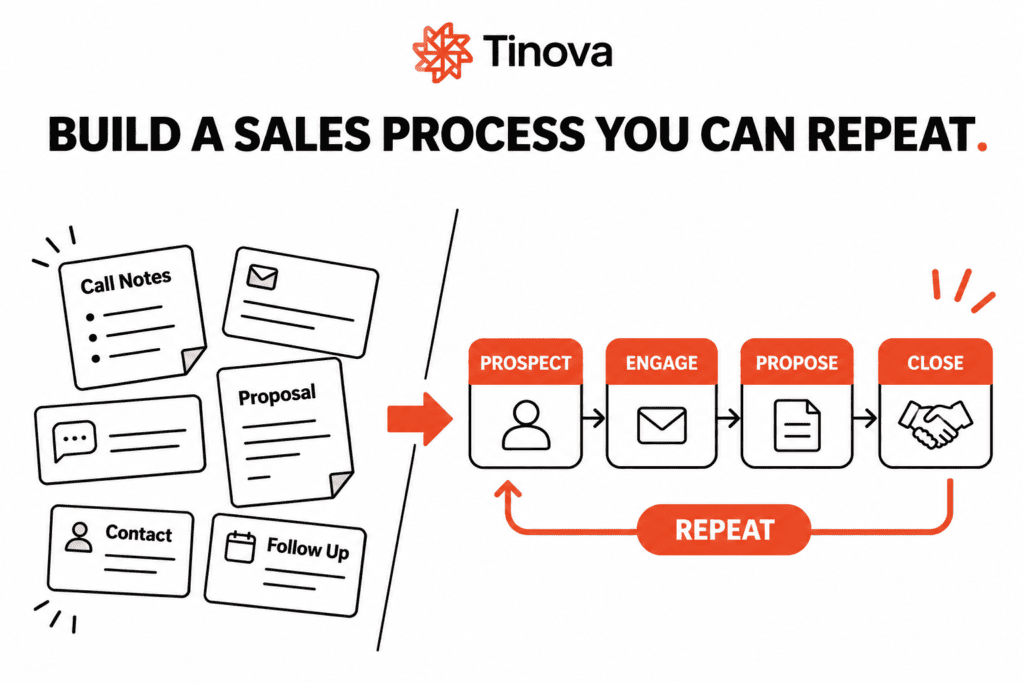
You’re closing deals, but you can’t explain exactly why.
One customer came through a referral. Another bought after a demo. You manage every sales conversation, follow up when you remember and keep important deal details in your head.
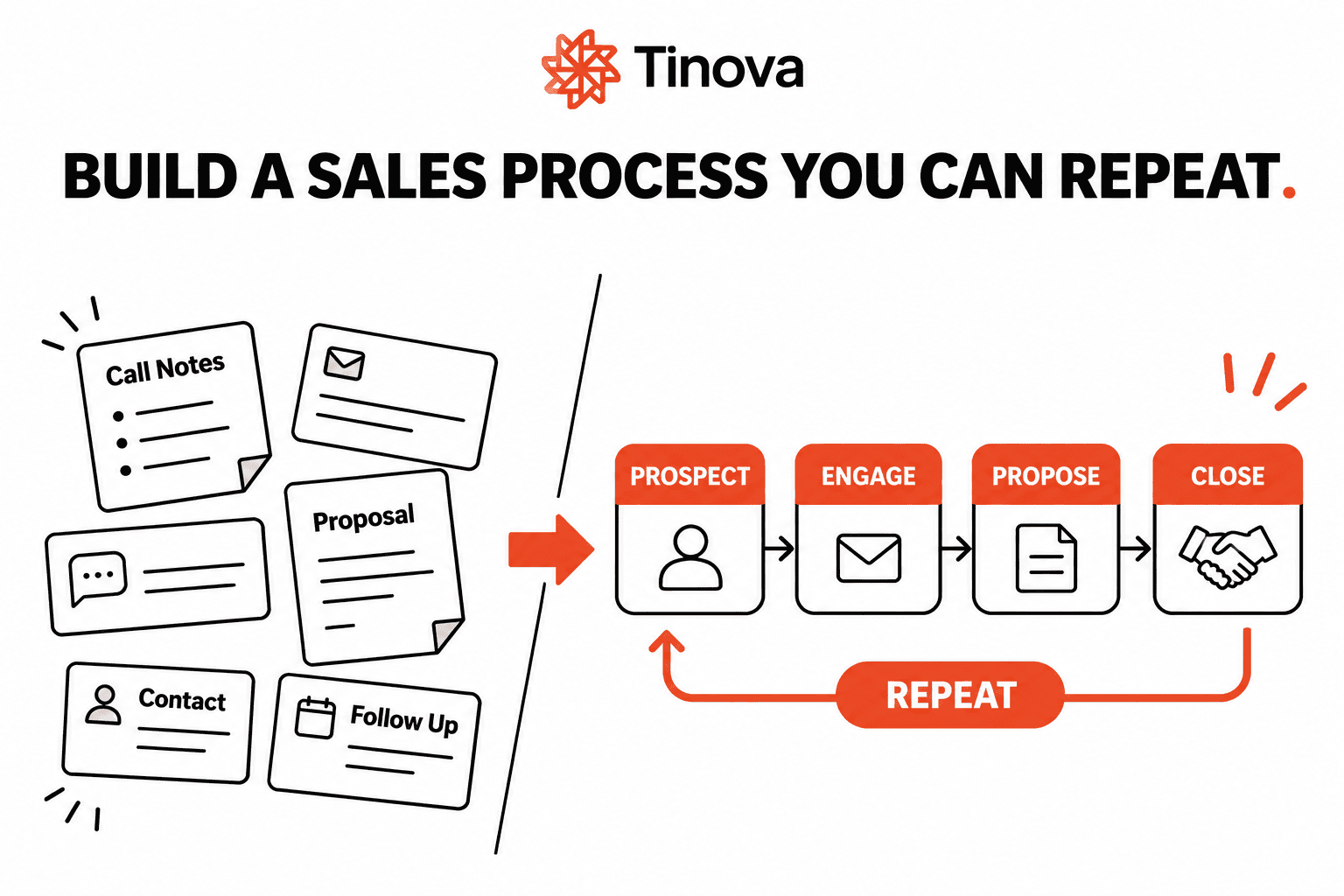
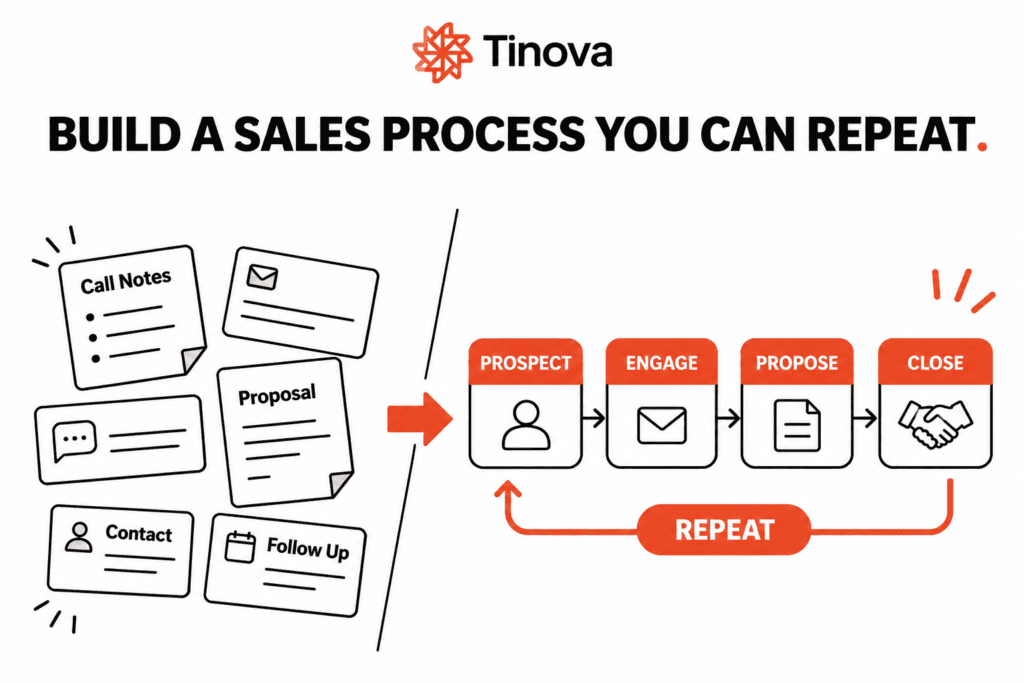
Building a repeatable sales process for startups involves understanding how customers buy, defining sales stages, documenting your approach and identifying where opportunities stall.
Your sales process defines the steps toward a purchase, while your sales methodology determines how you sell at each step.
The goal is to understand what works and build a process you can repeat, improve and eventually delegate.
Start With How Your Existing Customers Bought
Before creating sales stages or choosing a CRM, review up to ten recent opportunities, including won, lost and stalled deals. If you have fewer, start with what you have.
Review emails, call notes, proposals and invoices.
Ask yourself:
- What problem made the buyer look for a solution?
- What triggered their decision to act?
- What did your paying customers have in common?
- Who approved the purchase?
- What helped or prevented the deal from progressing?
Use recurring patterns to refine your ideal customer profile (ICP) and identify which buyers are worth pursuing.
Distinguish repeatable buying patterns from exceptional circumstances, such as a personal referral. With limited sales history, treat your findings as assumptions to test rather than a proven formula.
Define Your Sales Stages and When a Deal Should Move Forward
Your B2B sales process should reflect how customers make purchasing decisions, not simply the tasks you complete.
A Five-Stage Sales Process for Startups
Use this sales process template as a starting point:
| Sales stage | What you do | Evidence required to progress |
| Prospecting | Identify and contact relevant buyers | Buyer agrees to discuss their needs |
| Qualification | Assess the problem, fit, urgency and buying ability | Relevant need and credible purchasing path are confirmed |
| Solution evaluation | Provide relevant proof, a demo or pilot | Buyer confirms the solution fits their requirements |
| Commercial decision | Discuss pricing, terms and approvals | Buyer agrees to proceed and remaining requirements are clear |
| Closing and handoff | Formalize the purchase and delivery commitments | Purchase is documented and onboarding begins |
The conditions required to advance an opportunity are called stage exit criteria.
Adjust these stages according to your product, pricing and customer purchasing requirements.
Measure Buyer Progress, Not Just Sales Activity
Completing a sales task does not necessarily bring a customer closer to buying.
| Sales activity | Evidence of buyer progress |
| Demo completed | Buyer confirms solution fit |
| Proposal sent | Buyer identifies the approver and agrees to a review date |
| Follow-up sent | Both parties agree on the next action |
| Contract shared | Buyer provides a documented purchase commitment |
If an agreed next step passes without buyer action, investigate what changed. Record declined opportunities as lost and deferred deals separately, with a reason and review date.
Create a Simple Sales Playbook for Each Stage
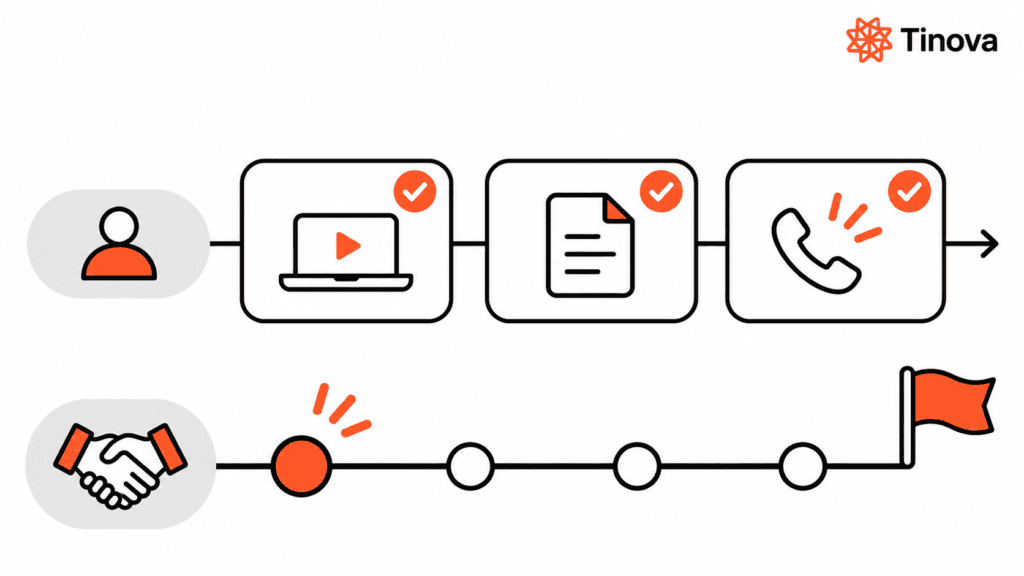
A startup sales playbook documents the information, actions and decisions needed at each stage.
Include qualification criteria, discovery questions, relevant proof, common objections, pricing boundaries, follow-up responsibilities and delivery commitments.
For lead qualification, start with these questions:
- What problem are you trying to solve?
- Why does it need attention now?
- What budget or approval is required?
- Who makes the purchasing decision?
Interest alone does not make someone a qualified buyer. If the problem falls outside your scope or there is no credible purchasing path, reconsider the opportunity.
One buyer may need a demo, while another needs a paid pilot. Standardize the decisions, not every conversation.
For help identifying suitable prospects, read our guide to B2B lead generation for startups.
Track Your Sales Pipeline Without Overcomplicating Your CRM
Your sales process defines how deals progress. Your sales pipeline shows where each opportunity currently stands.
Start with a spreadsheet or simple CRM.
| Field | What to record |
| Company and contact | Buyer and decision-makers |
| Current stage and evidence | Deal status and buyer-confirmed progress |
| Estimated deal value | Potential contract revenue |
| Main obstacle | What is preventing progress |
| Next action, owner and date | Responsibility and agreed deadline |
| Stage entry, start and closing dates | Time spent progressing and closing |
| Outcome and reason | Won, lost or deferred, and why |
Track three essential sales metrics:
- Stage conversion rate: (Opportunities advancing ÷ Opportunities entering the stage) × 100.
- Win rate: (Won deals ÷ All closed won and lost deals) × 100.
- Average sales cycle length: Total days from opportunity creation to purchase ÷ Number of won deals.
Compare opportunities from consistent time periods, allowing enough time for deals to progress. With small sample sizes, review actual deal counts alongside percentages.
Review Where Deals Stall and Fix the Underlying Problem
Knowing where deals stall does not automatically tell you why.
At Tinova, our approach starts with identifying where potential revenue is being lost. Increasing sales activity before understanding the problem can create more work without improving results.
| What’s happening | What to investigate | How to investigate |
| Few prospects respond | Targeting, messaging or channel | Review prospect fit and message relevance |
| Leads don’t qualify | Customer selection | Compare disqualification reasons |
| Qualified buyers don’t progress | Urgency or solution fit | Establish what makes solving the problem a priority |
| Demos don’t lead to offers | Requirements or perceived value | Ask what remains unresolved |
| Proposals remain undecided | Price, trust or approval | Confirm the outstanding concern and decision-maker |
| Customers leave after buying | Expectations or delivery | Compare sales commitments with customer feedback |
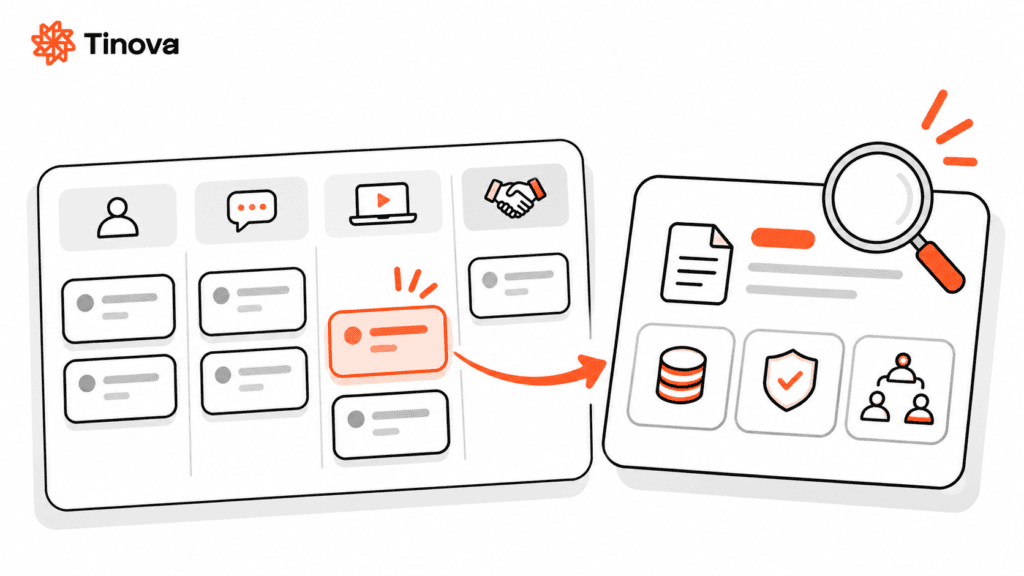
Review your pipeline each week. Identify which deals progressed, which stalled and what prevented movement.
Assign a next action to each active opportunity. When the same barrier appears across comparable deals, test one process improvement and review its effect.
Make Your Sales Process Work Without You
Hiring a salesperson does not automatically resolve an unclear sales process.
Before transferring responsibilities, establish three levels of sales process maturity:
- Documented: Stages, decisions and responsibilities are recorded.
- Repeatable: Comparable buying patterns produce sales across multiple opportunities.
- Transferable: Another person can manage opportunities with training and support.
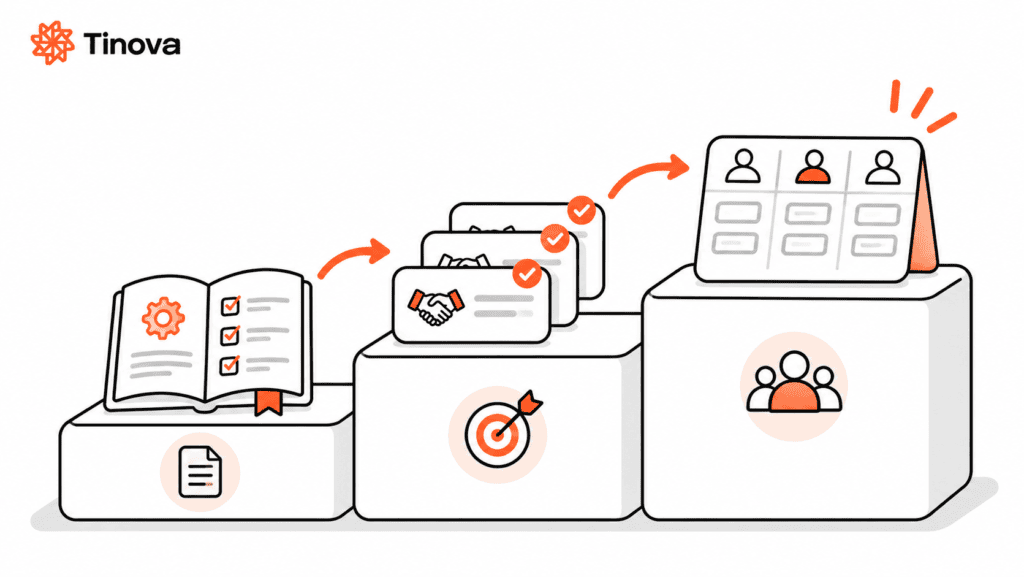
Begin by delegating deal tracking and follow-ups. Let someone observe discovery calls before leading them independently. Review their results before transferring pricing and closing responsibilities.
Automate repetitive tasks once the underlying process is understood.
If you’re considering expanding your sales team, use our guide to hiring your first salesperson.
A repeatable sales process doesn’t guarantee revenue. It helps you understand what works, improve what doesn’t and reduce dependence on founder-led sales.
If qualified buyers keep stalling and you cannot identify why, Tinova’s Free GAP Analysis can help you examine where potential revenue is being lost and decide what to fix before investing in more outreach, software or sales support.
Written by Tinova Growth Team
The Tinova Growth Team shares practical guidance for early-stage B2B founders working through positioning, marketing, sales and customer acquisition. Our articles focus on helping founders understand what’s holding their business back and what they can do next.