Welcome to our series on building and growing a startup.
Starting a business involves more than having a good idea. From understanding what your business needs to improving your offer and developing the skills to run it, each stage brings different decisions.
Explore the articles in this series:
Part 1: If You Had 30 Days to Work on Your Startup, What Would You Work On? ← This post
Part 2: How to Make Your Offer Clear to Potential Customers
Part 3: What Skills Do You Need to Run a Startup?
Let’s get into it.
You’ve got 30 days to make progress on your startup. Your website needs work, marketing isn’t bringing enough enquiries, and the people you’ve spoken to haven’t become customers. Maybe you should change the offer. Maybe you need another product feature.
What deserves your attention first?
Set startup priorities by identifying the result that isn’t progressing, reviewing what you’ve tried, and choosing one important question you can investigate this month.
Start With Where Your Startup Stands Today
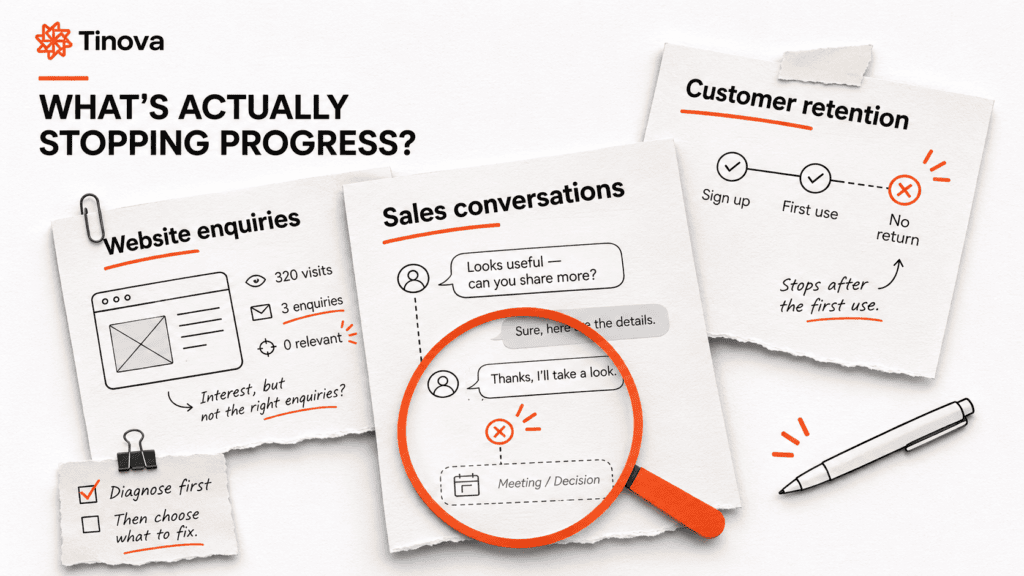
Your next priority depends on what is happening now, not what another founder is working on.
| What you’re experiencing | What to investigate first |
| An idea but little customer feedback | Whether a specific buyer experiences the problem |
| Website visits but few relevant enquiries | Who visits and whether the offer makes sense to them |
| Sales conversations that stop without a decision | Buyer fit, urgency, objections and purchasing steps |
| Customers who don’t continue | Whether the product delivers the value they expected |
These are starting points, not diagnoses. One poor result rarely reveals its cause. For deeper investigation, read Tinova’s startup growth diagnosis guide. Here, decide which question deserves your next month.
Y Combinator also advises early-stage founders; stay close to their users, build around their needs and use feedback to improve what they’re offering.
What Have Your Previous Efforts Actually Shown?
Review recent outreach, sales calls, campaigns and feedback. Record what you did, who responded, what happened next and what remains unclear.
Suppose you sent 50 messages to relevant businesses, received two replies and booked no meetings. Another hundred might increase activity without explaining where conversations stopped.
Were they the right buyers? Did they recognize the problem? Was your request too demanding? Those are questions to investigate, not conclusions. Two replies cannot prove whether a channel works.
How Do You Decide What to Fix First?

Compare competing projects using four criteria.
Business impact: Would addressing this issue help you reach relevant buyers, make sales, retain customers or protect cash? A cosmetic improvement may be useful, but less urgent.
Evidence: What customer conversations, sales outcomes or usage data suggest this is a real problem? Separate observations from assumptions.
Dependencies: Does another task need to happen first? Increasing traffic may achieve little when qualified visitors cannot understand the offer.
Feasibility: Can you make progress with the people, budget and time available this month?
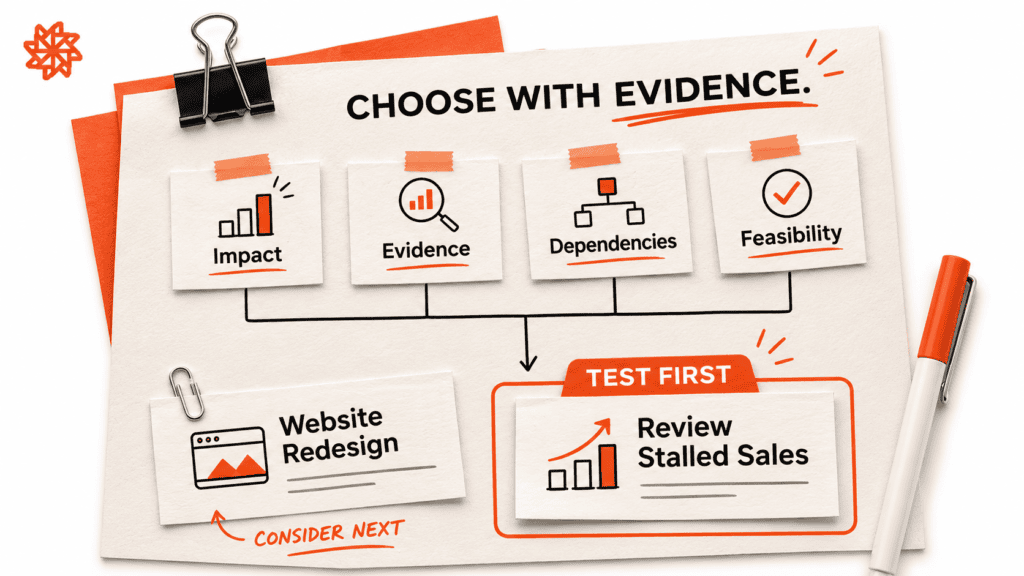
Consider that same founder choosing between redesigning the website and reviewing stalled sales conversations. If there is no evidence that the website is preventing purchases, a redesign is a costly assumption. Reviewing why prospects did not book a meeting is a smaller test that could reveal whether the problem concerns targeting, messaging or the next step.
That doesn’t mean sales review always beats website work. It means the available evidence should determine the order.
How to Build a 30-Day Startup Action Plan
Choose a question the month can answer: Why aren’t relevant prospects agreeing to a first meeting? That is more useful than “improve marketing.”
Week 1: Identify What You Need to Learn
Review outreach and sales notes. Check buyer fit, identify where conversations stop and record possible explanations. Finish with one clear hypothesis.
Week 2: Test One Focused Change
Test that hypothesis. Clarify the problem in your outreach or ask for a shorter introductory conversation. Keep other conditions as consistent as practical.
Week 3: Review What Happened
Track relevant replies, qualified conversations and agreed next steps, not just messages sent. Compare earlier results where possible and consider what remains uncertain.
Week 4: Decide What to Do Next
Continue if the evidence supports your approach. Otherwise revisit targeting, the offer or the next test. If evidence is limited, avoid declaring success or failure.
In Tinova’s Your Next Client Challenge, the team began by examining what participants had already attempted, agreeing on a measurable milestone and reviewing progress each week. The same discipline can help you make the next decision, even before a sale happens.
How Do You Know Whether the 30 Days Were Useful?
Thirty days of focused work does not guarantee a paying customer. But it should produce evidence that changes what you do next.
Can you explain which problem you investigated, what you learned and whether it justifies more time or spending? Did you identify a repeated buyer concern, rule out an assumption or find a clearer route to a qualified conversation?
A useful month ends with a decision supported by evidence, not merely a completed task list.
Choose One Question to Answer First
Before you begin, write down your current problem, question to answer, action to test and evidence to review. Keep those four answers visible throughout the month.
If you’re struggling to determine what deserves attention, Tinova’s Free GAP Analysis can help you examine your offer, website and follow-up, then identify where to focus first.
Written by Tinova Growth Team
Tinova shares practical guidance for B2B startup founders working through customer acquisition, positioning and sales decisions.