Still approving every decision? Take the 10-point founder to CEO transition test to identify the habits slowing your team and company growth.
The founder to CEO transition is a change in how you create results, not just a new title. Founders build by doing the work themselves. CEOs build teams, systems, and clear standards that help others deliver.
The transition begins when your time becomes a constraint on company growth. This guide explains what changes and includes a 10-point test to help you assess your readiness.
What Changes in the Founder to CEO Transition?
Early on, you write the copy, make sales calls, solve product issues, and make key decisions. Your personal effort keeps the company moving.
As the team grows, the same approach can slow everyone down. Work waits for your approval, team members hesitate to make decisions, and you have less time for strategy.
The real question becomes: How can the company produce better results without depending on you for every task?
Research by Harvard Business School professor Noam Wasserman on founder-CEO succession highlights the challenges founders face as their companies grow. His study of 212 startups found that about half of the founders were no longer CEO by the third year. This historical finding does not mean every founder should step aside. It shows why the skills required to lead a growing company deserve attention.
The Maker Mind vs. The CEO Mind
The founder’s instinct is to solve the problem personally. The CEO’s responsibility is to build a team that can solve it well.
| Founder mindset | CEO mindset |
| Does the work | Builds people who can do the work |
| Makes every decision | Sets clear decision boundaries |
| Fixes recurring problems | Creates processes to prevent them |
| Measures personal output | Measures team and company results |
| Checks every task | Sets standards and reviews outcomes |
For example, if every proposal needs your final approval, the team cannot move faster than your availability. Training one person to own proposals, setting review standards, and agreeing on when to escalate decisions can remove that bottleneck.
Your value as CEO comes from what the company can achieve through the team, not just what you can produce yourself.
Visual 2 — Middle (Founder Mind vs. CEO Mind)

When Should a Founder Start Delegating?
Start when recurring execution takes time away from decisions that need your attention.
However, delegation does not mean handing off every task as soon as you hire someone. Early-stage founders still need direct involvement in customer discovery, product development, and testing their business model.
The goal is to identify which work requires your judgment and which work another person can own.
Before hiring or handing over a major responsibility, define the result you need. Tinova’s pre-seed hiring guide explains how to hire around business problems and outcomes rather than job titles alone.
Are You Still Doing the Founder’s Job? Take the 10-Point Test
Give yourself one point for every statement that describes your current working habits.
| # | Readiness check | What it may indicate |
| 1 | You make decisions a team member could make. | Too many decisions depend on you. |
| 2 | You review work already approved by a manager. | Responsibilities are not clearly defined. |
| 3 | Projects wait for your final approval. | Your availability limits progress. |
| 4 | You remain the strongest individual contributor in most areas. | The team needs more ownership or development. |
| 5 | You feel unproductive when you are not completing tasks. | You still measure your value by personal output. |
| 6 | You have not handed over a major business function. | Too much responsibility remains with you. |
| 7 | Team members ask you how to solve every problem. | They may lack the context or authority to decide. |
| 8 | You attend meetings where your input is not needed. | Your time may be spent on unnecessary updates. |
| 9 | You solve the same recurring problem repeatedly. | The underlying process needs attention. |
| 10 | You cannot take a week off without frequent intervention. | Key responsibilities depend too heavily on you. |
How to Read Your Score
- 7 to 10 points: Start by transferring ownership of one major responsibility. Set the expected outcome, decision boundaries, and review schedule.
- 4 to 6 points: Track your decisions for one week. Identify which ones a trained team member could handle.
- 0 to 3 points: You have made progress towards leading through others. Review the test every quarter to spot habits returning.
This is a practical self-assessment, not a validated scientific test. Use your score to identify what needs to change, rather than judging your ability to lead.
Three Skills to Develop as CEO
1. Hire for the Problem, Not the Title
Before hiring a marketer, salesperson, or operations manager, define the result that person must deliver. A clear outcome helps you choose the right skills and assess performance.
2. Delegate Ownership, Not Just Tasks
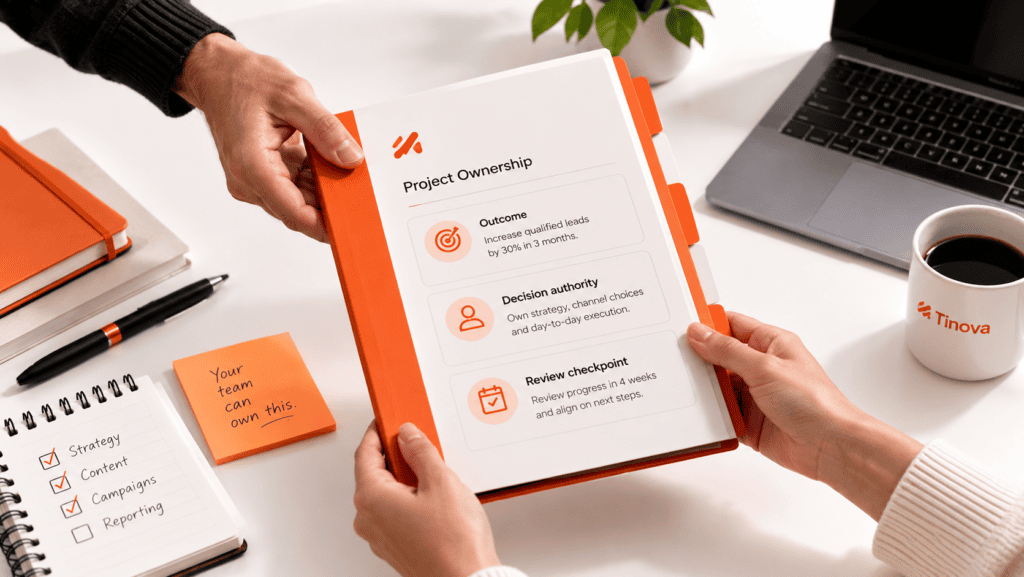
Hand over a result, the authority to make relevant decisions, and clear expectations. Agree on when you will review progress without taking the work back at the first mistake.
Visual 3 — Middle (Delegating Ownership)
3. Make Decisions Without Knowing Everything
As CEO, you will not have every detail available. Learn to separate decisions that are reversible from those that carry significant risk. Set a deadline, use the best available evidence, and review the outcome.
These skills also depend on having a sound business foundation. Tinova’s Business Foundation service focuses on the offer, pricing, business model, and decisions that support sustainable growth. Clear business priorities make it easier to decide what to delegate and where your attention matters most.
What Should You Hand Off First?
Start with a recurring responsibility that follows a clear process and does not require your personal judgment at every stage.
For example, you could hand over routine reporting, scheduling, or first-round quality checks. Document the expected result, give the new owner access to the information they need, and agree on what requires escalation.
Once the process works reliably, move to a larger area of responsibility.
Avoid hiring simply because you feel busy. As Tinova explains in its guide to premature scaling, adding people before the business has a clear process can increase costs without solving the underlying problem.
Founder to CEO Is a Job Change, Not a Title Change
You do not need to stop being a builder to become a better CEO. You need to recognise when your direct involvement helps the company and when it prevents others from doing their jobs.
Start with one decision, one recurring task, or one responsibility that no longer needs your personal attention. Set the standard, give someone ownership, and review the result.
The goal is not to make yourself less useful. It is to build a company that can achieve more without depending on you for every decision.
FAQs
What is the founder to CEO transition?
The founder to CEO transition is the move from personally handling much of a company’s work to leading through people, priorities, systems, and decisions. The founder can remain CEO while changing how they lead.
When should a founder start delegating?
Start when recurring tasks prevent you from focusing on strategy, customers, hiring, or important business decisions. Delegate work with a clear outcome and give the new owner enough authority to deliver it.
What should a founder delegate first?
Begin with repeatable tasks that do not require your unique expertise or judgment. Document the process, set quality standards, and agree on when the person should ask for help.
How long does the founder to CEO transition take?
There is no fixed timeline. It depends on the company’s stage, team experience, and how much work still depends on the founder. Review responsibilities regularly and transfer ownership as the business develops.
Written by: Tinova Growth Team
Tinova is a marketing and growth agency for startups and owner-led businesses. Its current site reports 200 startups diagnosed, 77+ businesses scaled, 3 awards in 2026, and $10M+ in client funding pipeline built.
Updated: October 7, 2026
Disclosure: Tinova provides diagnostic and strategic marketing services. This article offers practical guidance and does not guarantee a particular business outcome.