
Learn why customer readiness comes before investor readiness at pre-seed and how to build customer proof before raising.
You polish the deck, rehearse the pitch, and start booking investor meetings.
Then comes the question: “How many customers have you spoken to?”
A lot of founders are ready to pitch before they are ready to answer that question.
At pre-seed, you do not need a large customer base. You do need evidence that real people have the problem, care about it, and may pay to solve it.
Customer readiness comes before investor readiness.
The “$1.2M If Scaled” Problem
Tino once reviewed a pitch that opened with, “An investor told us we could be worth $1.2M once we scale.”
The issue was not the valuation estimate. It was the missing customer evidence.
The startup had 20 organic sign-ups, but no clear market research, discovery quotes, or proof that users returned.
Investor interest is not customer validation.
An investor can believe in the possibility. A customer has to act.
That difference matters when you prepare for investor readiness.
Why Customer Readiness Comes First
Three early signals can look stronger than they really are.
Revenue Alone Is Not Validation
One paying customer proves one person paid. It does not prove you can repeat the process.
A stronger test is whether you can find 20 to 30 relevant prospects, close customers, and repeat the process.
A Big-Name Hire Is Not Customer Proof
A strong résumé can help a team, but it does not show that buyers want the product.
Customer understanding comes from conversations, feedback, and behavior.
Funding Does Not Prove Product-Market Fit
Investors fund a future they believe is possible. Customers pay for value they already want.
That is why product positioning and customer clarity matter before the fundraising story is polished.
What Real Customer Proof Looks Like at Pre-Seed
You do not need thousands of users. You need evidence with context.
| Proof | What It Shows |
| 20 to 30 discovery calls | A repeated problem across real prospects |
| Customer quotes | How buyers describe the problem in their own words |
| LOIs or design partnerships | Willingness to test or adopt |
| Waitlist with context | Interest tied to a real problem |
| Paying pilot users | Early evidence of willingness to pay |
The key is not the number alone. It is what the number lets you prove.
For example, “300 people joined our waitlist” says less than “42 target buyers joined after telling us they lose eight hours a week to manual reconciliation.”
The Customer-First Proof Framework
Use three steps: Validate, Package, Then Raise.
Step 1: Validate Demand
Talk to 20 to 30 potential customers before relying on assumptions.
Ask:
- How do you solve this today?
- What makes the current process difficult?
- What does the problem cost you?
- Have you paid for a solution before?
Y Combinator has long emphasized talking to users as one of the core jobs of an early-stage startup. YC’s Essential Startup Advice
Step 2: Package the Proof
Turn your conversations into a simple evidence sheet.
Include:
Customer: who has the problem
Problem: what keeps happening
Quote: what the buyer actually said
Current solution: what they use today
Demand signal: pilot, LOI, payment, repeat use, or other action
This is more useful than adding another page of market-size estimates.
Step 3: Raise With Evidence
Now the investor conversation changes.
Instead of:
“Dentists probably need this.”
You can say:
“We spoke with 15 clinic owners. Twelve described the same billing problem, and eight asked to test the product.”
That is a much clearer starting point for a fundraising conversation.
Your 2-Week Customer Readiness Sprint
Days 1 to 3: Build the List
Find 30 to 50 people who match your target customer.
Use your network, LinkedIn, communities, or direct outreach. Focus on people who already experience the problem.
Days 4 to 10: Run 20 Conversations
Do not spend the calls pitching.
Ask how people handle the problem today, what frustrates them, and what they have already tried.
Write down their exact language.
Days 11 to 14: Organize the Evidence
Look for repeated problems and strong buying signals.
Then ask your most interested contacts about a pilot, design partnership, or LOI.
You should finish the sprint knowing:
Who has the problem.
How they describe it.
What they use today.
What they are willing to do next.
That is customer readiness.
A Simple Pre-Seed Proof Test
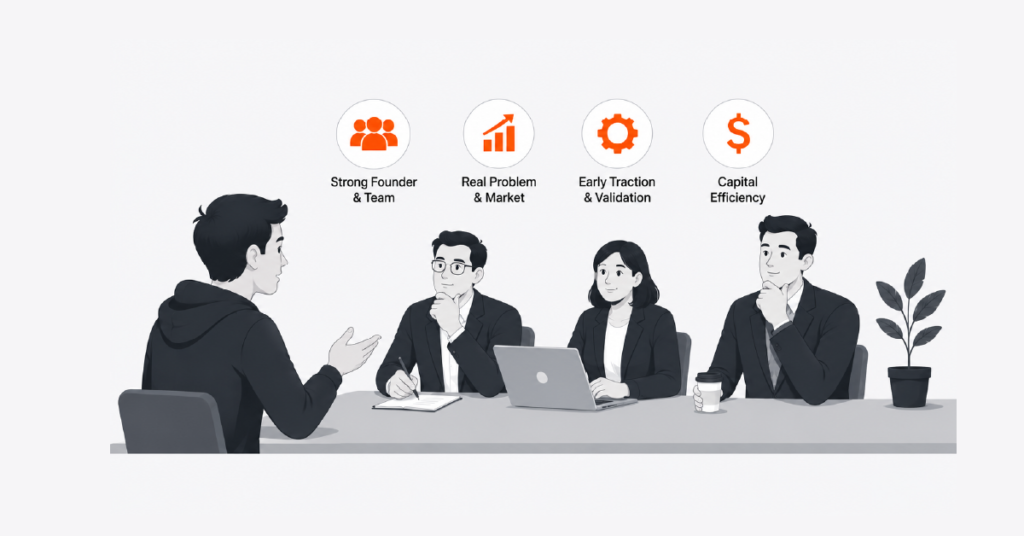
Before your next investor meeting, see whether you can answer these five questions:
- Who is your target customer?
- What problem keeps showing up?
- What proof do you have from real customers?
- What action have customers taken?
- Can you repeat the process?
If you cannot answer these clearly, another investor meeting may not solve the problem. More customer work might.
What Tinova Has Seen
This customer-first approach comes from the same diagnosis process Tinova uses with startups and businesses.
Tinova currently reports 200 startups diagnosed, 77+ businesses scaled, and $10M+ in client pipeline built. Its results library also states that published figures are tied to named clients and specific timeframes rather than anonymous claims. See Tinova’s results library.
The useful lesson is simple: proof becomes stronger when someone can trace it back to a real action, customer, and result.
FAQs
How Much Customer Validation Do I Need Before Raising?
There is no fixed number for every startup. A practical starting point is 20 to 30 customer conversations, several clear customer quotes, and a few people willing to pilot, sign an LOI, or pay.
What Proof Do Investors Want at Pre-Seed?
They want evidence that real customers have a real problem and that your team understands the buyer. Discovery calls, pilots, LOIs, repeat usage, early revenue, and clear customer patterns can all help.
Should I Get Customers Before Investors?
You do not need a large customer base before fundraising. You should have enough customer evidence to show that the problem is real, the buyer is clear, and people are willing to take action.
Can I Raise Pre-Seed Without Any Customers?
Yes. Some pre-seed startups raise before meaningful revenue or a large customer base. In that case, stronger customer discovery, pilot commitments, design partnerships, waitlist quality, or other demand signals can help demonstrate that the business is solving a real problem.
Build the Proof Before the Pitch
A finished deck is not the same as a validated business.
Before you spend more time pitching, make sure you can explain who wants the product, what problem they have, and what they have done to prove it.
That is the difference between investor readiness and customer readiness.
Tinova’s Investor-Ready in 21 Days program helps pre-seed and seed founders strengthen positioning, customer clarity, their website, offer, and investor narrative before a raise.
Build the proof first. Then build the pitch around it.
Further Reading
- “Come Back When You Have More Traction” The Pre-Seed Trap Nobody Warns You About
- Founder Led Sales Pre-Seed: The 30-Prospect Test