

Why do pre-seed startups get rejected? Discover five investor red flags, what they reveal about your startup, and how to fix each one before fundraising.
Raising money is hard enough. Only around 3% of pre-seed startups looking for external funding secure it. That number alone shows how competitive fundraising is. Yet many founders make their own chances even harder without realizing it.
Here is what many founders miss. Investors do not reject great ideas first. They reject weak positioning and poor timing. At the pre-seed stage, how you present your startup matters as much as the idea itself.
The good news is that positioning problems can be fixed. If you have been asking why do pre-seed startups get rejected, this guide breaks it down. You’ll learn the five red flags investors see, what each one signals, and the exact fix to strengthen your next fundraising conversation.
Red Flag 1: You Can't Name 10 to 20 Real People Who Have the Problem
Ask yourself this. If an investor asks who has this problem, can you name 10 to 20 real people or companies who face it today?
If your answer is “the market” or “everyone,” you have already lost credibility. “Everyone” is not a customer. It tells investors you have not spoken to real people, and they hear this all the time.
Tino Aliye, a founder of Tinova, who has advised many early-stage startups, puts it simply. One customer is not enough. What matters is whether you can repeat the process. Can you generate 20 to 30 leads, close six customers, and do it again next month? If you cannot name the people, you cannot prove that.
The Fix (Step by Step)
Step 1: Identify 20 to 30 people who experience the problem.
Step 2: Hold short customer discovery conversations.
Step 3: Record their exact words, biggest challenge, and current solution.
Step 4: Bring those customer quotes and names to your investor meeting.
A founder who says, “I spoke with 15 clinic owners, and 12 described the same billing problem,” is far more convincing than one who says, “Dentists probably need this.” One has evidence. The other is guessing. Investors can tell the difference in seconds.
Red Flag 2: Your Target Customer Changes Every Meeting
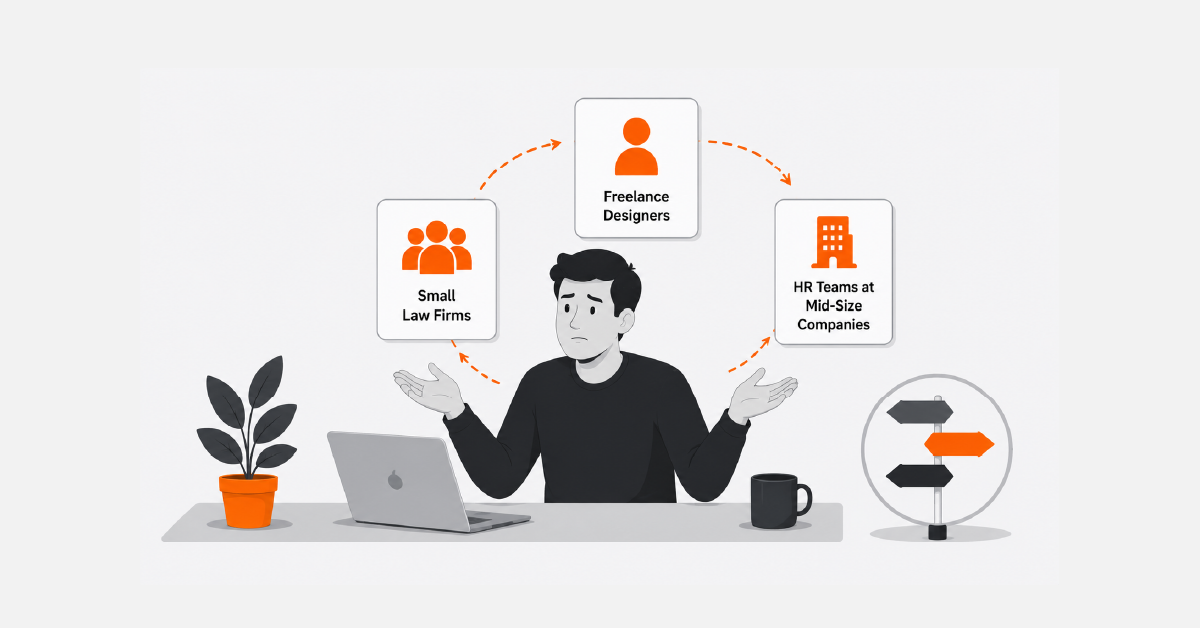
This is one of the biggest pre-seed fundraising mistakes to avoid. In one pitch, your customer is small law firms. Two weeks later, it is freelance designers. Then it becomes HR teams at mid-size companies.
You may think you are being flexible. Investors see a founder without conviction.
A changing target tells them you have not identified who truly needs your product. Instead of a clear strategy, it looks like you are testing different stories to see what gets a reaction.
At the pre-seed stage, you have very little data to prove your case. Your clarity is the proof. If your target customer keeps changing, investors assume your thinking is not fully developed.
The Fix (Step by Step)
Step 1: Choose one beachhead customer.
Step 2: Focus on one buyer and one problem.
Step 3: Keep the same customer story throughout your fundraising.
Step 4: Mention future expansion only after establishing your core market.
Conviction builds confidence. Show it.
Red Flag 3: "Tech Consumers, Millennials, and Gen Z" Is Your Whole Answer
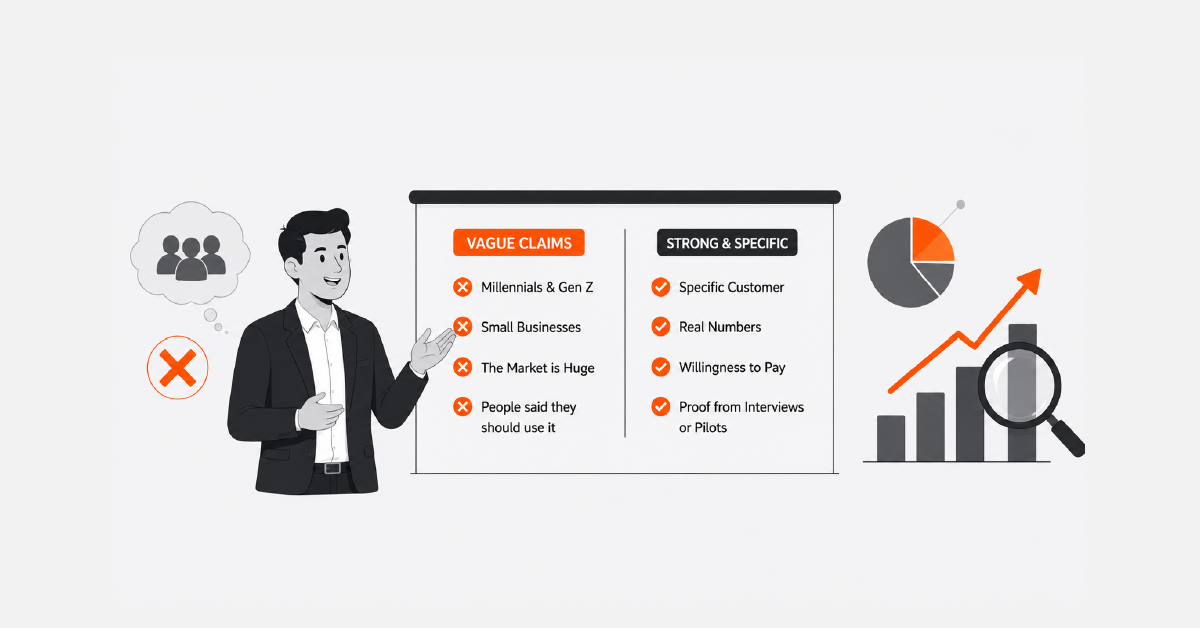
Many founders describe their customers with broad labels like Millennials, Gen Z, tech-savvy consumers, or small businesses. When your customer is everyone, your customer is no one.
This is one of the biggest reasons why investors reject startups. A market size of “$300 billion” does not prove demand. Investors want a bottom-up view showing who will buy, what they will pay, and how many customers you can realistically win.
Tino shares a simple example. A founder’s pitch opened with “Design, create, earn.” His response was, “Who cares?” The pitch had no market research, no supporting numbers, and only 20 organic sign-ups. When asked whether those users returned, the founder did not know.
That is the real problem. Big claims without proof do not build investor confidence.
Many founders describe their customers with broad labels like Millennials, Gen Z, tech-savvy consumers, or small businesses. When your customer is everyone, your customer is no one.
This is one of the biggest reasons why investors reject startups. A market size of “$300 billion” does not prove demand. Investors want a bottom-up view showing who will buy, what they will pay, and how many customers you can realistically win.
Tino shares a simple example. A founder’s pitch opened with “Design, create, earn.” His response was, “Who cares?” The pitch had no market research, no supporting numbers, and only 20 organic sign-ups. When asked whether those users returned, the founder did not know.
That is the real problem. Big claims without proof do not build investor confidence.
What you say now (vague) | What a fundable founder says (specific) |
“Millennials and Gen Z who love tech” | “Solo Shopify sellers doing $5K to $20K a month who hate manual bookkeeping” |
“Small businesses need this” | “12 of the 15 dental clinics I interviewed pay $800/month for a worse tool” |
“The market is huge” | “There are ~9,000 clinics in my target region; I need 300 to hit $2M ARR” |
“People said they would use it” | “8 of 10 pilot users converted to paid at $49/month in three weeks” |
See the pattern. Every strong example includes a real customer, a number, and proof. Investors have heard “People said they would use it” countless times. Specific evidence is what moves you to the next meeting, not broad claims.
Red Flag 4: Zero Customer Conversations Because You Are "In Stealth"
Many founders say, “We cannot talk to customers yet. We are protecting the idea.” Investors hear a different message. They see a founder who has not tested whether anyone truly wants the product.
This is one of the biggest pre-seed rejection reasons. Funding does not prove product-market fit. It only shows an investor believes your startup has potential.
Tino explains it well. Investors invest in your potential. Customers pay because you solved a real problem. Those are two very different decisions. Customers do not care who you are. They care whether your product works.
If you skip customer conversations, you miss the strongest proof you can bring to a pitch.
The Fix (Step by Step)
Step 1: Schedule 20 to 30 customer discovery calls.
Step 2: Ask about their biggest challenge and current solution.
Step 3: Collect customer quotes, pilot feedback, or waitlist data.
Step 4: Present those findings during investor meetings.
Red Flag 5: "We Execute Like Nobody Else" Is Your Entire Moat
Many founders say, “We execute better than anyone else.” Investors are not convinced by claims alone. Saying “we have no competitors” hurts your credibility even more. Every problem already has an existing solution, even if it is a spreadsheet or a manual process.
Tino shares a great example. His team hired a designer with an impressive background who created beautiful designs but missed what buyers actually wanted. The real advantage was understanding the customer, not an impressive résumé. The same rule applies to your startup. A title, a brand name, or a bold claim is not a competitive edge.
Timing can also work against founders. A startup may be too early for the market, fundraising before key milestonaves are reached, or seeking investment during a more cautious funding environment.
Then there’s competition. In competitive categories, investors often compare execution rather than ideas because several companies may be solving the same problem.
In crowded markets, investors compare multiple companies solving similar problems. If the startup can’t clearly explain why it stands apart, securing funding becomes more difficult.
The gap between a good idea and funding is proof.
The Positioning Proof Framework
All five red flags point to the same issue. They are not idea problems. They are positioning problems.
We call this the Positioning Proof Framework. Every successful pre-seed startup can clearly answer five questions:
- Who is the customer?
- What evidence proves the problem exists?
- Why this market?
- Why now?
- Why are you different?
If one answer is weak, investors start losing confidence.
That is why fixing them matters. You do not need a new startup. You need a clearer story backed by real evidence.
Here is a quick reference to the five red flags investors see and how to fix them.
Red flag | What the investor hears | The fix |
“Everyone” has this problem | You have talked to no one | Name 10 to 20 real people with the pain |
Customer changes every meeting | No conviction, still guessing | Pick one beachhead and hold it |
Millennials, Gen Z, everyone | No real target, top-down thinking | Bottom-up numbers and a named buyer |
We are in stealth, no calls yet | Scared the market will say no | Run 20 to 30 discovery calls first |
We just execute better | No real moat | Name a durable edge, show early proof |
We saw this with a founder who kept hearing “no.” The product stayed the same. We improved the positioning by adding a named customer, real discovery quotes, a bottom-up market, and one clear competitive edge. The result? They raised $650K. The idea was never the problem. The positioning was.
Positioning can be improved in weeks, not years. That is why it is one of the highest-impact investments you can make before your next fundraising round.
FAQs
Why do investors reject pre-seed startups?
In most cases, investors reject startups because of weak positioning, not the idea. They want to see a clear customer, market evidence, and proof that founders have spoken with buyers. With only about 3% of pre-seed startups securing external funding, a vague story is unlikely to stand out.
What are the biggest pre-seed fundraising mistakes to avoid?
The biggest mistake is raising money without customer evidence. Other common pre-seed fundraising mistakes to avoid include changing your target customer, relying on broad market numbers, lacking a go-to-market plan, and having no clear competitive edge. These are the red flags investors see first.
How do I know if my positioning is the problem?
Ask yourself a few simple questions. Can you describe your customer in one sentence? Can you name 10 real people with the problem? Do you have a bottom-up market estimate and one clear advantage? If not, your positioning needs work. The good news is positioning can be improved before your next fundraising round.
Fix These Before Your Next Pitch
All five red flags point to one issue: weak positioning. Founders who raise funding are not the ones with the flashiest pitch deck. They are the ones who can identify a clear customer, show real proof, and explain their competitive edge with confidence.
We helped a founder improve their positioning by defining a clear customer, strengthening their market story, and showing real customer evidence. The product stayed the same, but the startup went on to raise $650K.
If you think positioning is holding you back, let us help you test it before your next investor meeting.
→ Book a positioning audit → and we will show you where your story is losing the room, before an investor does.
Further Reading

Topics: