
Skip to content

Blogs · Founder education

Most founders do not have a marketing problem. They have a belief they have not tested.

Every article here exists because we watched the same mistake cost real money on real calls: selling before 30 prospects have been talked to, reading signups as traction, and pitching investors a product instead of a position. We wrote the fix down. Read it free, use it without us, and if you want it applied to your business, book the diagnosis.

78 articles 1 method behind them 0 gated downloads 0 recycled listicles

The articles

78 pieces, each one aimed at a decision you are about to get wrong.

Each article ends in the same place: the program that fixes the problem it describes.

How Investors Evaluate Startups After a Pitch 
Article 06 · Blogs

How Investors Evaluate Startups After a Pitch 

Learn how investors evaluate startups after a pitch, from the first debrief and data room to due diligence, references, financial review, and partner decisions.  The pitch ends. The call closes. Then comes the question every founder knows:  What happens now?  The answer depends on the investor and the startup, but a strong first meeting can […]
Who it is for

This guide is for startup founders who have finished an investor pitch and want to understand what happens next, from follow-up questions to due diligence and the final investment decision.

You will leave with

You'll understand the main steps investors may take after a pitch, what they examine at each stage, what can create concern, and how to prepare before the requests arrive. The pitch is only one part of the fundraising process. Afterward, investors may review your financials, customer data, legal documents, product, references, and market before discussing the opportunity with their partners. This guide explains how investors evaluate startups after a pitch so you can prepare for the process, not just the presentation.

Bootstrapping vs Raising Capital: How to Decide as a Founder 
Article 05 · Uncategorized

Bootstrapping vs Raising Capital: How to Decide as a Founder 

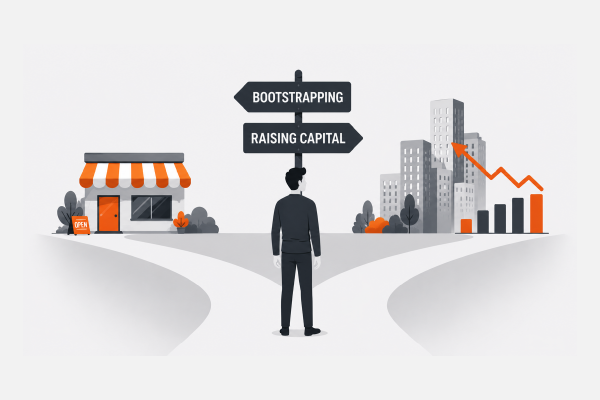
Bootstrapping vs raising capital? Learn how to choose based on control, growth speed, capital needs, investor expectations, and your startup’s long-term goals.  Every founder eventually asks: Should we bootstrap or raise capital?  Bootstrapping gives you more control and lets customer revenue fund growth. Venture capital can give you more capital to hire, build, and expand […]

Who it is for

This guide is for startup founders deciding whether to bootstrap or raise venture capital and trying to understand the trade-offs before choosing a funding path.

You will leave with

You'll understand the differences between bootstrapping and VC funding, what investors look for, when waiting can make sense, and how a hybrid path can work. Bootstrapping vs raising capital is more than a money decision. It affects your ownership, growth pace, financial pressure, and the company you build. This guide breaks down the trade-offs so you can choose a funding path based on your market, business model, and goals.

Startup Traction: What Investors Expect at Each Funding Stage 
Article 04 · Uncategorized

Startup Traction: What Investors Expect at Each Funding Stage 

Learn what startup traction investors expect at pre-seed, seed, and Series A, including the metrics, customer signals, and proof founders should present.  Startup traction is measurable proof that customers want what you are building. The type and depth of that proof changes as the company grows.  At pre-seed, investors may look at customer interviews, pilots, […]

Who it is for

This guide is for startup founders preparing to raise pre-seed, seed, or Series A funding who want to understand what traction investors expect at each stage.

You will leave with

You’ll learn which traction signals matter at each funding stage, how to present them clearly, and which mistakes can make strong numbers less convincing. What startup traction do investors actually expect at each funding stage? Pre-seed may rely on early validation, while seed and Series A require stronger evidence of growth, retention, and repeatability. This guide shows what to measure, how to present it, and how to tell whether your traction is keeping pace with your funding stage.

What Do Investors Want to See in a Startup Before Funding? 
Article 03 · Uncategorized

What Do Investors Want to See in a Startup Before Funding? 

Learn what investors want to see in a startup before funding, from founder-market fit and market size to traction, product-market fit, business model, and key metrics.  A strong idea can start a conversation, but evidence keeps it going.  Investors want to know whether your team can execute, whether customers actually want the product, whether the […]

Who it is for

This guide is for startup founders preparing to raise capital who want to understand what investors evaluate before funding a company.

You will leave with

You’ll learn the six areas investors commonly assess: team, market, traction, product-market fit, business model, and metrics, plus the red flags that can weaken your case during due diligence. A strong idea is not enough to get funded. Investors want evidence that your team can execute, customers want the product, the market can support growth, and the business has a credible path forward. This guide breaks down what investors want to see in a startup and how founders can build that proof before the pitch.

Why Investors Say No to Startups: 7 Common Reasons 
Article 02 · Blogs

Why Investors Say No to Startups: 7 Common Reasons 

Learn why investors say no to startups, what concerns drive rejection, and how founders can strengthen traction, pitch clarity, business model, and investor fit.  A strong idea is only the start of a fundraising case. Investors also need to see evidence of demand, a clear business model, capable execution, and a believable path to growth.  […]

Who it is for

Startup founders who have faced investor rejection, are preparing to fundraise, or want to understand what may be weakening their case.

You will leave with

You’ll learn the main reasons investors say no to startups, how to read rejection as useful feedback, and what to improve in traction, positioning, business model, pitch clarity, and investor fit. Investor rejection can feel personal, but a “no” may come from timing, proof, fit, or execution. This guide explains the common investor rejection reasons and shows founders what to fix before the next fundraising conversation.

Signs Your Startup Is Ready to Raise Capital (And When You Should Wait) 
Article 01 · Blogs

Signs Your Startup Is Ready to Raise Capital (And When You Should Wait) 

Learn the signs your startup is ready to raise capital, what investors look for, and when waiting can help you build stronger proof.  Raising funding is not just about having a strong idea. It is about having enough proof to show that more capital can help the business grow.  Some founders raise before they have […]

Who it is for

Early-stage startup founders who are unsure whether they have enough proof to approach investors and want to raise from a stronger position.

You will leave with

You’ll learn the key signs that your startup is ready to raise capital, the warning signs that suggest waiting, and a simple checklist to assess your fundraising readiness. Have no idea when to raise funding? This guide breaks down the real signs investors look for, from customer demand and traction to product-market fit and a clear use of funds. You’ll also learn when waiting can help you build a stronger case.

What we write about and why

We publish the diagnosis, not the sales pitch.

These articles come out of GAP Analysis calls. When the same broken assumption shows up across 200 diagnosed businesses, it stops being a client problem and becomes something worth writing down. That is the entire editorial rule.

TOPIC 01

Offers and founder-led sales

How to test an offer with your own mouth before you fund a channel, and how to tell a pricing problem from a positioning problem.

Written for the person doing the selling.

TOPIC 02

Metrics that are honest

Which numbers predict a business and which ones just decorate a deck. We name the difference between pipeline and revenue everywhere, including in our own reporting.

No vanity metrics defended.

TOPIC 03

Positioning and investor readiness

Finding the 1 customer you serve best, then making the brand, the site and the raise story agree with each other.

1 sentence a stranger can repeat.

Why it is free. We give the thinking away because the thinking is not the hard part, the build is. If an article fixes your problem without us, that is a good outcome. If it shows you the size of the job, book the diagnosis. Either way, scope and fee are quoted after the diagnosis, never before it.

Get new articles by email

New piece, sent when it is worth sending.

No weekly filler and no drip sequence pretending to be a newsletter. Send us a message with the word articles and we will add you to the list that goes out when a new piece is published.

Send 1 message, get every new article

Use the same form our clients use. A human reads it, and you can reply to any email to reach us directly.

Send us a message

The person who wrote this is the person who would run your build. Everything in these articles comes out of live client work, run by our own strategists, designers, developers and marketers. Under 1 contract with 1 point of contact, and you own every asset at the end.

1 way in

Reading is cheap. Fixing it is the work.

Book the free GAP Analysis. 30 minutes with the person who would run your build, and you leave with your leaks ranked, whether you hire us or not.