SaaS pricing tools can collect payments, but they do not tell you what to charge. Learn the WTP survey, value metric, and first-price worksheet to set your number.
Most SaaS pricing tools help you bill customers. They do not tell you what your first price should be.
Stripe Billing, Chargebee, and similar platforms solve billing. Pricing is a different problem.
At pre-seed, you need customer conversations, a simple willingness-to-pay method, and a way to turn what you learn into one price you can explain.
In Short
- Billing tools collect the price. Pricing research helps you find it.
- Run a simple willingness-to-pay survey with people who match your target buyer.
- Choose a value metric that makes the price feel connected to the value delivered.
- Test the number with a paid pilot before building a complicated pricing system.
Why SaaS Pricing Tools Do Not Solve Your Pricing Problem
A billing platform can handle subscriptions, invoices, and payments. It cannot tell you whether your SaaS should cost $49, $199, or $1,000 per month.
That number comes from customer value, willingness to pay, alternatives, and buying behavior.
Tinova sees pricing as part of the business foundation, not a billing task. Its Business Foundation service starts with the offer, pricing structure, business model, and the numbers underneath them.
Do not build the billing system before deciding what you are billing for.
Your First Price Is a Research Tool
The first time you ask for money, you learn more than you did when everyone was using the product for free.
A prospect who says, “This looks great,” gives you interest data.
A prospect who sees the price and says, “No, that is too much,” gives you pricing data.
Do not treat every objection as a reason to lower the number. Ask what makes the price feel too high, what they would spend to solve the problem today, and what would make the purchase worthwhile.
Tinova’s SaaS pricing guide makes the same case: a pricing conversation gives you customer research that free usage cannot.
Willingness-to-Pay: Start With Four Questions
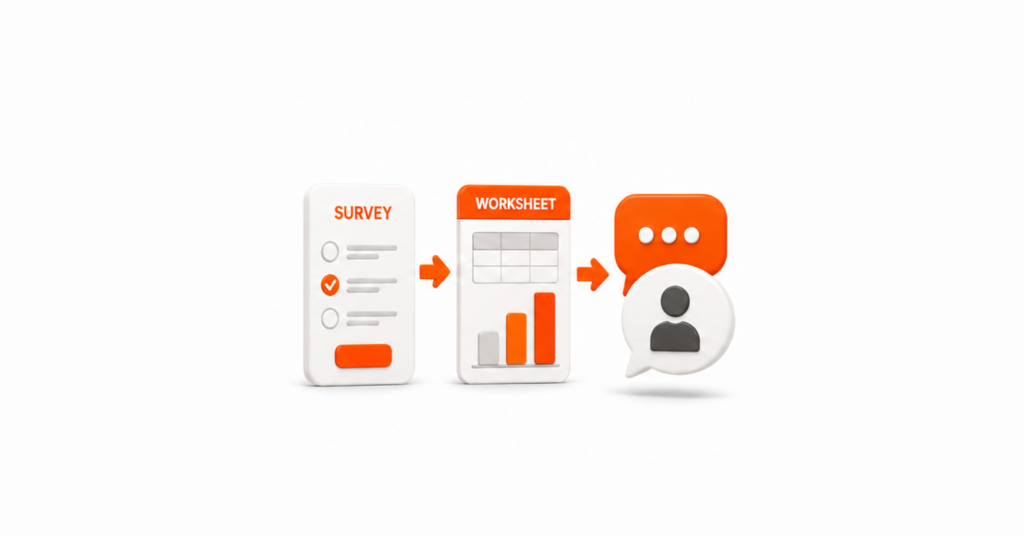
The Van Westendorp Price Sensitivity Meter uses four questions to understand how buyers perceive price: too cheap, a bargain, expensive, and too expensive. See the methodology and questions.
For an early SaaS product, use a small sample as directional research, not as proof of a statistically precise market price.
Ask:
- At what price would this feel so cheap that you would question its quality?
- At what price would this feel like a bargain?
- At what price would it start to feel expensive?
- At what price would it become too expensive to consider?
Run the survey with people who actually resemble your target buyer.
The goal is not to find a perfect number from a formula. You are looking for a useful range to test in sales conversations.
Choose the Value Metric Before the Price
Your value metric answers a simple question:
What should the customer pay more for as they get more value?
That might be seats, usage, locations, transactions, or another measurable unit.
Make a small worksheet:
| Value delivered | Pricing metric | Example |
| More users served | Seats | $X per seat |
| More usage | Usage | $X per 1,000 actions |
| More business value | Outcome | $X per result |
Choose the metric that makes sense to the buyer, not the one that is easiest for your billing software.
Test the Price With a Paid Pilot
A paid pilot gives you a stronger signal than another round of opinions.
Keep it simple:
“For the first 30 days, the pilot is $X. If we achieve [specific outcome], it converts to [plan] at $Y per month.”
Set a clear outcome and a clear conversion point.
A buyer who agrees to pay has given you evidence that a survey cannot provide.
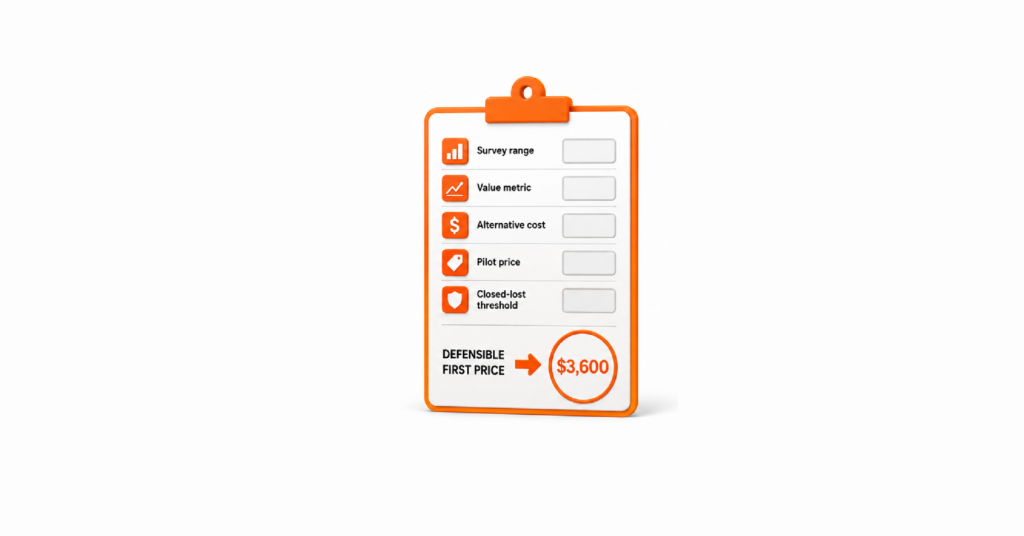
The First Price Worksheet
Put these five inputs on one page:
- WTP range: What target buyers said felt acceptable.
- Value metric: What the price scales with.
- Current alternative: What the buyer spends today in money, time, or effort.
- Paid-pilot result: What someone has already agreed to pay.
- Price objections: Where real prospects stopped moving forward.
Then choose a starting price that you can explain using all five.
You do not need certainty. You need a number with a reason behind it.
Three Pricing Resources Worth Reading
Monetizing Innovation
Monetizing Innovation by Madhavan Ramanujam and Georg Tacke is useful for understanding why willingness-to-pay conversations belong early in product and pricing decisions. Chapter 4 is the best place to start.
The Strategy and Tactics of Pricing
Use this once you have enough customer and market information to think about segmentation, value, and pricing structure. It is more useful after you have moved beyond your first rough price.
Kyle Poyar’s Pricing Work
Kyle Poyar’s work is useful once you have a working SaaS model and want to improve packaging, expansion, and monetization. It is less useful when your immediate question is simply, “What should my first customer pay?”
The Skip List
| Tool type | Why wait | Start here |
| Billing platform | You need a price before you need billing automation | Payment link or simple invoice |
| Dynamic pricing software | You need enough transaction data to optimize | Test one clear price |
| AI pricing platform | A tool cannot replace buyer conversations | WTP survey + sales calls |
| Subscription analytics | Limited value before you have meaningful MRR | Track pilots in a spreadsheet |
The right first step depends on what you have learned, not how advanced your software stack looks.
How to Price a SaaS Product With No Competitors
No direct competitor does not mean you have no pricing reference.
Look at:
What does the problem cost today? What does the buyer do manually? What happens if they do nothing? What result becomes possible after using your product?
Those answers help you build a value case without copying another company’s price.
Tinova’s GAP Analysis also starts with the numbers behind the offer, including pricing and economics, before recommending where to invest.
The First-Price Confidence Check
Give yourself one point for each “yes”:
- Have at least five target buyers discussed price with you?
- Do you have a WTP range rather than one random number?
- Does your pricing metric connect to customer value?
- Has at least one customer paid for a pilot or subscription?
- Can you explain your price without referring to a competitor?
- Have you recorded why prospects rejected the price?
- Does the price make sense with your delivery costs?
- Can you explain what changes between pricing tiers?
- Would you keep the same price after hearing your next objection?
- Do you have a clear reason to change the price later?
Below 6: You have a starting hypothesis, not a validated price.
FAQ
What are the best SaaS pricing tools?
For an early-stage SaaS company, start with Google Forms or Typeform, a spreadsheet, and customer conversations. Billing platforms solve payment collection, not price discovery.
How do I run a willingness-to-pay survey?
Use the four Van Westendorp questions to identify how buyers perceive different price levels. Use the results as a guide, then test the range through actual sales conversations.
What should I charge for my SaaS?
Start with a price based on customer value, your chosen value metric, the current alternative, and what buyers have shown they will pay. Then test it with paid customers.
When do I need advanced pricing software?
When you have enough customers and pricing data for automation or deeper analysis to save meaningful work. Before that, a spreadsheet and direct conversations can teach you more.
Remember This
The best SaaS pricing tools cannot choose your first price for you.
Start with the buyer. Learn what the problem costs, what the outcome is worth, and what people will actually pay.
Then test the number.
Price first. Build the billing system second.
For a broader look at your offer, economics, pricing, and growth model, see Tinova’s Business Foundation or book the Free GAP Analysis.
Written by: Tinova Growth Team
Tinova is a marketing and growth agency for startups and owner-led businesses. Its official site reports 200 startups diagnosed, 77+ businesses scaled, 3 awards in 2026, and $10M+ in client funding pipeline built.
Updated: September 24, 2026
Review Focus: Repeatable revenue, retention, customer acquisition cost, business durability, product-market fit.