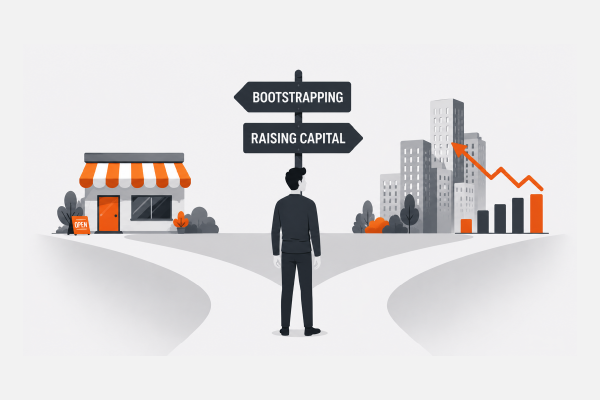
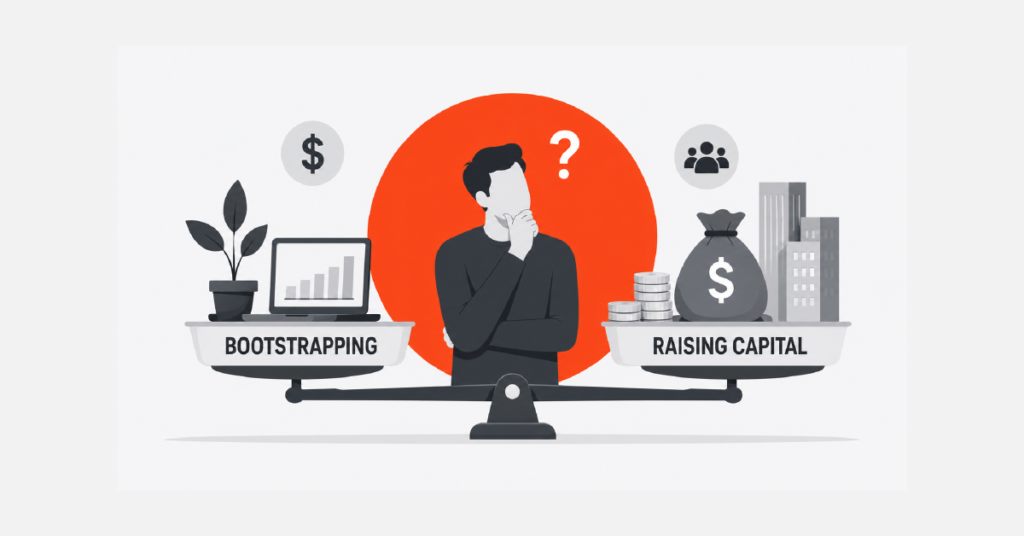
Bootstrapping vs raising capital? Learn how to choose based on control, growth speed, capital needs, investor expectations, and your startup’s long-term goals.
Every founder eventually asks: Should we bootstrap or raise capital?
Bootstrapping gives you more control and lets customer revenue fund growth. Venture capital can give you more capital to hire, build, and expand faster, but it also means giving up equity and taking on investor expectations.
The right answer depends on what your business needs next, not what other startups are doing.
Why Some Founders Struggle to Raise Capital
Founders sometimes assume a good product should lead to funding.
Investors also want to see why this team, why this market, and why now. They may look at founder-market fit, traction, customer demand, market size, and whether the business can support the growth the funding is meant to create.
Tinova’s guide on what investors want to see in a startup covers these evaluation areas in more detail.
Traction matters too, but one strong month does not tell the whole story. A clearer picture comes from progress over time.
Bootstrapping: More Control, More Financial Pressure
Bootstrapping means funding the company with your own money and customer revenue rather than selling equity to investors.
What You Keep
- Ownership: You keep more equity.
- Control: Major decisions stay with the founders.
- Customer focus: Revenue and customer feedback become direct signals for what to build.
What You Take On
- Slower growth: You may not be able to fund every opportunity at once.
- Financial pressure: Hiring and spending depend more heavily on revenue.
- Limited runway: There is no new funding round automatically available when cash gets tight.
Bootstrapping can work well when the business can grow through customer revenue and does not need large upfront investment.
Raising Venture Capital: More Capital, More Expectations
Venture capital is equity funding for companies with strong growth potential. It can help a startup hire sooner, develop the product faster, or expand into new markets. Investopedia’s venture capital guide explains how VC funding works and why it can affect both ownership and company control.
What Changes After You Raise
You may take on:
- Equity dilution
- Investor updates and board responsibilities
- Pressure to meet growth goals
- Less freedom over major decisions
VC investors also need a path to a return, which may involve an acquisition or IPO. That makes fundraising a long-term company decision, not just a way to pay current expenses.
The money changes the business because the expectations change with it.
Before You Choose, Ask Three Questions
The bootstrapping vs raising capital decision becomes clearer when you answer:
1. Does Your Market Reward Speed?
Some markets benefit from moving quickly, hiring early, or building a large network before competitors catch up.
For businesses that depend on network effects, adding more users can increase the value of the product for other users. NFX explains several forms of network effects and how they can create defensibility. Read the NFX Network Effects Manual.
2. Can Customer Revenue Fund Growth?
Look at your margins, sales cycle, retention, and cash needs.
A useful test is:
Can the next stage of growth be funded by customers without slowing the business too much?
If yes, you may not need outside capital yet.
3. What Do You Need the Money to Achieve?
Be specific.
Do you need to hire a technical team, enter a new market, build infrastructure, or accelerate a proven sales process?
“We need funding to grow” is not a plan.
“We need $500K to hire two engineers, expand a proven channel, and reach a defined product milestone” is much clearer.
When Bootstrapping May Fit
Bootstrapping may fit when:
- Your business can grow through customer revenue
- You are building a niche or sustainable company
- You want to keep more ownership
- Growth does not depend on moving faster than competitors
- Your margins support continued reinvestment
The goal is not to stay small. It is to build at a pace the business can support.
When Raising Capital May Fit
Raising capital may make sense when:
- Speed matters to the market
- You need significant upfront investment
- Competitors are moving quickly
- The business depends on network effects or rapid expansion
- You have enough evidence to explain what new capital will change
Capital works best when it amplifies a working model rather than paying for basic validation.
When Waiting Can Be the Better Move
You may not need to choose either path today.
Waiting can make sense when:
- Product-market fit is still unclear
- Customer demand is still being tested
- You cannot explain how funding would change the next milestone
- You can build more evidence before taking dilution
Tinova’s current Investor-Ready in 21 Days framework makes a similar point: the work starts with diagnosing the gaps before deciding what needs to be built.
Build the next proof point before funding the next big plan.
The Hybrid Path: Bootstrap First, Raise Later
Bootstrapping and VC funding do not have to be permanent choices.
A founder can bootstrap early, validate demand, generate revenue, and raise later when capital can accelerate a working business.
For example, a SaaS founder might build the first version while keeping another income source, sign early customers, improve retention, and then raise a strategic round to hire and expand.
This can give the founder more evidence, more negotiating leverage, and a clearer reason for taking investment.
Diagnose Before You Build
Tinova says it has diagnosed 200 startups and scaled 77+ businesses. Its current model starts with diagnosis, then ranks business leaks by revenue impact before deciding what to build.
That approach creates a useful funding test:
Before raising money, identify the specific business problem the capital will solve and the metric that should improve because of it.
If you cannot answer both, more customer evidence may be more valuable than another funding conversation.
Three Common Funding Mistakes
Raising Because Everyone Else Is Raising
A funding announcement can look like progress, but money is only useful when it helps achieve a clear business goal.
Treating Investor Interest as Validation
An investor saying yes does not prove product-market fit. Customers do that through buying, returning, renewing, and referring.
Tinova’s article Does Raising Funding Mean You Have Product-Market Fit? explores this distinction.
Copying a Startup With a Different Model
A venture-backed SaaS company and a profitable niche business may need completely different funding strategies.
Your funding path should fit your economics, not someone else’s timeline.
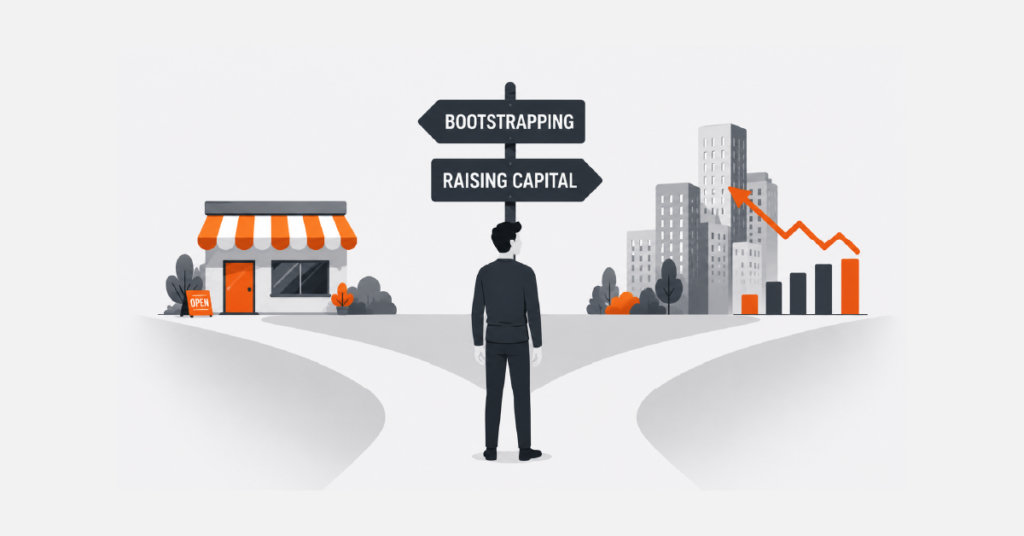
Bootstrapping vs Raising Capital: A Simple Comparison
| Bootstrapping | Venture Capital | |
| Ownership | Founders keep more equity | Equity is exchanged for capital |
| Control | More founder control | Investor involvement increases |
| Growth speed | Limited by company cash flow | More capital can support faster growth |
| Financial pressure | More direct on the founder | More capital, but higher growth expectations |
| Best fit | Businesses that can grow from revenue | Businesses where speed or capital needs are central |
Neither path guarantees success. The useful question is which trade-offs fit your business right now.
Choose the Capital Model That Fits the Business
Bootstrapping vs raising capital is not a universal choice.
Bootstrap when customer revenue can fund growth and ownership matters more than speed.
Raise when capital creates a clear advantage that revenue alone cannot provide.
Wait when you still need to prove the model or cannot explain what the money will change.
The goal is not to raise as early as possible or bootstrap forever.
The goal is to use the right source of capital at the right stage for the business you are actually building.
FAQs
What is the difference between bootstrapping and raising venture capital?
Bootstrapping means funding growth through founder money and customer revenue. Venture capital means giving investors equity in exchange for funding. The main differences are ownership, control, growth pace, and investor expectations.
Should I bootstrap or raise capital?
Look at your market, growth requirements, cash needs, and goals. Ask whether customer revenue can fund the next stage and whether outside capital would create a clear advantage.
What do investors look for before funding a startup?
Investors may assess the team, market, traction, business model, product-market fit, and supporting metrics. See Tinova’s startup investor checklist for the full breakdown.
Can I bootstrap and raise venture capital later?
Yes. You can bootstrap to validate the product, build customers, and generate revenue, then raise when capital can help accelerate proven growth.
When should a startup wait before raising?
Waiting may make sense when product-market fit is still unclear, traction is weak, or you cannot explain how new capital will produce a measurable next milestone.
What is a network effect?
A network effect happens when a product becomes more valuable as more users join or participate in the network. NFX documents several types of network effects and how they work. Read the NFX Network Effects Manual.
Does raising funding mean a startup has product-market fit?
No. Funding shows that investors chose to back the company. Product-market fit is demonstrated through customer behavior such as repeat usage, retention, renewals, and referrals.
Further Reading
- Investor-Ready in 21 Days
- What Do Investors Want to See in a Startup Before Funding?
- 1,000 Signups Is Not Traction
- Revenue Can Be a False Safety Net