
Learn how the Hustler and Hacker founding team framework helps pre-seed founders show customer access, product execution, and team coverage.
Before investors study your traction, they study the people building the company.
At pre-seed, you may have limited revenue and a product still taking shape. The question becomes simple: Can this team understand the customer, build the product, and keep learning fast?
The Hustler + Hacker framework gives you a practical way to answer that.

Why the Team Is the First Proof
Investors are not only backing a product. They are backing the founders who have to turn an idea into a company.
That means looking for customer understanding, execution speed, and evidence of learning.
Tino Aliye applies a similar principle when evaluating people at Tinova: look at the problem someone solved and the result they created, not just the title on a résumé.
So ask yourself:
If an investor saw only our founding team, what risks would they spot first?
That question tells you what proof is missing.
The Hustler: Customer Access and Demand
The Hustler is the founder closest to the customer.
Their job is to understand the pain, reach potential buyers, test the message, and find evidence that people care enough to act.
Proof can include:
| Hustler responsibility | Proof investors can see |
| Understand customer pain | 20 to 30 customer conversations, direct quotes, repeated pain points |
| Reach the market | Outbound conversations, warm introductions, qualified prospects |
| Test demand | LOIs, early customers, waitlists, response and conversion patterns |
Tinova’s [30-Prospect Test] Founder Led Sales Pre-Seed: The 30-Prospect Test uses the same principle: talk to real prospects before scaling a sales motion.
One customer is a signal. A repeatable pattern is stronger proof.
The Hacker: Product Speed and Learning
The Hacker turns customer problems into working products.
At pre-seed, investors do not need a perfect product. They need evidence that the team can build, test, learn, and improve.
Show:
- How quickly the MVP was built
- How many real users tested it
- What changed after feedback
- Which ideas were dropped because customers did not respond
For example:
“We built the first version in three weeks, tested it with 15 clinic owners, and changed the product based on their feedback.”
That is more useful than saying, “Our team moves fast.”
The Hustler finds the problem worth solving. The Hacker proves the team can build around it.
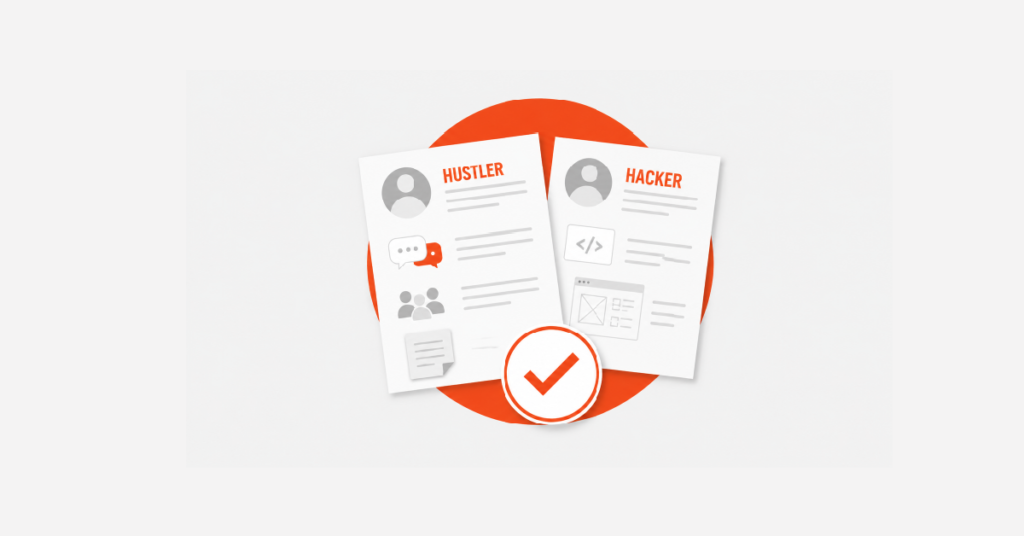
Hustler + Hacker: What Each Role Covers
| Hustler | Hacker |
| Customer pain | Product building |
| Market access | Shipping speed |
| Demand testing | User testing |
| Sales learning | Product learning |
| Customer proof | Product proof |
Your team does not have to match these labels perfectly. The point is to make sure both sets of risks have an owner and evidence.
What Current Data Says About Solo vs. Two-Founders
Carta’s 2026 Founder Ownership Report shows that about 36% of startups founded on Carta in 2025 were solo-founded. Among startups that successfully closed venture rounds on Carta, two-founder teams were the most common structure at 36%, rising to 40% in SaaS. Carta Founder Ownership Report 2026
That gives you two useful facts at once:
Solo founders are common. Two-founder teams are also common among funded startups.
The numbers do not mean every startup needs two founders. They show that team structure is part of the risk investors assess.
Y Combinator also says it accepts solo founders, while noting that one-person startups are harder and that founders are more likely to succeed with a co-founder. YC FAQ: Can a single person apply for funding?
Solo Founder vs. Two-Founder Team
A two-founder team can divide customer and product work. A solo founder has to show how both sides are covered.
That does not mean adding a co-founder just to make the team slide look stronger.
For a solo founder, show:
Customer side: conversations, demand, sales learning, market access.
Product side: product decisions, shipping, testing, iteration.
Support: technical partners, advisors, contractors, or other trusted people who cover genuine gaps.
The goal is not a bigger team. It is better risk coverage.
If You Are a Solo Founder
Start with the gap, not the title.
If you are technical but weak on customer access, show who helps you reach buyers and how you are building that skill.
If you are strong commercially but cannot build the product yourself, show the technical person responsible and their actual contribution.
Do not add a co-founder because you think investors expect a certain slide. YC’s guidance also warns founders against adding a co-founder simply because it seems like the right thing to do. YC on Finding a Co-Founder
Tinova makes a similar point in its guide on [prestige hires] Why Prestige Hires Don’t De-Risk a Pre-Seed Startup: a familiar name or title does not replace proof of execution.
Treat the Team Slide Like a Risk Map
Tinova has diagnosed 200 startups and built a diagnosis-first process around identifying the biggest business gaps before deciding what to build.
Apply that same thinking to your team.
For every major pre-seed risk, ask:
Who owns it? What proof do they have? What proof is still missing?
That turns a team slide from a list of résumés into evidence.
FAQs
Do investors prefer two founders?
Two-founder teams are common among startups that successfully raised venture funding on Carta, but solo-founded startups also make up a substantial share of companies. The important question is whether the team covers the risks the company faces. Carta Founder Ownership Report 2026
Can a solo founder raise pre-seed?
Yes. Solo founders can raise, but they need a clear answer for how customer, product, and execution gaps are covered. YC FAQ
What is the Hustler + Hacker framework?
The Hustler covers customer understanding, market access, and demand. The Hacker covers product building, shipping, testing, and learning. Together, they show whether the founding team can handle the two core early-stage challenges: reaching customers and building the right product.
Your Team Is Your First Proof
Your founding team tells investors what the company can realistically do next.
Whether you are a solo founder or part of a two-founder team, make the coverage clear:
Who understands the customer?
Who builds the product?
Who owns each major risk?
What proof supports each claim?
That is the story investors can actually evaluate.
Tinova’s Investor-Ready in 21 Days program helps pre-seed and seed founders strengthen positioning, offers, websites, pipeline, and investor assets before a raise.