Welcome to our series on building and growing a startup.
Starting a business involves more than having a good idea. From understanding what your business needs to improving your offer and developing the skills to run it, each stage brings different decisions.
Explore the articles in this series:
Part 1: If You Had 30 Days to Work on Your Startup, What Would You Work On?
Part 2: How to Make Your Offer Clear to Potential Customers ← This post
Part 3: What Skills Do You Need to Run a Startup?
Let’s get into it.
You’ve explained your service to a potential customer. They ask questions, say it sounds interesting, and promise to think about it. A week later, the conversation has stopped.
Was the buyer uninterested, or did they leave without understanding what they would purchase?
To learn how to make your offer clear, explain who it’s for, the problem it addresses, what customers receive, why the solution matters, what buying involves, and the next step. Then check whether real buyers understand it.
What Makes a B2B Offer Clear?
A value proposition describes why a solution matters. A B2B sales offer goes further: it gives someone enough information to evaluate a purchase.
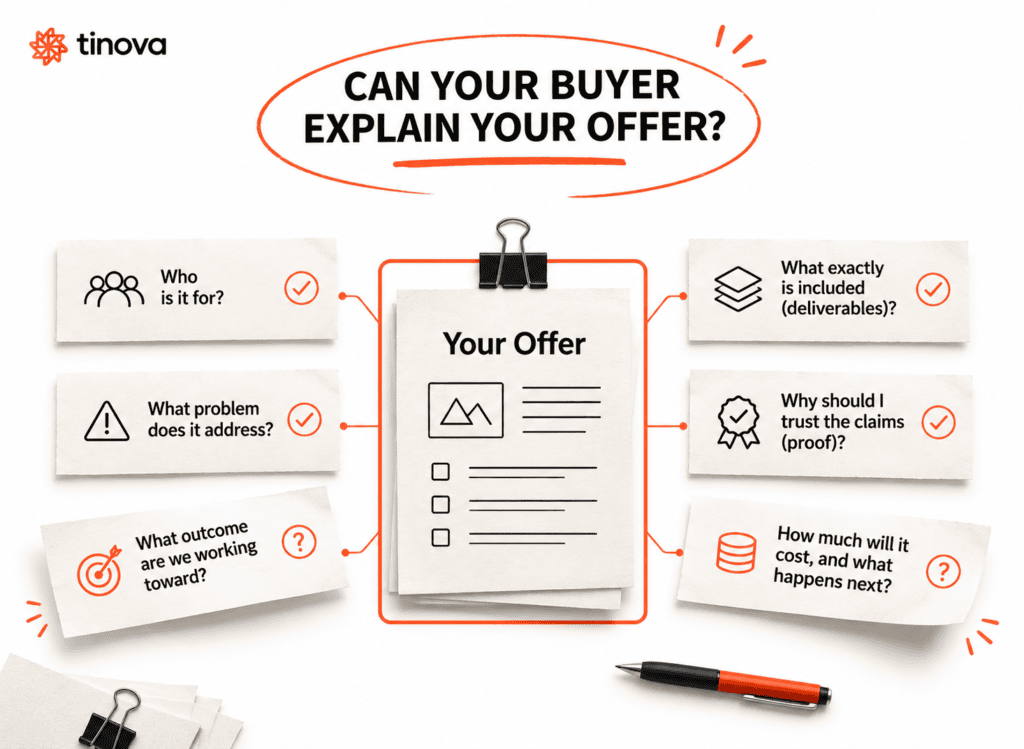
A buyer should be able to answer six questions: Is this for a business like mine? Does it address a problem I recognize? What outcome are we working toward? What exactly is included? Why should I trust the claims? How much will it cost, and what happens next?
If your prospect understands the general idea but cannot explain the commitment, your offer still needs work.
Start With the Problem Your Customer Wants to Solve
When you’ve spent months developing a product, it’s natural to describe its features first. But buyers need to recognize their own situation before those features become meaningful.
This is also the thinking behind Strategyzer’s Value Proposition Canvas, which connects a customer’s needs, problems and desired outcomes with the value a product or service provides.
Consider this illustrative example.
Unclear: “AI-powered workflow automation for growing businesses.”
Clearer: “A workflow tool for B2B service firms that lose track of prospects after sending proposals.”
The second statement identifies a buyer and a recognizable problem. To develop it further, ask how the business currently handles follow-ups.
Are proposals overlooked? Does nobody own the next action? What happens when a prospect replies?
Use the answers to describe the problem accurately, rather than assuming automation itself is the benefit.
Explain Exactly What Customers Will Receive
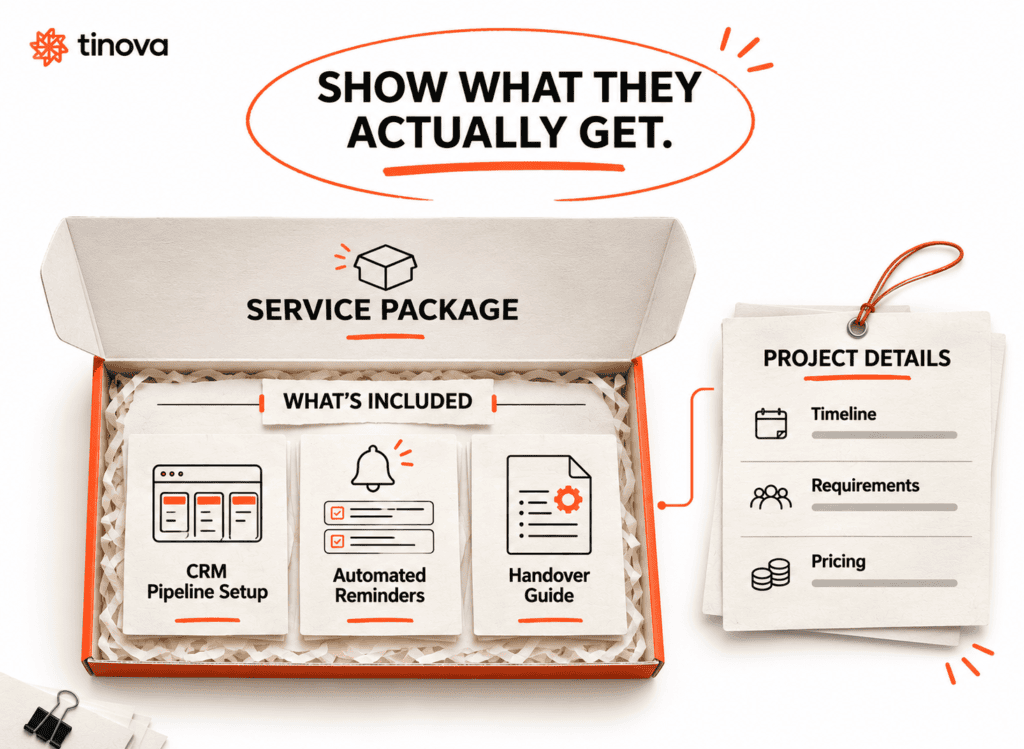
The clearer statement is a useful introduction, but it isn’t yet a complete offer. A buyer also needs to understand the actual work.
More complete offer (illustrative):
“For B2B service firms losing track of prospects after proposals, we configure a CRM follow-up workflow. The package includes pipeline stages, automated reminders, and a handover guide. We agree on pricing, delivery timing, and required system access before work begins.”
Now the buyer can picture what is being delivered and what still needs discussing.
In your own proposal, define the deliverables, expected timeline, support, and what isn’t included. Explain whether the client must provide data, grant system access, attend setup meetings, or approve anything.
For SaaS, clarify which features belong to each plan and whether onboarding costs extra.
An offer is easier to evaluate when its boundaries are visible, not hidden in follow-up conversations.
How Can You Show the Value of Your B2B Offer?
Your prospect may be comparing you with another provider, an existing tool, or doing nothing.
Connect the work to the cost of the problem. In the follow-up example, the value isn’t simply having automated reminders. It’s giving the team a reliable way to see which proposals need attention and who is responsible.
Use proof you genuinely have: a product demonstration, relevant completed work, documented customer feedback, or a case study with verifiable results.
If you don’t yet have results, explain how the buyer could evaluate the solution without promising an outcome you cannot support.
If your offer sounds interchangeable with competitors, review Tinova’s positioning guide.
Make Pricing and the Next Step Easy to Understand
A clear business offer should also explain what buying demands.
Is the fee recurring or one-time? What determines the final price? Are there setup costs, minimum terms, or required approvals?
You don’t need to publish a fixed price for custom work. You do need to explain how the price is established.
Remember that the person who wants your solution may not approve the budget. A sales manager might welcome better follow-up, while an owner checks costs and an IT colleague reviews system access.
Give everyone a specific next step, such as reviewing a scoped proposal or booking a call to confirm requirements.
How to Test Whether Customers Understand Your Offer
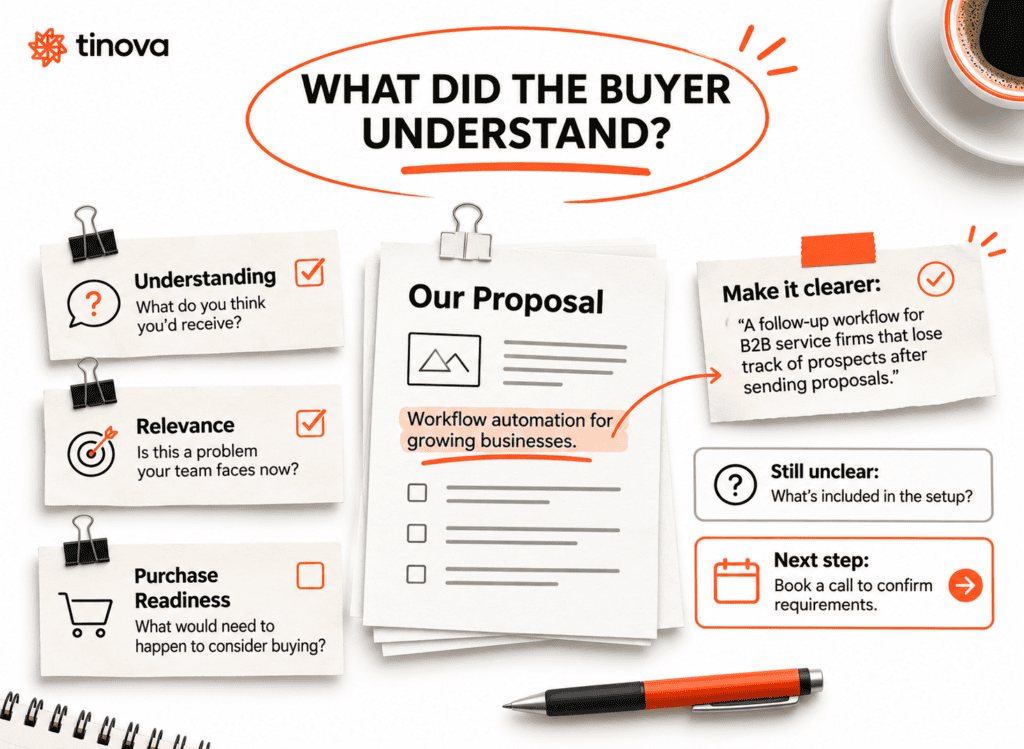
Show your current sales page or proposal to a few people who match your intended buyers. Let them read it without explaining it first.
Ask three kinds of questions:
- Understanding: “What do you think you’d receive?”
- Relevance: “Is this a problem your team is dealing with now?”
- Purchase readiness: “What would need to happen before your company could consider buying?”
Listen for missing information and unexpected assumptions.
Then ask whether the person would consider a meaningful next step, such as discussing a real project or involving the budget owner.
A positive reaction may suggest interest, but it doesn’t prove they’ll purchase. Record what buyers actually understood, questioned, and agreed to do.
What If Customers Understand Your Offer but Still Don’t Buy?
Clarity is only one part of the decision. A relevant buyer can understand everything and still say no.
| What the buyer says | What to investigate |
| “We don’t need this yet.” | Urgency and problem importance |
| “How would this work here?” | Implementation effort and scope |
| “My manager must approve it.” | Authority and purchasing process |
| “It’s too expensive.” | Budget, evidence, value, and alternatives |
Don’t discount or rewrite your offer after every objection. Identify what’s uncertain first.
If the real challenge is reaching qualified buyers, Tinova’s first 10 B2B customers guide addresses that earlier problem.
Review Your Offer From the Customer’s Perspective
Open your sales page or proposal. Can a buyer identify the intended customer, problem, expected improvement, deliverables, proof, commitment, and next step?
Find the biggest unanswered question, correct it, and test the revision.
If you’re unsure whether the obstacle is your offer, positioning, or sales process, Tinova’s Free GAP Analysis can help you identify what needs attention first.
Written by Tinova Growth Team
The Tinova Growth Team shares practical guidance for early-stage B2B founders navigating positioning, sales, and customer acquisition.