Learn how to spot a lead problem vs positioning problem with a 5-minute test. Find out what to fix before spending more on marketing.
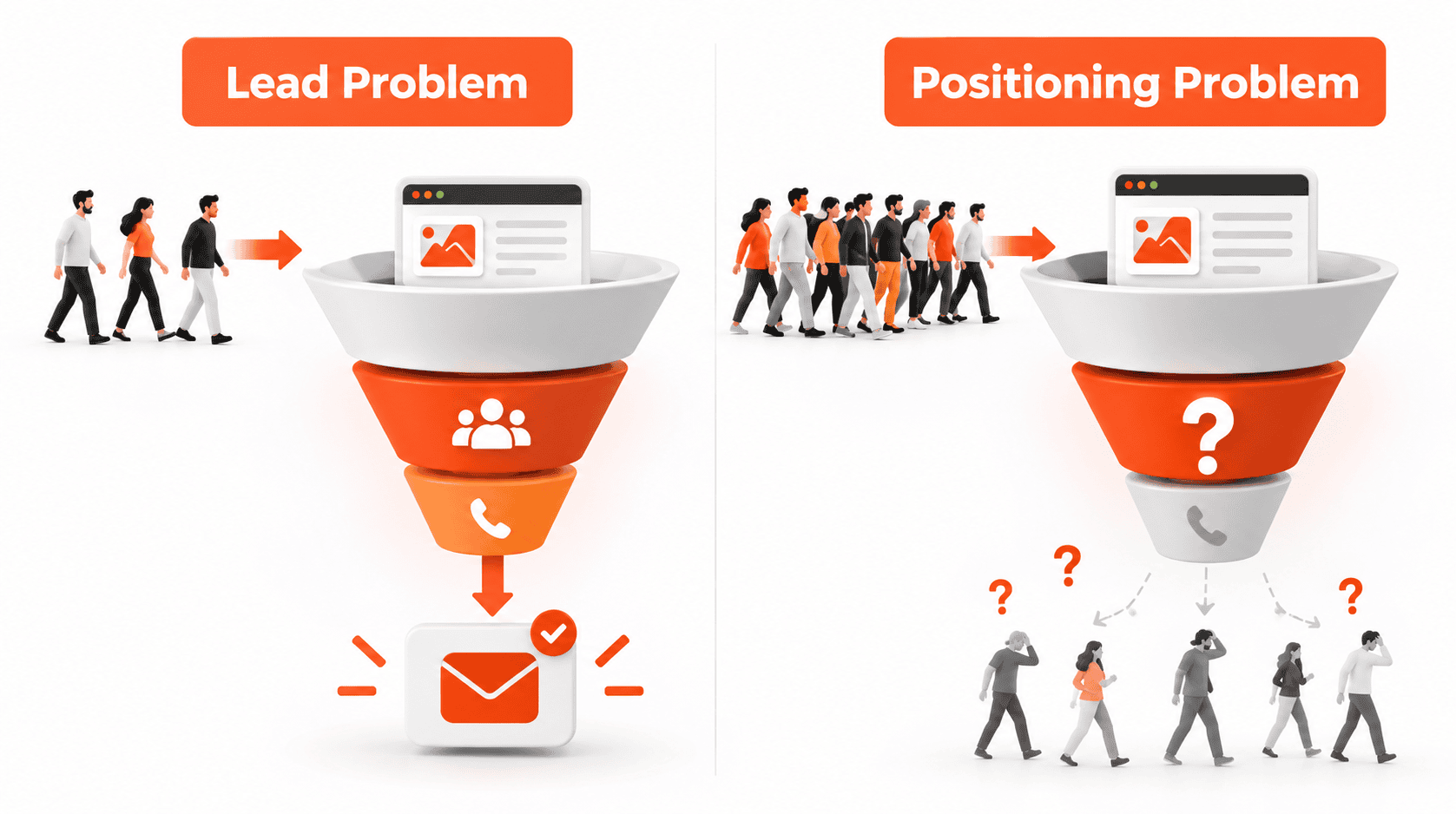
An empty pipeline does not always mean you need more leads. The difference between a lead problem vs positioning problem comes down to whether the right people can understand your offer and see why it matters to them.
Before increasing your marketing budget, use this five-minute test to decide what needs attention first.
TLDR: If few qualified prospects discover your business but people understand your offer and convert, focus on lead generation. If people visit your site but cannot explain your offer or see why they should choose you, fix your positioning first.
How to Diagnose Your Problem in 5 Minutes
1. Run the Retell Test
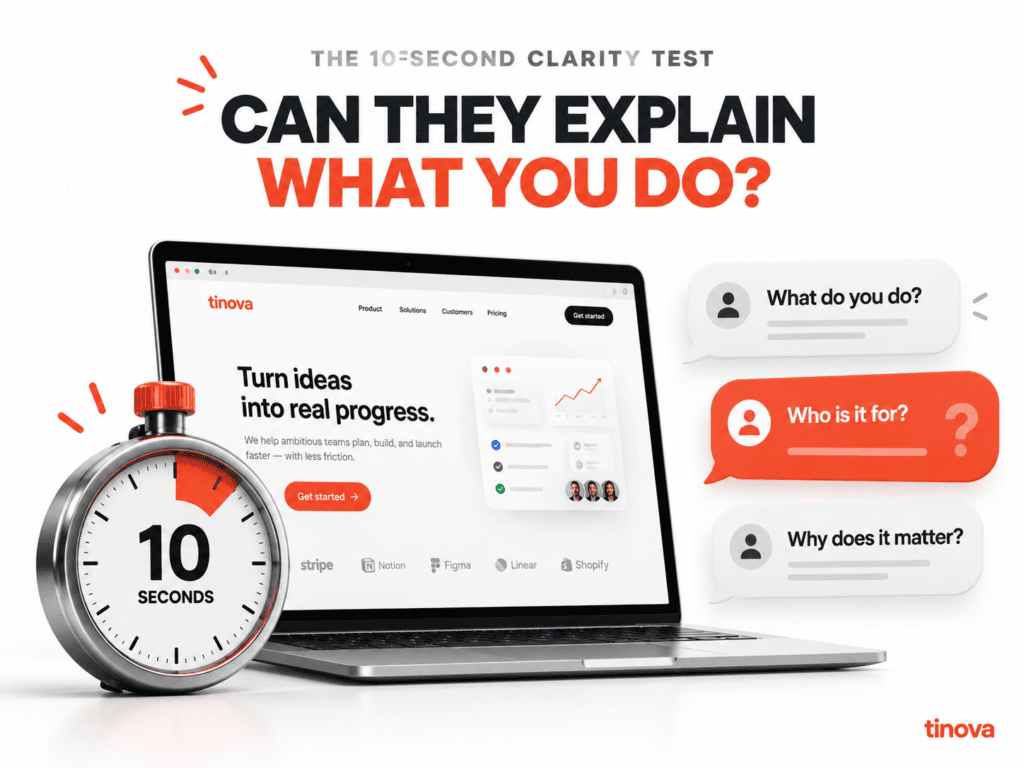
Show your homepage to five people in your target audience for 10 seconds. Hide it and ask:
“What does this company do, who is it for, and what problem does it solve?”
If their answers are vague, your message needs work. Phrases such as “we help businesses grow” tell people very little about your value.
If they can explain your offer clearly, your positioning may be working. For more guidance, explore Tinova’s brand strategy and positioning services.
Visual 2 — Middle (The 10-Second Clarity Test)
2. Check Your Conversion Rate
Look at how many qualified visitors take your primary action, such as booking a call or requesting a demo.
- Low conversion: People arrive but do not act. Review your message, offer, proof, pricing, and page experience.
- Healthy conversion but few enquiries: Your offer may be clear, but not enough qualified people are finding you.
A conversion rate below 1% can be a warning sign, while 3% or more may be encouraging. These are practical clues, not universal benchmarks. The right rate depends on your audience, channel, and call to action.
Check your website structure and conversion path before assuming you need more leads.
3. Look at Why Deals Stall
Are prospects choosing a competitor, or are they delaying the decision altogether?
A Harvard Business Review article covering more than 2.5 million recorded sales conversations reported that 40% to 60% of deals ended in customer indecision rather than a completed purchase. Read the research on customer indecision.
This does not prove a positioning problem on its own. However, when prospects repeatedly question your value, struggle to see the difference between your offer and alternatives, or cannot justify the cost, your message deserves a closer look.
4. Check Whether Your Message Sounds Different
Read your homepage headline beside those of three competitors. Replace their logos with yours. Does your message still sound unique to your business?
If every company promises efficiency, innovation, and growth, prospects have little reason to remember one over another.
Wynter’s B2B messaging research found that 64% of B2B buyers find it difficult to distinguish vendors from their websites. Clear positioning helps explain who you serve, which problem you solve, and why your approach is a relevant choice.
The 5-Point Positioning Scorecard
Give yourself one point for each statement that describes your business.
| Check | Score |
| Strangers cannot clearly explain your offer. | +1 |
| Your headline could describe several competitors. | +1 |
| Qualified visitors reach your site but few take the primary action. | +1 |
| Prospects keep asking what makes your offer different. | +1 |
| Deals stall because the value, price, or reason to act is unclear. | +1 |
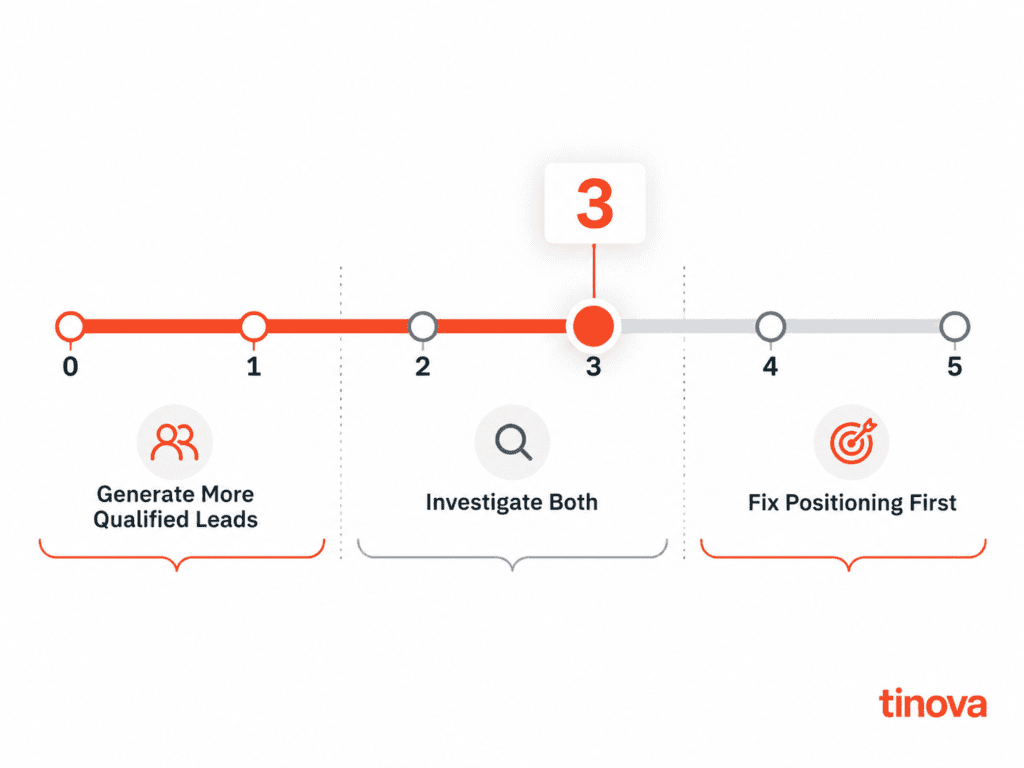
How to interpret your score:
- 0 to 1: Check lead generation first. If people understand your offer and conversion is healthy, focus on reaching more qualified prospects.
- 2 to 3: Investigate both. Test your message and review where qualified prospects drop off before changing your budget.
- 4 to 5: Prioritise positioning. Clarify your audience, offer, value, and proof before increasing acquisition spend.
This scorecard is a practical starting point, not a validated scientific test. Use it alongside your conversion data and feedback from prospects.
Visual 3 — Middle (The Positioning Scorecard)
Lead Problem vs Positioning Problem: The Difference
| Factor | Lead Generation Problem | Positioning Problem |
| Qualified prospects | Too few are reaching you. | The right people may already be finding you. |
| Conversion | Healthy for your main action. | Low or declining despite qualified visits. |
| Customer feedback | People understand the offer. | People struggle to explain its value. |
| Lost deals | Not enough suitable opportunities. | Unclear value, weak differentiation, or hesitation. |
| Next step | Reach more qualified prospects. | Clarify the offer, message, and proof. |
When Should You Spend More on Marketing?
Do not rewrite a message that already works. If prospects understand your offer, your conversion rate is healthy, and qualified opportunities are limited, focus on the channels that can bring you more suitable prospects.
A published DriveShield case study offers a useful example of why the order matters. The company rebuilt its offer and follow-up process before activating one acquisition channel. The reported result was $3.2 million in new revenue over 28 days. This is a specific client outcome, not a guarantee of similar results.
The lesson is simple: fix the main constraint before spending more to bring in leads.
FAQs
How do I know if I have a lead problem or a positioning problem?
Check whether qualified prospects can explain your offer, understand its value, and take the next step. If they can but too few reach you, lead generation may be the priority. If they cannot, investigate positioning and conversion first.
Why am I getting website visits but no enquiries?
Your message may be unclear, your offer may not fit the audience, or your page may lack proof and a clear next step. Review these factors before increasing your marketing spend.
Should I fix positioning before running ads?
If people cannot explain what you offer or why it matters, improve the message before investing more in ads. If your offer is clear and converts well, focus on reaching more qualified prospects.
Diagnose Before You Spend
If you are still unsure which problem is holding your business back, start with a free 30-minute GAP Analysis through Tinova. It examines your offer, website, and follow-up process to help identify the most important gap to address first.
Written by: Tinova Growth Team
Tinova is a marketing and growth agency for startups and owner-led businesses. Its current site reports 200 startups diagnosed, 77+ businesses scaled, 3 awards in 2026, and $10M+ in client funding pipeline built.
Updated: October 7, 2026
Disclosure: Tinova provides diagnostic and strategic marketing services. This article offers practical guidance and does not guarantee a particular business outcome.