PLG vs sales-led pricing: learn why price affects your GTM motion and how to match SaaS pricing with the way customers actually buy.
PLG vs Sales-Led Pricing: Why Price Comes First
Most founders choose a price and a GTM strategy separately.
That creates a problem.
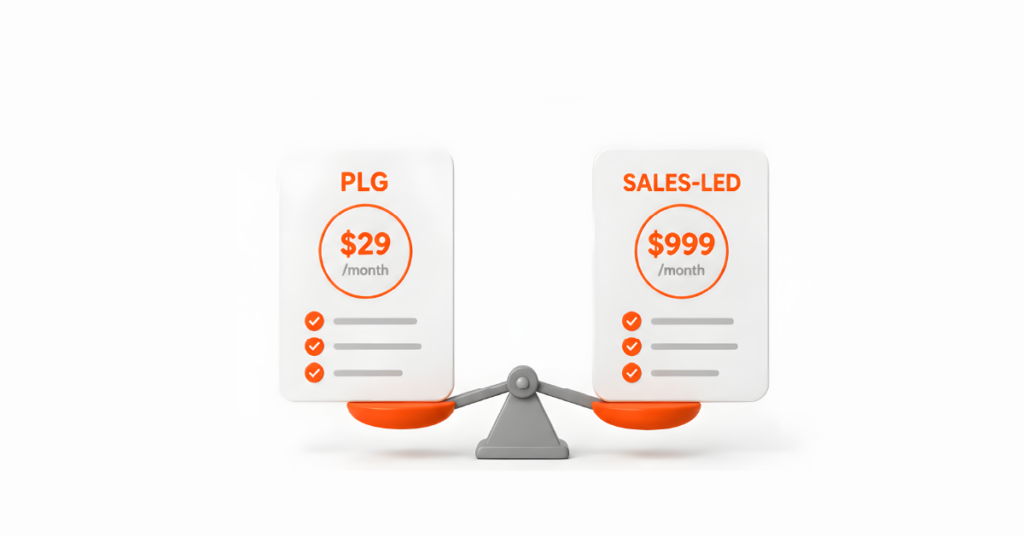
A $49/month SaaS product cannot support the same customer acquisition process as a $10,000/year enterprise product. Your price affects how much you can spend to acquire a customer, how much human support the sale can carry, and how quickly you need customers to convert.
So the better question is not:
“Should we use PLG or sales-led growth?”
Ask:
“What GTM motion can our price actually support?”
Key Takeaways
- Lower prices generally fit self-serve or PLG motions better.
- Higher prices can support more human involvement and longer sales cycles.
- Complex B2B purchases may need sales even when the product has a self-serve entry point.
- At pre-seed, pricing is a hypothesis, not a proven ASP.
- Test your price and GTM motion together before hiring around either one.
What the SaaS Data Shows
ChartMogul’s 2025 SaaS Go-To-Market Report analyzed 2,500 SaaS companies and found that lower-price B2B companies can grow new business faster through PLG, while companies with higher prices tend to introduce sales as the buying process becomes more complex. Their research also found that trial-to-paid conversion spikes around the first week for both PLG and sales-led companies.
The useful lesson is not that PLG always beats sales.
It is that your price, customer, and buying process need to make sense together.
Why Price Sets Your GTM Motion
Consider a simple example.
A product costs $50/month and a customer stays for 12 months.
That gives you $600 in revenue per customer before considering costs.
If you use a 3:1 LTV:CAC target, your allowable acquisition cost would be around $200.
That leaves very little room for a sales process that requires a salesperson, demos, multiple calls, and long follow-up.
Now compare that with a product priced at $1,000/month. The economics can support much more human involvement.
Tinova’s pricing guidance makes the same point: price determines your GTM motion, and your GTM motion determines what the economics need to support.
The Two Common Pricing Mistakes
1. Low Price + Sales Team
A founder prices a SaaS product at $49/month, then hires a salesperson because growth feels too slow.
The problem is not the salesperson.
The problem is the math.
If each customer generates too little revenue, sales costs can consume the margin before the model has time to prove itself.
2. Complex Product + Self-Serve Only
The opposite problem happens when a founder sells a high-value B2B product that requires security reviews, procurement, implementation, or several decision-makers, then expects customers to buy without talking to anyone.
For a product costing $10,000/year, a sales conversation may be part of the buying process.
The motion should match how the customer buys.
Which GTM Motion Fits Your Price?
| Monthly Price | Annual Value | Possible GTM Motion | Why |
| Under $50 | Under $600 | Self-serve / PLG | Limited room for sales costs |
| $50 to $250 | $600 to $3,000 | PLG + sales assist | Some human help can fit |
| $250 to $1,000 | $3,000 to $12,000 | Founder-led / inside sales | More room for direct selling |
| $1,000+ | $12,000+ | Sales-led / enterprise | Supports higher-touch buying |
These are working ranges, not universal rules. Your buyer, retention, gross margin, sales cycle, and implementation costs can change the answer.
Image alt text: PLG vs sales-led pricing tiers matched to SaaS GTM motions
At Pre-Seed, Your Price Is a Hypothesis
You probably do not have enough customers to call your price a proven Average Selling Price.
You have a pricing hypothesis.
That number should come from evidence.
Tinova’s current pricing guidance recommends looking at the cost of the customer’s alternative, testing willingness to pay with prospects, and checking whether the resulting ACV can support the intended GTM motion.
For example:
“We think customers will pay $500/month.”
That is an assumption.
A stronger version is:
“We tested $500/month with 10 prospects. Six considered it reasonable, three asked for annual pricing, and two agreed to a paid pilot.”
Now the number has evidence behind it.
Use Pricing as Customer Research
Do not ask:
“What would you pay?”
People can give you a polite answer without ever buying.
Instead, put a price in front of them and watch what happens.
Ask:
- Is this too expensive?
- What would make this worth the price?
- What are you paying today to solve this?
- Who controls the budget?
- If the price worked, when would you start?
A price conversation gives you more information than a hypothetical pricing question.
Tinova’s recent pricing research also recommends comparing your price with the customer’s current alternative, including manual work, spreadsheets, employees, or existing software.
Your Pricing Should Match Your Customer
Price also affects who says yes.
A $200/month product may attract smaller teams with a specific urgent problem. A $2,000/month product may require a buyer with more budget, a larger problem, and a stronger business case.
That is why pricing and your Ideal Customer Profile (ICP) should be considered together.
If you have not defined your first customer segment, start with Tinova’s guide to choosing a beachhead market for pre-seed fundraising.
And if you are testing founder-led sales, Tinova’s 30-Prospect Test gives you a practical way to test whether the buyer, problem, and message are connecting.
A Tinova Insight: Pricing Is Part of the Business Foundation
Tinova currently reports 200 startups diagnosed and 77+ businesses scaled, with $10M in client pipeline built. Its Business Foundation service treats pricing, offers, business model, and unit economics as the first layer to examine before marketing.
That matters because marketing cannot fix pricing that cannot support growth.
If the economics do not work with 10 customers, getting 100 customers will not solve the underlying problem.
That is a useful test for any pre-seed pricing hypothesis.
How to Explain Pricing in Your Pitch Deck
Do not put a price on the slide without explaining the logic behind it.
Try:
“We priced at $99/month, so we are testing a self-serve motion. Our main risk is activation and conversion, which we will test with our first 100 users.”
Or:
“We priced at $1,200/month and are using founder-led sales. Our main risk is whether the sales process can become repeatable beyond the founders.”
Now the investor can see the connection between price, GTM motion, and risk.
That is much stronger than simply saying, “Our competitors charge $999, so we charge $999.”
Y Combinator’s pricing guidance also emphasizes understanding the relationship between price, customer value, costs, and the incentive to sell.
Should You Use PLG and Sales-Led Together?
Yes, but the two motions should have a reason to coexist.
A SaaS company might let smaller customers sign up through PLG while a sales team works with larger accounts.
ChartMogul’s research shows that PLG and sales-led approaches can complement each other, particularly as products move toward more complex buying processes.
For a pre-seed startup, however, running two motions can create two sets of experiments, metrics, processes, and costs.
Prove one motion before adding another unless your customer journey already demands both.
Before You Change Your Price, Check These 5 Things
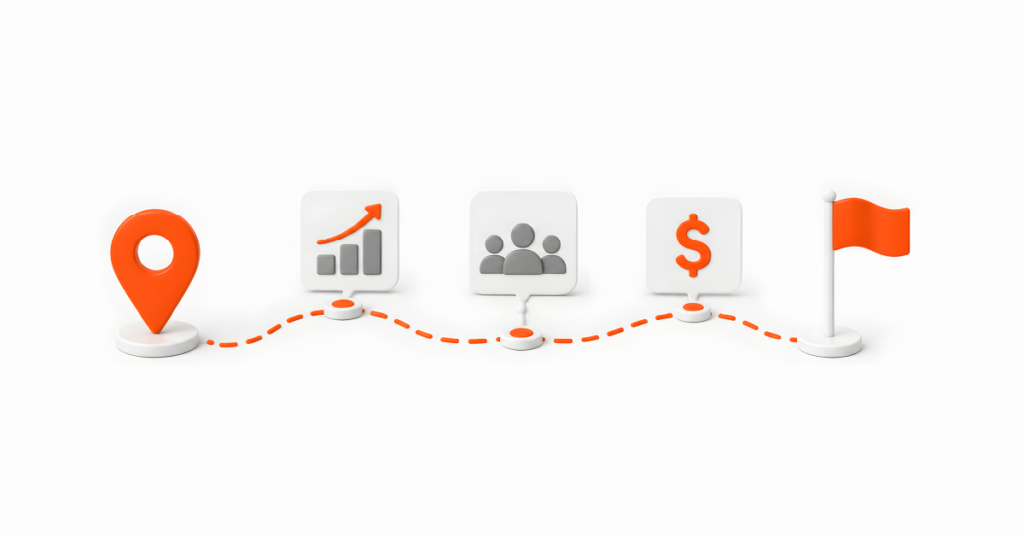
- Customer: Who is buying?
- Value: What does the product save or create for them?
- Alternative: What do they use today?
- ACV: Can the price support the acquisition process?
- Motion: How does this customer actually want to buy?
If the answers do not connect, do not rush into hiring sales or spending more on acquisition.
Fix the model first.
FAQs
What is the difference between PLG and sales-led GTM?
Product-led growth (PLG) uses the product itself to drive acquisition, activation, and conversion with limited human involvement. Sales-led growth relies more heavily on people to guide prospects through the buying process.
How does pricing affect GTM strategy?
Pricing affects how much you can spend to acquire a customer and how much human involvement the economics can support. Lower prices tend to fit self-serve models, while higher prices can support more sales involvement.
Can a SaaS startup use both PLG and sales-led growth?
Yes. A company can use PLG for smaller accounts and sales for larger or more complex purchases. The key is knowing why each motion exists and whether the economics support both.
When should a SaaS startup add a sales team?
Consider sales when the price supports the cost of selling, the buying process needs human involvement, and you have evidence that customers will buy. Do not hire sales simply because self-serve growth feels slow.
How should a pre-seed startup set its first SaaS price?
Start with the customer’s current alternative, estimate the value your product creates, test willingness to pay with prospects, and check whether the price supports your planned GTM motion.
Price and GTM Are One Decision
Your price tells you more than what to charge.
It affects who you can sell to, how you sell, what acquisition cost you can afford, and which GTM motion makes sense.
At pre-seed, you do not need a perfect price.
You need a price you can test, explain, and connect to customer evidence.
Before hiring a sales team or committing to PLG, make sure the numbers and buying process point in the same direction.
If you need help checking your pricing, business model, and GTM economics, start with Tinova’s Business Foundation or Investor-Ready in 21 Days.