
Learn how a customer Letter of Intent, design partner agreement, and paid pilot can create stronger startup proof at the pre-seed stage.
“We have three Fortune 500 pilots in progress.”
That sounds impressive. But if none becomes a paying customer, the logos tell you very little.
At pre-seed, you may not have meaningful revenue yet. What you can have is evidence of customer commitment.
A customer Letter of Intent, design partner agreement, or paid pilot can show that a real buyer is willing to give up time, budget, access, or internal resources to work with you.
That is the foundation of a useful proof layer.
What Is a Customer Letter of Intent?
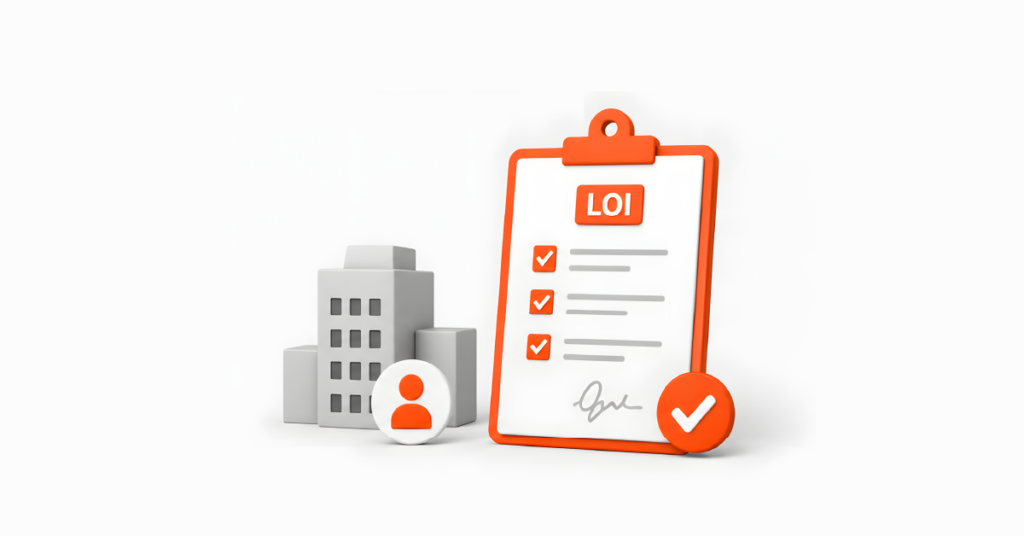
A customer Letter of Intent (LOI) is a document showing that a potential buyer intends to purchase or work with your company under agreed conditions. It is generally not the same as a final sales contract.
It is also different from an investor LOI, which relates to potential investment.
For startup fundraising, the useful question is not simply whether you have an LOI. It is what the LOI actually commits the customer to.
A detailed LOI with a buyer, price, timeline, and conditions tells a clearer story than a one-line statement of interest.
What Makes a Startup Proof Point Valuable?
Use one simple rule:
The value of a proof point increases with the commitment the other party makes.
A person joining a waitlist gives you an email address.
A design partner gives you time, feedback, access, and possibly payment.
A paying customer gives you money.
That creates a simple Commitment Ladder:
| Proof Point | Customer Commitment | What It Shows |
| Waitlist signup | Email address | Interest |
| Free pilot | Time and feedback | Engagement |
| Customer Letter of Intent | Written purchase intent, internal approval, or budget planning | Demand |
| Design partner agreement | Time, product input, access, and sometimes payment | Active collaboration |
| Paid pilot or contract | Actual budget | Willingness to pay |
The point is not that every startup needs to reach the bottom of the table before fundraising.
The point is to describe each proof point honestly.
Why Do Investors Look Beyond Logos and Signups?
Early-stage investors know that pre-seed companies may have little or no revenue. What matters is whether the founder has evidence that customers care about the problem and are willing to take action.
Hustle Fund’s early-stage framework, for example, looks at customer discovery, pre-sales or waitlists, and experimentation when evaluating startups that may not have traditional traction yet.
That is why 1,000 free signups and one customer willing to pay are not interchangeable proof points.
A signup shows interest.
A payment shows a financial decision.
A detailed LOI can sit between the two, depending on its terms and the commitment behind it.
What Should a Customer Letter of Intent Include?
A useful customer LOI should make the intended purchase clear.
Investors and buyers may look for:
- Who signed it?
- Is the person involved in the buying decision?
- What will they buy?
Include the product, quantity, pricing, or scope where possible.
- When will they buy?
Give a timeline rather than leaving the commitment open-ended.
- What conditions apply?
State what needs to happen before the purchase.
For example:
“Company A intends to purchase 50 seats at $200 per seat per month if the product meets the agreed specifications by Q3 2026.”
That is much easier to evaluate than:
“Company A is interested in our product.”
The details turn interest into evidence.
When Is a Design Partner Better Than a Customer LOI?
A customer Letter of Intent shows purchase intent. A design partner agreement shows that a customer is willing to help develop and test the product.
A design partner can make more sense when:
- The product is still being built.
- You need real customer feedback.
- The buyer will give your team access to users or workflows.
- The company is willing to contribute time, resources, or payment.
An LOI can make more sense when:
- The product is close to ready.
- The buyer has already validated the problem.
- The customer is waiting for specific features or conditions to be completed.
The strongest proof depends on the stage of your product. A signed design partner agreement with active participation can be more meaningful than a vague LOI. A paid pilot can be stronger still because money has changed hands.
How Do You Ask for a Customer LOI?
Do not open the first discovery call by asking for an LOI.
First, confirm that the problem is real.
1. Validate the problem
“You mentioned this costs your team 15 hours a week. Is that still the main issue?”
2. Test the buying condition
“If we can reduce that time by half, would you consider running a pilot?”
3. Get the commitment in writing
Once the buyer agrees, document the scope, timeline, success criteria, and intended purchase.
4. Make it two-way
You commit to specific deliverables. The customer commits to evaluating the product and paying if the agreed conditions are met.
Tinova’s 30-Prospect Test is useful before this stage because it helps founders test the problem, buyer, messaging, and response before asking for a deeper commitment.
How Do You Build a Proof Layer Before Fundraising?
Your proof layer should show progression, not just a collection of numbers.
For example:
- 50 qualified waitlist signups
- 10 free pilots with documented feedback
- 2 signed customer LOIs from decision-makers
- 1 paying design partner
Each point answers a different question.
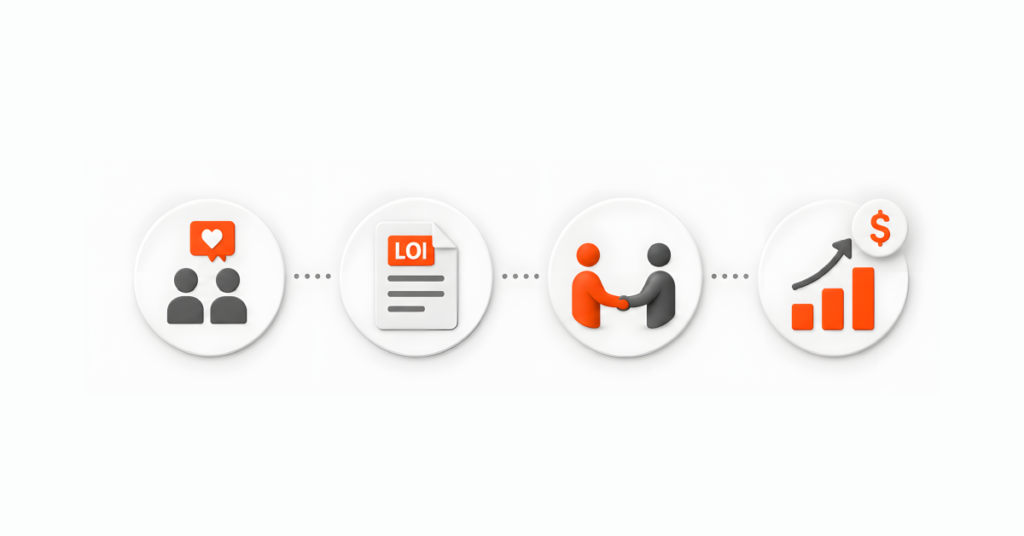
Interest: Do people care?
Engagement: Will they spend time using it?
Demand: Will they commit to buying?
Willingness to pay: Will they actually spend money?
That progression gives investors more context than a slide filled with logos.
It also fits the broader principle behind Tinova’s own pre-seed GTM framework: early assumptions should be connected to evidence and testing rather than presented as established facts.
A Tinova Proof Principle: Name the Number and the Commitment
Tinova’s current proof library uses a similar standard for its own published results. It reports 200 startups diagnosed and 77 businesses scaled, while separating client results from agency numbers and naming the clients behind published case studies.
For example, Tinova’s Genova Medical Courier case study reports $68K from a standing start in 38 days, with the work and timeframe explained alongside the result.
The useful lesson for a startup proof slide is simple:
Do not just show the number. Show what happened, who committed, and over what period.
“$50K pipeline” is incomplete.
“$50K qualified pipeline from 8 named target accounts over 60 days” gives the number context.
The same principle applies to LOIs, pilots, and early customers.
Conclusion
Your proof layer should make one thing clear: real customers are taking real actions because they believe your product can solve a real problem.
A customer Letter of Intent, design partner agreement, or paid pilot can help show that before you have substantial revenue.
Do not count every proof point equally.
Ask:
What did the other party commit?
That answer tells you how much weight the proof should carry in your fundraising story.
If you are preparing to raise and need to strengthen your startup’s positioning, proof, and investor story, Tinova’s Investor-Ready in 21 Days program is built for pre-seed and seed founders preparing to raise.
FAQs
What is a customer Letter of Intent?
A customer Letter of Intent is a document showing that a buyer intends to purchase or work with a startup under stated conditions. It is generally not the same as a final sales contract.
Do investors care about customer LOIs at pre-seed?
Customer LOIs can provide useful evidence of demand, especially when they identify the buyer, intended purchase, pricing, timeline, and conditions. Their value depends on the actual commitment behind the document.
How do you find design partners for an early-stage startup?
Start with customer discovery. Talk to prospects who have the problem you are solving, understand their current process, and identify buyers willing to test the product and give structured feedback.
What is the difference between a pilot and a design partner agreement?
A pilot tests a product with a potential customer. A design partner agreement usually involves deeper collaboration, with the customer helping shape or improve the product during development.
Does a free pilot matter to investors?
Yes, but the details matter. A free pilot can provide useful evidence if it generates meaningful product usage, feedback, a testimonial, or a clear path to payment. A pilot with no engagement or next step is much weaker proof.