What startup traction do investors expect at pre-seed, seed, and Series A? Learn the metrics that matter, signs of product-market fit, and how to present traction that builds investor confidence.
Introduction
Startup traction is the proof that your business is solving a real problem and moving in the right direction. What investors expect, however, changes at every funding stage. Early validation may be enough at pre-seed, but by Series A, investors want consistent growth, strong customer retention, and evidence that your business can scale.
This article explains what startup traction looks like at pre-seed, seed, and Series A, the metrics investors care about most, and how to present your progress in a way that builds confidence.

What Is Startup Traction?
Startup traction is measurable proof that customers want what you’re building. Investors use it to evaluate whether your startup is solving a real market problem and has the potential to grow.
The traction investors expect depends on your funding stage. Early validation may be enough at pre-seed, while seed and Series A require stronger evidence of growth, customer retention, and scalability.
Why Traction Is the Only Thing That Matters
Investors hear hundreds of pitches every year. Most of them sound similar: big market, innovative solution, impressive team. But when the pitch ends, the question that always comes next is the same: “Show me the users.”
That question cuts through everything. It separates belief from evidence. It separates an idea from a business.
Here’s what traction actually proves:
- Real people want your product enough to try it
- Real customers value it enough to pay or return
- Real momentum exists beyond the founder’s own effort
Without traction, you have a hypothesis. With traction, you have a business.
What Traction Do Investors Expect at Each Funding Stage?
If you’re asking what traction do investors expect, the answer depends on where your startup is in its journey.
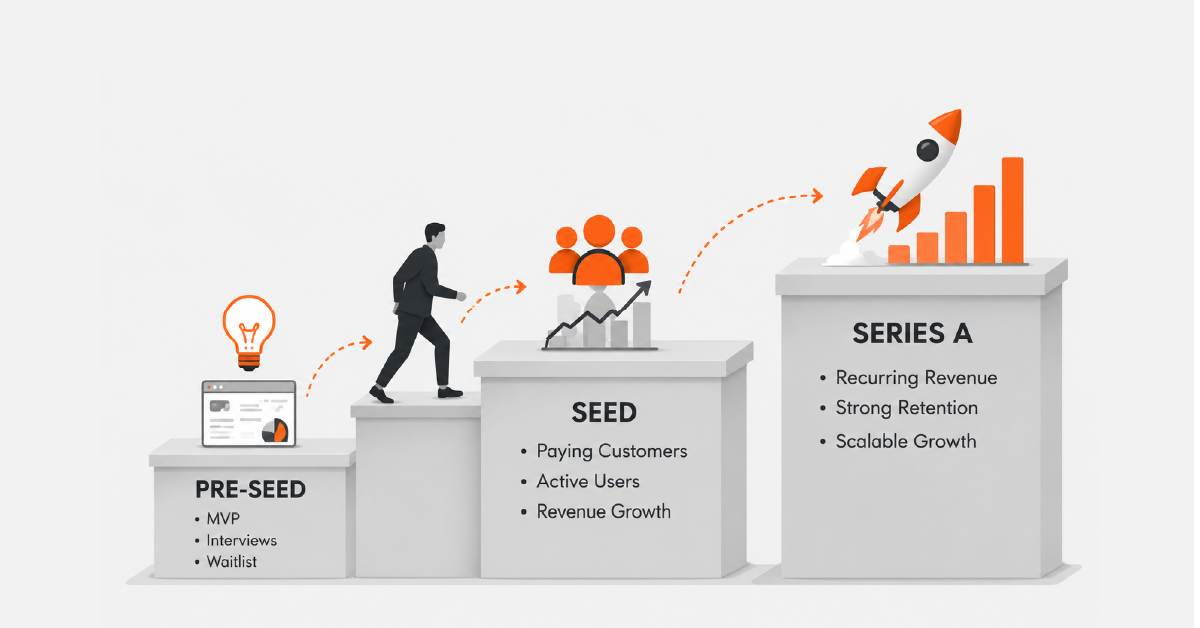
Investor expectations don’t stay the same. They rise with every funding round. At the pre-seed stage, investors may look for customer interviews, an MVP, or early user interest. By the seed stage, they expect signs of steady growth, paying customers, and meaningful engagement.
When you reach Series A, they want proof that your business can scale with consistent revenue, strong retention, and a repeatable growth model.
Think of each funding stage as a higher standard of proof. Every round requires stronger evidence than the one before it. The question isn’t whether you have traction. It’s whether your traction matches the stage you’re raising for.
Pre-Seed Traction: Proving People Actually Want Your Idea
At the pre-seed traction stage, investors are not looking for a fast-growing company. They want proof that you’re solving a problem people care enough to fix.
That proof starts with customer discovery. Have you spoken with potential customers? Did those conversations shape your product? Next comes an MVP, a simple version people can test. A growing waitlist or thoughtful early feedback also shows that interest exists before you invest heavily in development.
Strong pre-seed traction signals
You don’t need thousands of users to impress investors. A handful of strong signals can carry more weight than a large audience with no engagement. Investors pay attention to:
- Beta users who actively test your product and share feedback.
- Pilot customers willing to try your solution in a real business setting.
- Letters of intent that show serious buying interest.
- Early engagement, such as repeat usage or positive referrals.
- Founder expertise that proves you understand the problem and the market better than most.
Common mistakes founders make at pre-seed
Many founders spend months polishing a product before speaking with customers. Others focus on pitch decks instead of collecting evidence that people want what they’re building. Another mistake is celebrating vanity numbers while ignoring feedback that could improve the product.
At the pre-seed stage, investors care less about scale and more about validation. Clear evidence always beats confident assumptions.
Seed Stage Traction: Showing Early Growth and Customer Demand
At the seed stage traction phase, investors expect more than proof that people like your product. They want proof that your business is growing in a repeatable way. This is the stage where early validation starts turning into measurable business performance.
What changes after pre-seed
Pre-seed is about proving the problem is worth solving. Seed is about proving you’ve started building a business around that solution.
Investors expect paying customers instead of interested prospects, repeat usage instead of one-time signups, and steady progress instead of isolated wins. Your product no longer speaks for itself. Your results do.
Startup traction metrics investors want to see at seed
The best startup traction metrics show that your startup is gaining momentum across multiple areas, not just one.
Metric | What It Shows |
Monthly Recurring Revenue (MRR) | Revenue that grows consistently month after month. |
Active users | Customers who continue using your product on a regular basis. |
Customer retention | Your ability to keep customers over time. |
Revenue growth | Whether sales continue moving in the right direction. |
Customer Acquisition Cost (CAC) | How efficiently you gain each new customer. |
Lifetime Value (LTV) | The long-term value each customer brings to your business. |
Conversion rate | How effectively you turn prospects into paying customers. |
No single metric wins a funding round. Investors look for a healthy pattern where these numbers support one another and improve over time.
Real Example: What Seed Traction Looks Like
A SaaS founder showed investors his MRR growing from $1,000 to $5,000 over 8 months. The numbers were small but the trend was clear. More importantly, his churn dropped from 15% to 3% after he rebuilt onboarding. Investors saw the learning curve and backed him.
Why growth matters more than perfection
Seed investors know every startup has gaps. They are not searching for flawless charts or perfect metrics. They want founders who learn quickly, respond to customer feedback, and improve with every step.
A startup that grows steadily, keeps customers, and strengthens its numbers month after month gives investors far more confidence than one with a few impressive figures that fail to hold up over time.
Series A Traction: Proving Your Startup Can Scale
By the time you reach Series A traction, investors already believe your product has value. Now they want proof that your business can grow consistently without relying on founder-led effort alone. The question changes from “Does this work?” to “Can this keep working as the company grows?”
What investors expect before Series A
Series A investors expect a business with a proven foundation. Your startup should have a clear product-market fit, growing revenue, loyal customers, and a business model that delivers consistent results. At this stage, growth needs to look predictable, not accidental.
Key growth indicators that support Series A funding
Investors evaluate several signals together to judge whether your startup is ready to scale.
Growth Indicator | Why It Matters |
Revenue consistency | Shows the business generates dependable income instead of occasional spikes. |
Product-market fit | Confirms customers see lasting value in your product. |
Low churn | Demonstrates customers continue using and paying for your product. |
Expanding customer base | Proves demand continues growing across your target market. |
Repeatable sales process | Shows new customers can be acquired through a reliable system. |
Team growth | Indicates the company is building the people and structure needed for the next stage. |
Strong Series A traction comes from these indicators working together. One impressive metric will not outweigh weaknesses across the rest of the business.
Real Example: What Series A Traction Looks Like
A marketplace startup had $2M ARR but declining retention. Instead of hiding it, the founder presented a plan: improve the matching algorithm, add customer success, and reduce response times. Investors funded the fix because the founder proved she understood the problem.
What can delay a Series A round
Many startups reach this stage with growing revenue but still struggle to raise funding. Investors become cautious when customer growth slows, churn increases, revenue swings between strong and weak months, or sales depend too heavily on the founders.
These gaps raise doubts about whether the business can continue growing at a larger scale.
Series A funding is less about proving your startup can succeed once and more about proving it can repeat that success again and again.
Startup Traction Metrics Every Founder Should Track
Not every metric matters at every stage. The best founders track the numbers that match their current goals instead of chasing every KPI they can find. Investors think the same way. They want metrics that explain where your business is today and where it’s headed next.
Customer validation metrics
These metrics matter most during the early stages when you’re proving demand.
Metric | Why It Matters |
Customer interviews | Validate that you’re solving a real customer problem. |
Waitlist signups | Show early market interest before launch. |
Beta users | Demonstrate that people are willing to test your product. |
Pilot customers | Provide real-world validation in a business environment. |
Letters of intent (LOIs) | Indicate serious buying interest from potential customers. |
Revenue and financial metrics
As your startup grows, investors expect stronger financial performance and predictable revenue.
Metric | Why It Matters |
Monthly Recurring Revenue (MRR) | Measures predictable monthly revenue growth. |
Annual Recurring Revenue (ARR) | Shows long-term recurring revenue, especially for SaaS businesses. |
Revenue growth | Demonstrates business momentum over time. |
Average Revenue Per User (ARPU) | Indicates how much value each customer generates. |
Product engagement metrics
Acquiring users is only the first step. Investors want to know whether they keep using your product.
Metric | Why It Matters |
Active users | Measures how many customers regularly use your product. |
Daily or monthly usage | Reveals how frequently customers engage. |
Feature adoption | Shows whether users are finding value in core features. |
Session frequency | Indicates how often customers return. |
Growth metrics
Growth metrics show whether your startup continues gaining momentum.
Metric | Why It Matters |
New customer growth | Measures your ability to attract new customers. |
Conversion rate | Shows how effectively you turn prospects into customers. |
Sales pipeline growth | Indicates whether future revenue opportunities are increasing. |
Market expansion | Demonstrates your ability to reach new customer segments or regions. |
Retention metrics
Strong retention tells investors customers continue finding value after they sign up.
Metric | Why It Matters |
Customer retention | Measures how well you keep existing customers. |
Churn rate | Shows how many customers stop using your product. |
Repeat purchases | Indicates ongoing customer value and satisfaction. |
Customer satisfaction | Reflects how likely customers are to stay and recommend your product. |
Efficiency metrics
As your business scales, investors expect growth to become more efficient.
Metric | Why It Matters |
Customer Acquisition Cost (CAC) | Measures how much it costs to acquire a new customer. |
Lifetime Value (LTV) | Estimates the total revenue generated by a customer over time. |
LTV-to-CAC ratio | Evaluates whether customer acquisition is profitable. |
Payback period | Shows how quickly acquisition costs are recovered. |
Focus on the metrics that match your current funding stage instead of trying to optimize everything at once. Investors care more about relevant traction than a dashboard full of numbers.
How to Show Traction to Investors Without Overcomplicating It
Knowing how to show traction to investors is just as important as building it. Strong numbers lose their impact when they’re presented without context. Your goal is to make investors understand your progress within minutes, not make them search for it.
Tell the story behind the numbers
Every metric has a reason behind it. If revenue doubled, explain what drove the increase. If customer retention improved, point to the product update or strategy that made the difference. Numbers explain what happened. The story explains why it happened.
Present growth instead of isolated metrics
A single number says very little on its own. Investors look for direction, not snapshots. Show how your key metrics have improved over time so they can see steady progress instead of one strong month or one successful campaign.
Use charts and milestones
Simple visuals make progress easier to understand. A revenue chart, customer growth graph, or timeline of major milestones helps investors spot patterns quickly. Focus on the milestones that changed your business, such as launching your product, signing your first paying customer, or reaching a recurring revenue target.
Highlight customer proof
Customer proof strengthens your traction story because it shows your value through real experiences instead of founder claims. Include:
- Testimonials that explain the results customers achieved.
- Case studies that show how your product solved a real business challenge.
- Partnerships with respected companies or organizations that add credibility to your business.
When your numbers, achievements, and customer proof support one another, investors spend less time questioning your traction and more time thinking about your startup’s potential.
Be transparent about challenges
Startup Funding Stages and How Traction Expectations Change
One mistake founders make is assuming the same traction works at every funding round. It doesn’t. As your startup moves through different startup funding stages, investors raise the bar. Each stage demands stronger proof that your business can grow, keep customers, and generate consistent results.
The table below shows how traction expectations evolve as your company grows.
The biggest change isn’t the funding amount. It’s the level of evidence investors expect. Every new round requires stronger traction than the one before. Founders who understand that shift can focus on the right milestones instead of chasing metrics that don’t match their current stage.
Funding Stage | Primary Goal | Typical Traction |
Pre-Seed | Validate the problem | Customer interviews, MVP, waitlist, beta users, early feedback |
Seed | Prove customer demand | Early revenue, active users, customer retention, improving conversion rates |
Series A | Scale the business | Product-market fit, recurring revenue, low churn, predictable growth, repeatable sales process |
Can You Raise Funding Without Strong Startup Traction?
Yes, but those cases are the exception, not the standard.
Most investors want clear evidence that your startup can attract customers and grow. Still, a few founders raise capital before building strong startup traction because they bring other advantages that reduce investor risk.
When Investors May Still Say Yes
- Experienced founders: Entrepreneurs with successful exits or a strong track record have already shown they can build and grow companies.
- Breakthrough technology: A product with a meaningful technical advantage or defensible innovation can attract investors before commercial traction develops.
- Large market opportunity: Investors may back a startup early if it addresses a massive market with a clear, urgent problem.
- Strategic partnerships: Partnerships with well-known companies or industry leaders can strengthen credibility, even before significant customer growth.
These factors can open doors, but they don’t replace traction forever. Investors still expect progress after funding. The next round will depend on customer adoption, revenue growth, and stronger business performance.
For most founders, the most convincing path is still the same: build traction first, then raise capital. Strong evidence gives investors fewer reasons to hesitate and more reasons to believe your business can keep growing.
Biggest Startup Traction Mistakes That Turn Investors Away
Building startup traction takes time, but losing investor confidence can happen much faster. Many founders weaken their pitch by presenting the wrong evidence or leaving out the details investors care about most.
Focusing on vanity metrics
High download numbers or social media followers may look impressive, but they don’t prove your business is succeeding. Investors care more about paying customers, recurring revenue, and long-term engagement than headline-worthy numbers.
Showing growth without retention
Fast customer growth means very little if customers leave just as fast. Investors look for businesses that can keep the customers they earn. Strong retention shows your product continues delivering value after the first purchase or signup.
Inflated projections
Optimistic forecasts are fine when they’re backed by data. Unrealistic revenue estimates with no clear path to reach them raise questions about your planning and decision-making. Investors trust realistic growth supported by evidence.
Inflated projections
Optimistic forecasts are fine when they’re backed by data. Unrealistic revenue estimates with no clear path to reach them raise questions about your planning and decision-making. Investors trust realistic growth supported by evidence.
Ignoring customer feedback
Customer feedback is one of the strongest forms of validation. Founders who dismiss it miss opportunities to improve their product and strengthen their traction. Investors want to see founders who listen, adapt, and improve based on real customer insights.
Presenting data without context
Numbers alone don’t tell the full story. Explain what changed, why it changed, and what you learned. Context helps investors understand whether your progress reflects a repeatable pattern or a one-time result.
Conclusion
Final Truth: What Investors Are Really Saying
When investors ask about traction, they’re not just asking for numbers. They’re asking:
“Have you figured out something that works? And can you keep making it work?”
Your job isn’t to present perfect numbers. It’s to show that you’re learning, adapting, and building something people genuinely want.
Here’s what to do next:
- Audit your current metrics against the stage you’re raising for
- Identify your weakest signal and create a 30-day plan to improve it
- Practice your traction story out loud until it feels natural
- Collect one customer testimonial or case study
Start small. Stay honest. Build evidence. The funding will follow.
FAQs
What level of traction is persuasive at pre-seed versus seed?
At pre-seed, investors are often evaluating whether the problem is real and whether early users care enough to engage. That can include interviews, waitlists, pilot programs, or MVP usage. At seed, the bar rises: investors want evidence that customers are converting, returning, and generating early revenue in a way that suggests the business can scale.
Which traction metrics matter most when the business model is still evolving?
When your business model is still being refined, investors don’t expect perfect economics yet. They want to see signals that customers are finding value. Here are the metrics that actually matter:
Activation Rate: What percentage of new users complete the “aha moment” within their first session? For a productivity tool, this might be creating their first project. For a marketplace, it might be their first listing or first purchase. If this number is below 20%, you have a product problem, not a marketing problem.
Retention Curves: Investors want to see cohort retention charts, not just overall averages. A flat retention curve (users keep coming back at the same rate) is more valuable than a high but declining one. If your Day 30 retention is above 20-30% for B2C or above 70-80% for B2B, you’re onto something.
Conversion Rate from Free to Paid: If you have a freemium model, what percentage of users convert to paying customers within 90 days? Below 2-3% is a warning sign. Above 5% suggests strong product-market pull.
Cohort Engagement: Track how each new group of users behaves differently than the last. Are newer cohorts more engaged? This shows your product improvements are actually working.
Early MRR (Monthly Recurring Revenue): If revenue exists, show it. But more important than the number itself is the trend. Is it growing month over month, even if the amounts are small?
What investors are really looking for: Evidence that users are moving from curiosity to habit. They want to see that real humans are getting real value, not just clicking around out of boredom.
How should founders explain traction if growth is uneven?
Uneven growth is the norm, not the exception. Investors know this. What they don’t accept is founders who can’t explain why the bumps happened.
The “Almost, But Not Yet” Script
Use this exact framework when presenting uneven numbers:
“So at this point, we have [insert your current traction numbers]…”
“…but at the last fundraise, we saw [insert the specific risks or challenges we faced]…”
“…and so we [insert the specific actions we took to address those risks].”
Example: “So at this point, we have 5,000 active users and $10,000 in MRR. But at the last fundraise, we saw that our enterprise customers were churning after 3 months because our onboarding was too complex. And so we rebuilt our onboarding flow, reduced setup time from 2 weeks to 2 days, and now our enterprise retention is above 90%.”
What investors want to hear:
- What caused the dip? (Be specific)
- What did you learn from it? (Show self-awareness)
- How did you adjust? (Show execution ability)
- What improved as a result? (Show results)
The Red Flag: If your growth is perfectly linear, investors will suspect you’re fabricating numbers. Real startups have real struggles. Honest founders who can articulate their learning journey are more trustworthy than those who pretend everything is smooth.
What makes a traction story credible in an investor meeting?
A credible traction story follows one simple rule: show, don’t tell.
Here’s what investors do NOT count as traction:
- Press mentions or “we were featured in TechCrunch”
- High website visits with no engagement
- Free users who never convert
- Letters of Intent (LOIs) that aren’t signed contracts
- “Interest from” big companies without actual deals
Here’s what investors DO count as traction:
- Signed contracts with revenue attached
- Repeat usage (users coming back without prompting)
- Organic referrals (users telling others on their own)
- Case studies showing measurable ROI for customers
- Testimonials from recognizable industry names
The Story Structure That Works:
- Discovery: “We noticed that [specific customer group] was struggling with [specific problem].”
- Response: “We built [specific feature/product] to solve it.”
- Result: “Within [timeframe], we saw [specific metric improve by X%].”
- Validation: “One customer, [name if allowed], said [direct quote about value].”
The Power of Cohort Trends: Instead of showing overall user growth (which can hide problems), show how newer cohorts are performing compared to older ones. If each cohort is more engaged and retains better, that’s the strongest signal you can provide.
The Investor’s Unspoken Question: “Are people actually using this, or are they just trying it once and leaving?” Every slide in your traction deck should answer that question directly.
Which early indicators suggest a startup may be approaching product-market fit?
The search for product-market fit is the most important journey a startup takes. Here are the specific, measurable signals that you’re getting close:
- The Sean Ellis Test
Ask your users:“How would you feel if you could no longer use this product?”
- If 40% or more say “very disappointed,” you have product-market fit.
- If it’s below 40%, you still have work to do on the product.
- This test works across B2B, B2C, and any business model.
- The 15% Referral Rule
If more than 15% of yournew users come from word-of-mouth referrals, you have organic demand. This means customers are so satisfied they’re telling others without any incentive from you. This is the cheapest and most powerful growth channel. - Flat-Then-Rising Growth
Investors look for “hockey stick” curves, but the real signal is “flat-then-rising.” Most startups see flat growth for months while they refine the product, then a sudden inflection point. If you’re seeing that inflection, you’re approaching product-market fit. - Retention Without Pushing
If users are coming back without email reminders, push notifications, or sales outreach, you have a habit-forming product. For B2C, this means daily or weekly active usage. For B2B, this means renewing contracts without a fight. - Consistent Demand from a Specific Segment
Are you seeing the same type of customer showing upover and over? When the same persona keeps finding you, you’ve identified your beachhead market. Double down on that segment before expanding.
The Key Insight: Product-market fit is not a binary state. It’s a process. These signals help you know you’re moving in the right direction. The moment you can answer “yes” to most of these, you’re ready to scale.
What do investors want to see after the first signs of traction?
Once you’ve shown early traction, investors shift their focus from “does this work?” to “can this scale?” Here’s what they’re looking for:
- Improving Unit Economics
- Your Customer Acquisition Cost (CAC) should be decreasing over time, not increasing.
- Your Lifetime Value (LTV) should be increasing as customers use the product longer.
- The ratio of LTV to CAC should be at least 3:1. If it’s below that, the math doesn’t work at scale.
- CAC Payback Period
This is the time it takes to earn back the money spent to acquire a customer. If it takes more than 12 months for B2B or 6 months for B2C, your cash flow will choke your growth. Investors want to see this number improving with each cohort.
- Burn Multiple
This is the amount you burn for each dollar of net new revenue. A burn multiple below 1.5 is healthy. Above 2.0 is dangerous. This tells investors if you’re spending efficiently or just throwing money at growth. - Stronger Retention
Early retention might be good. Investors want to see retention that stays strong as you grow. As you add more customers, do they stay as long as the first ones? If retention declines with scale, you have a quality problem. - Clear Path from Early Momentum to Scalable Growth
- What channels will you use to acquire customers at scale?
- How will you maintain quality as you grow?
- What’s your hiring plan for the next 12 months?
- What’s your cash runway, and when will you need more funding?
The Investor’s Core Question: “This is working now. Can it keep working when you’re 10x, 50x, or 100x bigger?” Your answer needs to show you’ve thought about the operational, technical, and financial challenges of scaling.

Topics: