Test your startup positioning in 10 minutes with three simple checks and a 10-point scorecard for your homepage, message, and differentiation.
Cover your logo.
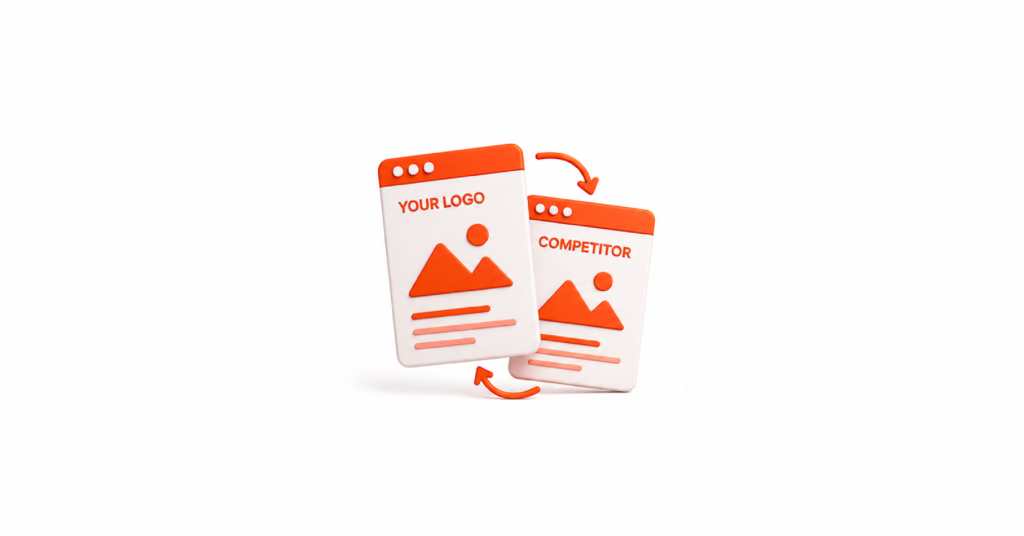
Swap in a competitor’s logo.
Read the headline again.
Would anyone notice the difference?
If the answer is no, your startup may have a category description, not clear positioning.
This startup positioning test takes about ten minutes. It helps you see whether your homepage tells people who you serve, what problem you solve, and why your company is a better fit for that problem.
How Do You Test Startup Positioning?
Start with three simple checks:
1. Cover the logo: Can a stranger tell who the company serves and what it does?
2. Swap the competitor: Would your headline still make sense with another company’s logo?
3. Explain it in one sentence: Can someone understand the business without a long explanation?
These tests reveal a common problem: the company is describing the category rather than the position it can own.
April Dunford’s positioning framework makes a similar point. Good positioning helps prospects understand why a product is different and better than the alternatives, not just what category it belongs to. April Dunford’s positioning guide
Test 1: The Cover-the-Logo Test
Take a screenshot of your homepage and hide the company name.
Show it to someone who does not know your startup for five seconds.
Ask:
Who is this for?
What does it help them do?
A headline such as:
“AI-powered platform for modern teams.”
does not give the person enough information.
Compare it with:
“We help B2B SaaS teams reduce churn through better onboarding.”
The second statement gives a customer, problem, and outcome.
Your logo should not have to explain what your words failed to say.
Run this test before paying for more promotion. More visitors will not solve unclear positioning.
Test 2: The Competitor-Swap Test
Take your headline, subhead, and first paragraph.
Now imagine your direct competitor’s logo sitting at the top.
Does the copy still fit?
If yes, your positioning may be too broad.
A strong position creates a clear context for your company. The prospect should understand what problem you are solving, who you are solving it for, and what makes your approach relevant.
Dunford’s positioning work also stresses the importance of understanding competitive alternatives, including the status quo. She notes that at least 40% of B2B sales processes can end in “no decision”, making the option of doing nothing a serious alternative to address.
That means differentiation is not just about beating another company. You also have to give people a reason to act.
Test 3: The One-Sentence Test
Explain your startup to a smart friend without slides.
Can you do it in one sentence?
A useful structure is:
We help [specific customer] solve [specific problem] through [clear solution].
For example:
“We help revenue teams spot renewal risk before customers leave.”
That is much easier to understand than:
“We are an intelligent customer lifecycle platform built for the future of revenue.”
One describes a problem. The other describes a category.
Your team should also be able to repeat the same positioning without opening a deck.
When five people describe the company five different ways, the positioning is not finished.
Why Startup Positioning Matters More in 2026
Your company can now be evaluated before a sales call happens.
Wynter’s January 2026 study of 101 mid-market B2B SaaS CMOs found that 84% use AI tools or LLMs to discover vendors, and 68% start their vendor search with AI before traditional search. The study also found that 48% arrive at sales calls very familiar with the vendor.
That creates two audiences for your positioning:
People who need to understand your value quickly.
AI systems that need specific information they can connect to a question.
“Platform for modern businesses” gives neither audience much to work with.
“Onboarding automation for B2B SaaS teams with high early churn” gives both a clearer signal.
Your positioning should therefore be specific enough to understand and specific enough to retrieve.
“Everyone Is Our Customer” Weakens the Message
Broad targeting sounds safe because it keeps the potential market large.
But a message written for everyone tends to say very little to anyone.
Tinova’s High-Expectation Customer framework recommends identifying the customer who needs the product most, understands its value, and is most likely to act.
Try this:
Instead of:
“We help businesses improve operations.”
Try:
“We help mid-market ecommerce teams reduce inventory losses caused by inaccurate forecasts.”
The second statement excludes many companies.
That is useful.
Positioning gets clearer when the audience gets narrower.
Find the Difference You Can Defend
Your differentiator should do more than sound unique.
Ask three questions:
Who cares most about this difference?
What problem does the difference solve?
Could a competitor copy this sentence tomorrow?
“Easy to use” is weak.
“Built only for multi-location dental groups managing centralized scheduling” gives you a more specific position.
Your best position may come from the customer segment that values your product most, not from the feature you are most proud of.
One Tinova Example
Tinova’s Results Library documents a useful positioning example with Tahira Collection. The original positioning targeted five audiences. Tinova narrowed it to one audience, rebuilt the positioning around that group, and launched the new system.
The result was $10K in the first 48 hours, before paid spend was switched on. Tinova presents this as a named client result with a specific timeframe, and notes that individual results are not a guarantee.
The lesson is not that narrowing an audience guarantees $10K.
The useful lesson is:
A sharper message can improve what the rest of the marketing system has to work with.

The 10-Point Positioning Clarity Test
Give yourself one point for every “yes.”
| # | Check | A Yes Looks Like |
| 1 | Cover-the-logo test | A stranger names the customer and problem |
| 2 | Competitor-swap test | Your headline would not fit a direct rival |
| 3 | One-sentence test | The team explains the company in one sentence |
| 4 | Specific customer | Your first statement identifies a clear audience |
| 5 | Specific problem | The problem is concrete, not a broad category |
| 6 | Clear difference | You can explain why your approach is different |
| 7 | Narrow ICP | Your positioning excludes some customers |
| 8 | Consistent message | Homepage, LinkedIn, and deck tell the same story |
| 9 | AI-readable language | Your offer and audience are stated clearly |
| 10 | Team alignment | Everyone can repeat the same positioning |
Your Score
9 to 10: Your positioning is clear. Focus on execution.
6 to 8: The foundation is there, but important gaps remain.
Below 6: Your positioning needs work before you increase promotion or rewrite everything else.
Start with three questions:
Who is the customer?
What problem are they trying to solve?
Why should they choose your approach?
How to Fix Weak Startup Positioning
Do not begin with a new logo or another homepage redesign.
Start with the customer and the problem.
Then define the value your company creates and the difference that matters to that customer.
Tinova’s What Investors Want to See in a Startup Before Funding guide applies the same proof-first logic to fundraising: connect the customer, problem, evidence, and solution instead of relying on broad claims.
When the positioning is clear, the website, pitch deck, LinkedIn profile, and campaigns have a common foundation.
That is the real job of positioning.
Make the right company obvious to the right person.
FAQs
How do I test my startup positioning?
Run the cover-the-logo test, competitor-swap test, and one-sentence test. Then score the 10-point Positioning Clarity Test. A low score means the message needs more work before you increase promotion.
What is the cover-the-logo test?
Hide your logo and company name from a homepage screenshot and show it to someone who does not know the company. Ask who the product is for and what problem it solves. If they cannot answer, your copy may be too broad.
Why do startups sound like their competitors?
They often rely on the same category language, features, and broad customer claims. Strong positioning focuses on a specific customer, problem, value, and difference.
Is narrowing your target market bad for a startup?
No. A narrower first customer can make your message easier to understand and test. Tinova’s HXC framework explains how selecting a high-expectation customer can create a clearer starting point for positioning.
Written by: Tinova Growth Team
Tinova is a marketing and growth agency for pre-seed and seed founders and owner-led businesses. Its current site reports 200 startups diagnosed, 77+ businesses scaled, 3 awards in 2026, and $10M+ in client funding pipeline built.
Updated: October 7, 2026