
Learn why pre-seed startups get rejected and how to fix five investor red flags with stronger customer proof, positioning, and market evidence.
Why do pre-seed startups get rejected? A common reason is weak proof.
Investors do not need a perfect startup at pre-seed. They need a founder who can explain who the customer is, what has been learned, and why the business can work.
At pre-seed, proof beats polish.
Here are five red flags that can weaken that case.
Red Flag 1: You Can’t Name 10–20 Real People With the Problem

If the answer to “Who has this problem?” is “everyone,” the customer is still too broad. A founder should be able to name real people or companies and explain what they do today.
Fix it:
- Pick 20–30 potential customers.
- Run short discovery calls.
- Record their words, pain points, and current solution.
- Bring the patterns into the pitch.
“I spoke with 15 clinic owners, and 12 described the same billing problem” is stronger than a broad market claim. Tinova’s founder-led sales resources cover a practical 30-prospect test for this stage.
Red Flag 2: Your Target Customer Changes Every Meeting
A pitch for small law firms becomes a pitch for freelancers two weeks later. Research can change your thinking, but changing the target during fundraising can make the core market hard to understand.
Fix it: Choose one beachhead customer, one buyer, and one problem. Keep the core customer story consistent, then show expansion after that foundation is clear.
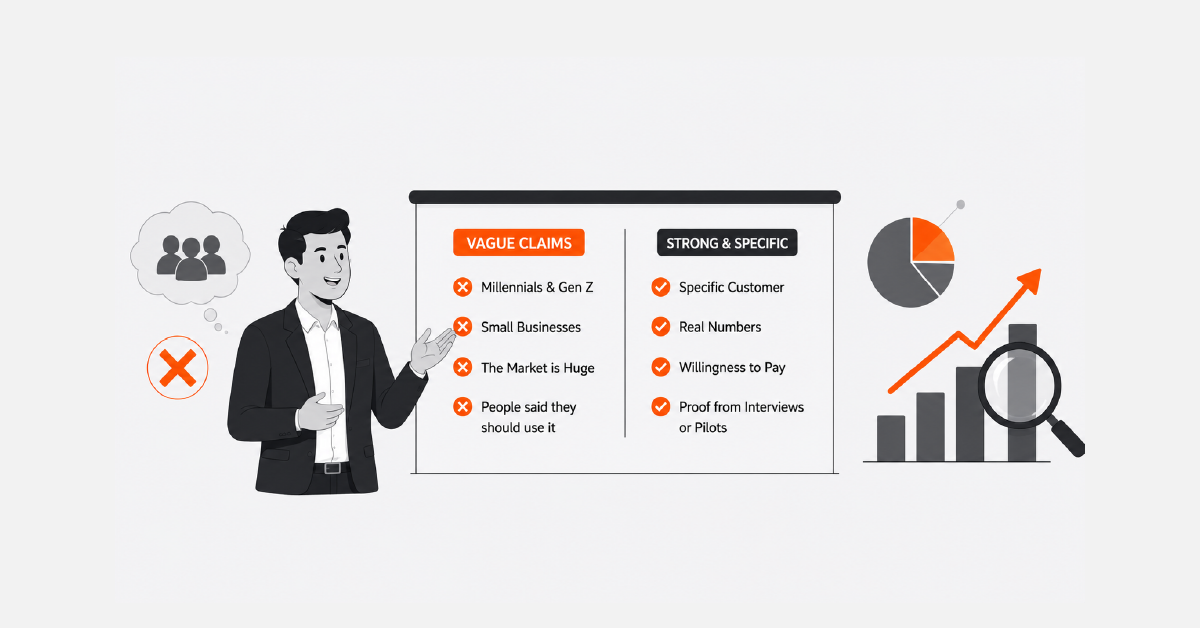
Red Flag 3: “Millennials and Gen Z” Is Your Whole Answer
A $300 billion TAM does not prove that your startup can win customers. Investors need a bottom-up view: who buys, what they pay, how many buyers exist, and what evidence supports the assumptions.
| Weak claim | Stronger proof |
| “Millennials who love tech” | “Solo Shopify sellers doing $5K–$20K/month who hate manual bookkeeping” |
| “Small businesses need this” | “12 of 15 dental clinics interviewed pay $800/month for a weaker tool” |
| “The market is huge” | “There are ~9,000 clinics in our region; we need 300 to reach $2M ARR” |
| “People said they would use it” | “8 of 10 pilot users converted to paid at $49/month in three weeks” |
The strongest examples connect a customer, a number, and evidence.
Red Flag 4: Zero Customer Conversations Because You’re “In Stealth”
Protecting an idea can feel important, but avoiding customer conversations leaves one major question unanswered: does anyone need this badly enough to act?
Y Combinator’s startup guidance also emphasizes talking directly to customers while founders are still learning what to build and how to serve them. YC’s Essential Startup Advice
Fix it:
- Schedule 20–30 discovery calls.
- Ask about the problem and current workaround.
- Collect quotes, pilot feedback, or waitlist data.
- Show what changed because of those conversations.
Red Flag 5: “We Execute Like Nobody Else” Is Your Entire Moat
Execution is not a moat because every founder can claim it. “We have no competitors” is also a weak answer. Your alternative may be a spreadsheet, agency, manual process, or existing tool.
Fix it: Name the advantage, show proof, explain why it is hard to copy, and show how it strengthens as the company grows.
The point is not to sound different. It is to prove why customers should choose you.
The Positioning Proof Framework

These five red flags come back to five questions:
- Who is the customer?
- What evidence proves the problem exists?
- Why this market?
- Why now?
- Why are you different?
If one answer is weak, the fundraising story becomes harder to trust.
Tinova reports 200 startups diagnosed, 77+ businesses scaled, and more than $10M in client pipeline built. Its results library also names the client, explains the work, and gives the timeframe for each case. See Tinova’s results library
That is the kind of proof this framework calls for: specific, traceable, and tied to an outcome.
Fix These Before Your Next Pitch
A strong pre-seed pitch does not need the biggest TAM slide or the longest deck. It needs a clear customer, real evidence, and a believable reason you can win.
Before your next investor meeting, test the five red flags above. Make every important claim easier to verify.
Book a positioning audit if you want a focused review of your story before the investor meeting. Tinova’s Investor-Ready in 21 Days program is built for pre-seed and seed founders who need stronger positioning, brand, website, pipeline, and investor assets before a raise.
FAQs
Why do investors reject pre-seed startups?
Pre-seed startups can lose investor interest when the customer, problem, market, or competitive advantage is not supported by enough evidence. Customer conversations, pilots, usage, revenue, and clear positioning can make the story easier to assess.
What are the biggest pre-seed fundraising mistakes?
Common problems include targeting everyone, changing the customer story, relying only on top-down market size, skipping customer discovery, and making competitive claims without proof.
How do I know if positioning is the problem?
Try answering four questions in one sentence each: Who is the customer? What problem do they pay to solve? Why is your approach different? What evidence proves it? Weak or changing answers point to a positioning gap.
What is the difference between a red flag and a dealbreaker?
A red flag is a warning sign that calls for more evidence or a clearer explanation. A dealbreaker is a condition that can end investor consideration. The difference depends on the investor, fund, stage, and company.